Michigan State University Athletics
Neil's Notebook: Penalty Kill Shines in Early Going
11/6/2014 12:00:00 AM | Men's Ice Hockey
By Neil Koepke
MSUSpartans.com staff writer
EAST LANSING - Michigan State would like to see its penalty killing hover around the 88-90 percent efficiency range this season.
Right now, the Spartans are even better than that.
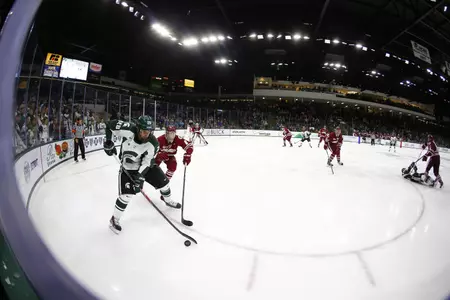
MSU's penalty-killers have given up only two goals during 25 shorthanded situations in six games for a stellar 92 percent success rate. It ranks 10th in the nation.
Last season, the Spartans struggled most of the season to consistently shut down opponents' power plays. They ranked No. 47 in the nation (among 59 teams) with a poor efficiency percentage of 79.7 percent. MSU allowed 28 power-play goals during 138 opportunities.
For sure, penalty killing was one of the areas Michigan State this season targeted for a major improvement.
Six games, of course, is a small sample size, but the Spartans like what they've seen so far.
"We have more guys in the mix in penalty killing and that's important because we don't want to give guys too much ice time where fatigue will be a factor,'' MSU coach Tom Anastos said. "When it's a factor, decision-making becomes a factor.
"Our penalty killing has been very good at 92 percent. That's going to be a hard number to maintain, but what we're going to work toward is being in the 88-90 percent range. That's an objective for us.''
The Spartans (2-4) will try to keep their penalty-killing numbers at a high level when they head back out East to face New Hampshire (2-4, 0-2 Hockey East) in a non-conference series at 7 p.m. on Friday and Saturday at the Whittemore Center in Durham, N.H.
MSU has been used three sets of forwards to kill penalties thus far this season - sophomores Thomas Ebbing and Joe Cox, junior Michael Ferrantino and sophomore Mackenzie MacEachern and juniors Matt DeBlouw and Ryan Keller.
"I'd like to get seven or eight guys going,'' Anastos said. "For example, we're not sure Keller will be able to play this weekend, and last Saturday, we had three guys take penalties that normally kill penalties, so that inhibits you a little. If we had eight, that would be great.''
The two power-play goals scored against the Spartans were by Massachusetts in a 4-3 win over MSU at Munn Arena in the second game of the season and at UMass-Lowell in a 2-1 loss two weeks ago.
"Our communication has been huge,'' said Ebbing, a 5-foot-11, 184-pound center from Troy. "Not only on the ice but off the ice, too. Before games, we look at the opponent's offensive threats and who we should attack, what tendencies do they have and how are we going to kill.
"We have guys who are dedicated to blocking shots and doing whatever it takes to kill the penalty. It's been huge so far because we've been getting a lot of momentum out of it.''
With three penalty-killing combinations, the there's more time in between shifts than when there's only two sets of forwards sharing PK time.
"With MacEachern and DeBlouw (in the mix), it's giving us more rest,'' Ebbing said. "Joe Cox and I were together last year so it's easy for us to know where the other is going and what they're going to do.''
In addition to blocking shots, stick positioning is important in disrupting puck moment by the opposition.
"If we get sticks in the lanes and poke pucks away, that's a big part in getting to loose pucks so we can force them out (of the zone),'' said Cox, a 6-foot, 173-pound right wing from Chelsea. "We try to focus on that.
"We've come a long way already. It's definitely a lot different now. There's a lot more communication and now we've got 6-7 guys. That 30 seconds of extra rest is huge.''
The Spartans have been good at making adjustments to the other team's power play after they've changed things around to better attack the Spartans.
"Ferris scouted our penalty killing so they went to a big spread and tried to get us running around,'' Cox said. "Once we saw that, between periods we decided to just front them instead of forcing them out. We let them pass the puck around while we kept our sticks in our lanes.
"We see what they do on video and our coaches do a good job about deciding what they want us to do. On the ice, we talk to each other.''
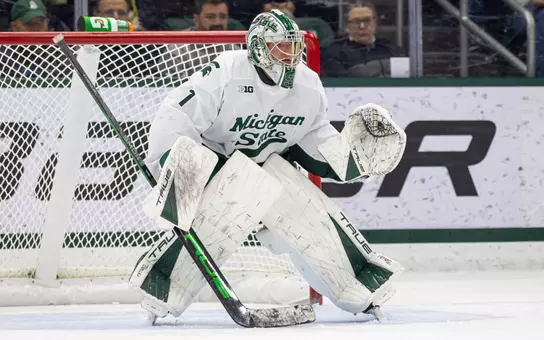
Michigan's State defensemen have also played a huge role in MSU's successful penalty killing. Their coverage around the net has been strong. And of course, a team's best penalty killer needs to be its goaltender, and the Spartans have one of the best in junior Jake Hildebrand.
"We have a good corps of guys - defensemen and forwards - who will do whatever they can to keep us from giving up a goal,'' Ebbing said. "And Hildy has been great.''
The Spartans will have to make a few more adjustments this weekend when they face New Hampshire on an Olympic-size rink - which is 100 feet wide, instead of the normal 85 feet.
"They'll be spread out a lot more on power plays and we won't be able to chase them around as much,'' Cox said. "When they do loose possession or just bobble the puck, we have to jump on them quicker.
"We might go to fronting them, clogging the middle and let them pass it around and we'll try to block shots. We need to keep things out on the perimeter and let Hildy made saves from far out.''
Michigan State is No. 1 in penalty killing in the Big Ten. Ohio State is second at 85.7 percent (18 kills-21 PPs by opponents), Minnesota (78.6, 22-28) ranks third, followed by Penn State (76.6, 20-26), Michigan (76, 19-25) and Wisconsin (72.7, 8-11).
Although New Hampshire had a tough time defensively in give up eight goals to UMass-Lowell in an 8-2 defeat last Saturday, the Wildcats' penalty killing is a shade better than the Spartans. UNH ranks No. 9 in the nation, killing off 94 percent of opposing power plays (26-28).
MSU's penalty killing will get tested with Boston College, Ohio State and Minnesota on the schedule in the weeks ahead. In six games, the Gophers' power play is clicking at 30 percent (7-23) to rank No. 3 in the nation behind Bentley (31.2) and Quinnipiac (31.0).
NOW ABOUT THAT OFFENSE: After breaking loose for four goals against Ferris State last Saturday and a much-needed 4-1 victory, the Spartans are determined to keep creating quality chances and being in the right areas to turn them into goals.
Over the last four games - a 1-0 loss at Boston University, a 2-1 defeat at UMass-Lowell, a 1-0 loss against Ferris State at home and a 4-1 win over the Bulldogs at home - MSU had enough good scoring opportunities to win all four games, instead of one.
Not finishing chances and not scoring on the power play has kept MSU below .500.
"If we had scored any goals on the power play and were scoring (5-on-5) at a reasonable rate, based on the scoring chances that we've generated, we should be 4-2 or 5-1,'' Anastos said.
"That would help the guys' confidence, it would help team confidence, get in us in the national mix and give us a lot to build on. We have to keep grinding through it.''
While goals have been elusive, keeping the puck out of the net has turned into a team strength. Goaltender Jake Hildebrand has been very good, the defensemen have played well in their own zone and the commitment to team defense is taking hold.
In six games, MSU has given up 12 goals and seven came during the first weekend against Massachusetts - 5-3 win and 4-3 loss. Over the last four games, the Spartans have allowed 1, 2, 1 and 1 goals.
"If we can maintain that low of goals-against average, it certainly gives us an opportunity to be in every game we play,'' Anastos said.
"The area we have to continue to get better in is our offensive productivity. When I say `productivity,' I'm specific with that because I think our offensive play has been better all season. We're getting more scoring chances.
"It's not a matter of searching for scoring chances, it's converting them. On Friday, we had tons of them. On Saturday, we had tons of them. We had a lot in both games at Boston U. and UMass-Lowell.
"It's really getting over the hump and converting those chances.''
Of course, the power play is a major target for improvement. MSU has scored on two power-play goals in 28 chances for a 7.1 percent rate of success.
"We moved the puck around better last weekend, and created some good chances,'' Anastos said. "We were close several times. We got one goal on the power play Saturday. We just have to keep working at it.''
SPARTAN STATS: Matt Berry got his team-leading fifth goal of the season with a power-play goal in the third period against FSU on Saturday, giving MSU a comfortable 4-1 lead. Berry is the team's top scorer with seven points.
Mackenzie MacEachern had a goal and an assist on Saturday, and now has two goals and four assists for six points and ranks second in team scoring.
And while junior defenseman Travis Walsh got lots of attention Saturday for scoring his first career goal in the first period, that gave MSU a 1-0 lead, sophomore forwards Thomas Ebbing and JT Stenglein quietly chipped in with two assists apiece.
HILDEBRAND IN SYNC: After allowing two goals in two games against FSU and three goals in two games the previous weekend, goalie Jake Hildebrand has lowered his goals-against average to 2.03. He's allowed 12 goals in six games. The reason is his GAA isn't exactly 2.00 is that a goaltender's average is based on 60-minute games played. With Hildebrand off the ice for an extra attacker in three of the last four games, or off to the bench during a delayed penalty, he's a just over five minutes short of playing a full six games (360 minutes).
"We had high expectations statistically for him. But what I want to see (get better) is the category with more wins. Not just saves percentage or goals-against average,'' Coach Tom Anastos said. "I think he'd like to see that too. We expected him to be our No. 1 and play with consistency.
"He was OK the first two games but he hit his stride in the third game (at Boston U.), and since that time, we expect him to stay at that level all season.''
Hildebrand, who has a .921 saves percentage, was named the Big Ten's First Star of the Week, after making 35 saves in two games against Ferris State and allowing only two goals.
DRAGER DEBUT SOLID: Junior defenseman John Draeger made his season debut on Friday and Saturday, after missing the first four games while recovering from off-season hip surgery.
"It was a good opening weekend for him. It's something to build on,'' Anastos said. "It's nice to have him back.
Draeger teamed with senior defenseman Ron Boyd.
Anastos said they had "a pitch-count type of mentality" in how they were handing Draeger's ice time.
"We decided we were going to spoon-fed him because we didn't want to overdo it,'' Anastos said." Looking back a year ago, I think we moved along too fast (after Draeger recovered from sports hernia surgery).
`'We said we were going to try so many shifts, and after the first period, we assessed it. We assessed it again after the second period.
"In the third, we kind of looked at his body of work and decided to give him what he could handle. On Saturday, he felt pretty good and his confidence level was where we hoped it would be. We approached it as a regular game. I saw him on Monday and I think he's feeling pretty good.''
IN THE BIG TEN: Four of the six teams are involved in non-conference games this weekend as the start of the Big Ten season draws near.
Minnesota (5-1), still No. 1 after splitting last weekend against St. Cloud State, plays host to Notre Dame (5-2-1) at 8 p.m. Friday (Big Ten Network) and at 5 p.m. Sunday (ESPNU).
Wisconsin (0-4), which hasn't played in almost three weeks, is home against former WCHA rival North Dakota (5-1-1), ranked No. 2 in the nation. The Badgers and the Sioux collide at 8 p.m. on Friday and Saturday.
No. 19 Nebraska-Omaha (4-1-1) plays at Ohio State (2-3-1) at 7 p.m. Friday and Saturday.
Michigan (2-5), coming off two losses at Michigan Tech, and Penn State (5-1-1) have the weekend off.
The first Big Ten series of the season is Michigan State at Ohio State, Nov. 20-21 (Thursday-Friday). On Nov. 21-22, Michigan plays host to Penn State.