Michigan State University Athletics

Neil's Notebook: Key Series Begins Thursday at Minnesota
2/25/2015 12:00:00 AM | Men's Ice Hockey
By Neil Koepke
MSUSpartans.com staff writer
EAST LANSING - The best penalty killers in the Big Ten are facing a huge challenge on Thursday and Friday when they try shut down the most successful power play in the conference and in the nation.
One of intriguing matchups of the crucial Michigan State-Minnesota series in Minneapolis is the Spartans' stingy penalty killing vs. the Gophers' potent power play.
Since the Gophers stung the Spartans for five power-play goals in two games at Munn Arena in early December - a 5-0 Minnesota win and 3-3 tie - MSU's penalty killing has emerged as a team strength and the best in the Big Ten.
With three weeks left in the regular season and the top four teams separated by two points, the Spartans are eager to make amends for allowing the Gophers' power play to strike for five goals two-and-a-half months ago.
"All five guys on the ice can move the puck pretty well, they're smart players and at home they have a bigger ice sheet, so they want to get teams running around and take advantage of it,'' said junior defenseman Travis Walsh, MSU's top shot blocker and a key penalty killer.
"We have to shut down their passing lanes and make them uncomfortable. On the big ice, you don't want to get too far outside the (faceoff) dots. We need to stay in the shot lanes, we'll try to block shots and get in passing lanes and have good sticks.''
Minnesota (17-10-3 overall, 8-3-3-0 Big Ten), tied with Michigan for first place with 27 points, and Michigan State (13-13-2, 7-5-2-2), tied with Penn State for third with 25 points, meet at 9 p.m. Thursday and Friday at Mariucci Arena.
The Gophers' power play is converting on 29.3 percent of their chances (34-for-116), by far the best in the nation.
The Spartans have skated off 87.5 percent of opponents' power plays (84-for-96). They rank 9th in the nation.
And since giving up five PPGs to the Gophers - three in the 5-0 loss and two in the 3-3 tie - MSU has allowed only TWO power-play goals in the last 13 games, skating off 38 of 40 opportunities.
"They have guys that can shoot it, they have guys that can move the puck and they have guys who have good vision who can find open players,'' MSU coach Tom Anastos said of the No. 14/15-ranked Gophers. "They're very aggressive and can beat you on the rush or in the zone. It's as good a power play as I've seen.''
It's been an up-down-up type of season for the Gophers, who started the year 7-1, then hit the skids with a record of 4-8-2 through late January. But Minnesota has rebounded and is 6-1-1 in its last eight games and back on top of the Big Ten, where everyone expected them to finish when the season started.
After the MSU series in December, the Gophers' power play struggled, scoring only four goals in 33 chances (12.1 percent) during a seven-game stretch.
But in the last nine games, Minnesota's power play is back on track with 17 goals in 66 opportunities (25.7 percent), including scoring at least one power-play goal in eight of its last nine games.
Three weeks ago, in a 4-2, 6-2 sweep of Ohio State, the Gophers went 2-for-4 and 3-for-4 on the power play, and last weekend at Penn State, in a 2-1 victory and 4-3 loss in overtime, Minnesota was 1-for-4 and 2-for-4 with the manpower advantage.
Minnesota senior forwards Travis Boyd and Kyle Rau have nine and six power-play goals, respectively. Sophomore Justin Kloos also has six.
Minnesota's leading scorer is a defenseman - junior Mike Reilly, who has five goals and 29 assists for 34 points. Reilly, the top-scoring defenseman in the nation, anchors one power-play unit from the point and has two goals.
Boyd is having a career season with 15 goals and 15 assists for 30 points, ranking third in team scoring, behind Reilly and Rau (13-18-31).
To stop or contain Minnesota on the power play, the Spartans have to accomplish several things, Anastos said.
"No. 1, we have to not take penalties to minimize our penalty-killing situations,'' he said. "No. 2, your goaltender has to your best penalty killer and No. 3 you're going to have to block shots.
"What makes them so successful is there's not one or two keys to their power play. You can't just shut one or two things down because it has too many dynamics.''
MSU's top penalty-killing units include sophomore forwards Joe Cox and Thomas Ebbing, junior forward Matt DeBlouw and sophomore forward Mackenzie MacEachern. A third duo features a pair of junior forwards - Mike Ferrantino and Ryan Keller. Redshirt sophomore Connor Wood is also available for PK duty.
On defense, Walsh is paired with freshman Josh Jacobs and senior Ron Boyd partners with junior John Draeger.
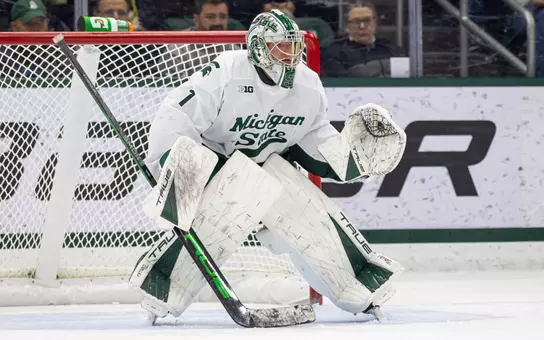
And of course, Jake Hildebrand has been the Spartans' linchpin with superb goaltending while MSU is killing penalties and at even strength.
"We've kept it really simple. We've stuck to one formation and we just go out and get clears off that,'' said Cox, who put on a sensational display of penalty killing - blocking five shots and feeling lots of pain in the first period - two weeks ago against Penn State.
"Hildy has been a huge part and we've seen a lot of sacrifices with forwards and defensemen blocking shots. If Ebbing and I can get a clear, we get off the ice fast and MacEachern and DeBlouw come on, and if we're tired, then Ferrantino and Keller can go. We have a lot of depth on our PK.''
Anastos believes getting more players involved has helped the Spartans improve their penalty killing from last season in which they skated off only 79.7 percent of opponents' power plays (allowing 28 goals on 138 chances).
"We went with four guys last year and it's hard to do and hard to sustain that,'' Anastos said. "Two of the guys were freshmen in Cox and Ebbing and the other two were (seniors) Lee Reimer and Greg Wolfe. We kind of grinded it out.
"Having more depth is the No. 1 difference, and No. 2 is having players who can play off one another, both as forward and as defense pairings.
"It's great to have players with a common mindset and we've been able to do that. We've got seven guys teed up who are in our lineup pretty regularly. We're building the kind of culture we want ... players that take great pride in this and want to be the best in the country. They put as much emphasis on and take as much pride in killing penalties as they would scoring a goal on a power play.''
Cox has developed into a premier shot-blocker and is fearless in sacrificing his body.
"Penalty killing is the part of the game I really look forward to, and I know it's bad because being shorthanded is a handicap,'' Cox said. "But I love being part of the penalty kill and going out and stopping them.
"And anytime you can have the crowd on their feet and cheering, it only makes you play better.''
Said Walsh: "Blocking shots has been in our DNA since I've been here. It's not just blocking shots that's (made us better), it's clearing the puck from our zone quicker. If we have a chance to clear, it's on the glass and down the ice and we can get fresh guys out there. The more fresh legs the better.''
DIFFENT TIMES, DIFFERENT TEAMS: When Michigan State and Minnesota met in early December, the Spartans were still struggling to find consistency in various aspects of their game.
After splitting a series at Princeton, a team which has only won four games all season, MSU proceeded to play one of its worst games of the year in the 5-0 loss to Minnesota at Munn Arena, and then the next night played one of its most spirited games in the 3-3 tie and shootout victory.
Over the last two-and-a-half months, both teams are a lot different, especially MSU, which is 8-4-2 starting with the tie vs. the Gophers.
"We have a little more experience in Big Ten play and we're more settled in as a team,'' Joe Cox said. "Our systems have come to shine a little better as the season has gone along.''
Coach Tom Anastos said improvement, execution and confidence have led to his team being in contention for a high finish in the Big Ten.
"We're a way different team. We've gained experience and we're playing with confidence. We have a better understanding of who we are,'' he said. "I know we're a better team. I've been saying that for the last couple years.
"I'm seeing progress and now we're seeing some end results and that leads to great confidence. We still have to learn and understand what it takes to have that kind of success. We're definitely better than the last time we saw Minnesota.''
And the Gophers, having survived a tough stretch in which they went from No. 1 in the nation to out of the top 20 rankings, are a different team, too.
"They're playing with tons of confidence and probably with a great sense of urgency,'' Anastos said. "They've got one of those teams with lots of depth, lots of skill and talent and they gained tons of experience last year by getting to the NCAA championship game.''
Minnesota, which finished first in the Big Ten last season, lost in the title game to Union, 7-4.
"If you talk to coaches who have had those kinds of teams over the years, sometimes they go through periods that they're looking ahead and not living in the day,'' Anastos said of the Gophers' midseason struggles. "That's one of the challenges with a team like that. But they've been playing like a lot of people expected them to play.
"To me, it's not a surprise. It's a really good team with depth, goaltending, dynamic offense and their power play caused us fits. They also play a good defensive brand of hockey, too.''
Junior Adam Wilcox, a second-team NCAA West All-American and Big Ten Goaltender of the Year and Player of the Year last year has the second-best goals against average (2.50) and third best saves percentage (.907) in the conference in overall games.
MSU's Jake Hildebrand is No. 1 in GAA (2.18) and save percentage (.926). Both Hildebrand and Wilcox lead the Big Ten in shutouts with four apiece.
SHOOTOUT ISSUE: The Gophers don't seem to be a big fan of shootouts. In two years in the Big Ten, Minnesota has tied six conference games and has never emerged from the shootout as the winner.
Last season, the Gophers lost two shootouts against Michigan State - one on the road and one at home - and one at Ohio State.
This year, Minnesota tied the Spartans 3-3 in December and lost the shootout, and in two games against last-place Wisconsin, the Gophers lost in a shootout at home and on the road.
Meanwhile, the Spartans are 2-0 in shootouts this season, also coming out on top at Penn State on Jan. 16. Last year, MSU went 4-2 in shootouts for a 6-2 record in almost two seasons.
SPARTANS POTPOURRI: Anastos announced Tuesday that freshman defenseman Carson Gatt and freshman forward Dylan Pavelek have been suspended indefinitely for "a violation of teams rules.''
Gatt has dressed for 27 of MSU's 28 games and has seen a lot of playing time with sophomore defenseman Rhett Holland. Gatt has three assists. Pavelek have dressed for 20 games, mostly on the third or fourth lines and does not have a point. ...
Over the last 15 seasons, Michigan State and Minnesota have played a lot of close games, but unfortunately, the Spartans haven't won many of those contests. Starting with the College Hockey Showcase matchup on Nov. 24, 2000, MSU has won only three of the last 21 games, but nine have ended in ties. So, the Spartans are 3-9-9 against the Gophers in the last 15 seasons, including this year. MSU's last win in Minnesota was a 5-2 victory in the College Hockey Showcase on Nov. 26, 2010. The Gophers are 5-0-4 in the last nine meetings, since the Spartans' last win in the series - a 4-3 decision on Nov. 25, 2011, at Munn Arena. ... Minnesota won back-to-back NCAA championships in 2002 and 2003. The Gophers made it to the Frozen Four in 2005, 2012 and 2014 but came away without a title. ... The last Big Ten team to win an NCAA title was Michigan State in 2007, one year after Wisconsin ruled college hockey in 2006.
BIG TEN RACE: In the chase for the top four spots in the Big Ten standings, Penn State appears to have to toughest finishing schedule with two games at home and four on the road.
But each of the four teams in the title chase - Minnesota (17-10-3 overall, 8-3-3-0 Big Ten), Michigan (17-11-0, 9-5-0-0), Michigan State (13-13-2, 7-5-2-2) and Penn State (16-10-4, 8-5-1) - plays two series against contenders and one series vs. a team at the bottom of the league in either Ohio State (9-17-2, 4-10-0-0) or Wisconsin (4-20-4, 2-10-2-2).
The Gophers, tied with Michigan for first with 27 points and two ahead of MSU and Penn State, have four games at home and two on the road. Minnesota hosts MSU, plays at Ohio State next weekend and finishes at home against the Nittany Lions.
Michigan has three games left at home and three on the road. The Wolverines host Wisconsin this weekend, then visit Penn State before their season-ending series against the Spartans - at MSU, March 6 and at Yost Arena, March 7.
Penn State visits Ohio State this weekend, then hosts Michigan and wraps up its season at Minnesota.
Finishing in the top two spots is important in the Big Ten Tournament because those teams get first-round byes, and only have to play two games in two nights to win the title and secure the automatic berth in the NCAA Tournament.
The third-place and fourth-place teams play against the No. 6 and 5 teams, respectively, on the first night of the tournament, March 19, at Joe Louis Arena in Detroit.
The No. 3 vs. 6 winner advances to play the second-place team and the No. 4 vs. 5 survivor faces the first-place team on March 20, with the title game set for March 21.
The 16-team NCAA Tournament field will be announced at noon on Sunday, March 22, on ESPNU. The Frozen Four is in Boston, April 9 and 11.