Michigan State University Athletics
Koepke: Mason Was a Winner
6/15/2016 12:00:00 AM | Men's Ice Hockey
By Neil Koepke
MSUSpartans.com staff writer
EAST LANSING -- Ron Mason loved to win. At everything.
Whether it was playing hockey at St. Lawrence, coaching at Lake Superior State, Bowling Green and Michigan State, playing tennis with Bud Cooper, the Lake Superior State athletic director who gave him his start in coaching, playing golf or catching fish or even playing games with his family, he was a fierce competitor.
Mason hated losing and it drove him to be successful in most every aspect of his life.
Mason, who passed away Monday morning at age 76, was passionate about life and the challenges it brought. And he loved to compete, to be the best. He wasn't perfect but he worked hard at life.
About 20 years ago, I had the pleasure of playing in Michigan State's then-annual Broomball charity game at Munn Arena, matching Spartan players against the Legal Eagles, a team of local attorneys, headed up by district court judge Charles Filice.
We were on skates in full uniform and I was on an honorary all-media forward line for the Legal Eagles. The Spartans regularly won but it was a great event and proceeds went to the Boys and Girls Clubs of Lansing.
On this night, however, the Legal Eagles somehow upset MSU by a goal or two. The Spartan players laughed it off as a fluke. But in the handshake line, I'll never forget Coach Mason's message to the victors.
"You better enjoy this because it'll never happen again,'' Mason said. And he wasn't smiling.
The next season, the Spartans won. Tradition was restored.

Ron Mason landed in the Lansing area in 1979 and really never left. He became a Spartan for life. He coached hockey here for 23 seasons, building Michigan State into a national power, then served as athletic director for five years before retiring in 2007.
He and his wife, Marion, have recently spent the winters in Florida, but Lansing and his summer home in Port Albert, Ontario, were still his favorite spots.
For sure, Mason loved to reflect on past accomplishments, but he was a forward thinker, focusing on the present and looking to the future.
Public Funeral Service Information | MSU Remembers Ron
He loved following the careers of his grandsons -- Travis Walsh, who played for MSU for the last four years, and Tyler Walsh, who has embarked on a coaching career and is now a coach for the U.S. National Team Development Program in Plymouth, Mich.
During his 36-year coaching career, Mason built highly successful programs at his three stops -- Lake Superior, Bowling Green and MSU.
Along the way, there were some glorious victories and devastating losses, but he will always be remembered for his ability to evaluate talent, recruit players to his schools, develop them on the ice as players and off the ice as young adults, and put together a cohesive team. In the community, Mason was active in raising money for various organizations, including Sparrow Hospital.
But Ron Mason didn't just win a lot of games with great talent and good role players. His legacy will also be about growing college hockey into what it has become today. That combination is why Mason was inducted into the U.S. Hockey Hall of Fame in 2013.
The Pittsburgh Penguins had 11 former NCAA players in their lineup on Monday when they won the Stanley Cup. When Mason started coaching in 1966-67, there weren't 11 former college players in the entire NHL.
Listen to Neil Koepke talk Ron
Mason knew what it was like to coach at small schools and understood the challenge of competing with major programs. When Mason settled in at MSU, he scheduled many games against emerging programs and helped give them credibility.
I remember the Spartans playing non-conference games against Northern Arizona, U.S. International, Miami, Illinois-Chicago, Minnesota State, Nebraska-Omaha, Quinnipiac and Wayne State.
If Coach Mason was still with us and coaching, for sure he would welcome Arizona State, the NCAA's newest program, to Munn Arena, and would be OK with a return trip to play in Tempe.
For Mason, it was about bringing in quality players and people, winning and growing the game of hockey on every level, and sharing his wisdom with up-and-coming coaches. He loved to talk hockey -- with anyone.

Among the numerous tributes on social media over the last few days, you will find many from coaches who were impacted by Mason from seminars or simply good conversations when they just started in coaching. Some at big schools, some at small schools.
Mason always remembered how he was helped and inspired by the top coaches of the day when he started the Lake Superior State program in 1966-67. There was John MacInnes at Michigan Tech, Amo Bessone at Michigan State and Al Renfrew at Michigan, among others, who impacted Mason's development as a coach.
In seven seasons at LSSU, Mason's teams won one National Association of Intercollegiate Athletics (NAIA) title and were runners-up three times. During his six-year stay at Bowling Green, the Falcons won three CCHA titles, played in three NCAA Tournaments and reached the Final Four, now known as the Frozen Four, in 1978.
After 13 seasons in coaching, Mason was ready for the challenge of rebuilding the Spartan program in 1979-80. He did it fairly quickly and with flair, bringing in high-level recruits, and with a wide-open style, the Spartans' high-scoring offense attracted lots of fans and eventually sellout crowds.
After two losing seasons in 1980 and 1981, the Spartans made the NCAA Tournament for nine consecutive years, from 1982-90. After a tough, down year in 1991, the Spartans made the NCAA Final Four in 1992, missed the NCAAs with a fairly good team in 1993, and then Mason closed his coaching career with nine straight seasons in the NCAA Tournament, including two more in the Final Four.
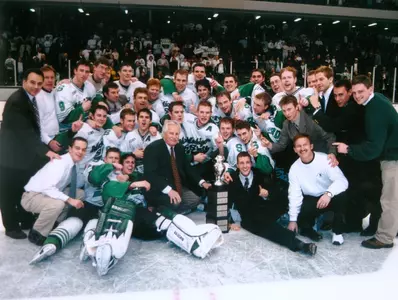
Under Mason, the Spartans won the NCAA title in 1986, played in the Final Four/Frozen Four seven times (1984, 1986, 1987, 1989, 1992, 1999 and 2001) and had teams in 1985, 1990 and 1998 that probably should have been in the Frozen Four. And all three were capable of winning it all.
In addition, Mason's teams won 10 CCHA playoff titles, seven regular-season championships and captured the Great Lakes Invitational eight times.
Mason's record at MSU was 735-270-69, including 56-39-8 against his favorite rival, Michigan. For several years, he was college hockey's all-time winningest coach, finishing with a career record of 924 victories, 380 losses and 83 ties.
Three years ago, Jerry York of Boston College took over as the career leader in wins, and now has 1,012 victories in 39 seasons as a coach.
For Mason, there were some heartbreaking defeats at MSU, but what was impressive was how a crushed coach handled them.
One that stands out the most was when MSU's so-called "Dream Team" in 1985, arguably the best Spartans team ever assembled, had its NCAA title dreams shattered by Providence in an old-school two-games, total-goals series at Munn Arena.
MSU won the first game 3-2 and things looked good. But the Friars, thanks to a spectacular goaltending performance by Chris Terreri, shocked the Spartans 4-2 in the second game to win the series, 6-5.
It was the last game of their careers for standouts Kelly Miller, Tom Anastos, Craig Simpson, Lyle Phair, Dale Krentz, Gary Haight, Dan McFall and Harvey Smyl. Most Spartans fans had already purchased tickets for the Final Four in Detroit and looked forward to a possible showdown with the other highly touted team of that season -- RPI -- for the national title.
The players were shocked, the fans were stunned. Everyone in college hockey was surprised.
Afterward, Mason stood tall in defeat, showing poise and an amazing calmness in breaking down the game with the media and paying tribute to his players for a great season. He was hurting but showed class in answering tough questions.
That night, I came away with more admiration and respect for what Ron Mason was all about.
A year later, the Spartans won the NCAA championship in Providence. And even though, I still hadn't started my career as the MSU beat writer for the Lansing State Journal and was still working in Ann Arbor, I had the opportunity of asking Mason the first question at the post-game press conference.
As I formulated the question and then listed to Mason's response, I had flashbacks to one year earlier and how he kept things together in the face of heartbreak. And here he was, on top of the college hockey world.
Later that night in a one-on-one chat, Mason again was calm and reflective and smiled as he said, "A lot better ending than a year ago, eh."

A few minutes later, with his dream of a NCAA title realized, Mason went off to celebrate with his players, coaches, staff, family, friends and fans.
Over the next six seasons, Mason guided the Spartans to three more appearances in the Frozen Four, including a runner-up finish in 1987. After the 1997-98 team, which compiled a 33-6-5 record, had its title quest squashed by an underdog Ohio State team in an NCAA Regional in Ann Arbor, the Spartans bounced back the next year and earned a berth in the NCAA Frozen Four in Anaheim.
In Mason's second-last season, the 2000-01 Spartans (33-5-4), led by Hobey Baker Award winner Ryan Miller, landed back in the Frozen Four, losing to North Dakota, 3-0, in the semifinals.
In four of Mason's last five seasons as coach, Michigan State lost no more than nine games. In his last final season, 2001-02, the Spartans went 27-9-5.
Then it was time to help Michigan State in a new role -- as athletics director.
One of the best moments of Mason's stay as athletic director was the hockey team's national championship in 2007 in St. Louis. This time, the Spartans were the underdogs, the Cinderella team. Under Coach Rick Comley, who played for Mason at LSSU, MSU knocked off Boston University and Notre Dame in the regionals and Maine and Boston College in the Frozen Four.
The Spartans were champions again. And a proud, smiling Mason loved it.
Although his voice has been silenced, Ron Mason will live on in the hearts and minds of his family, friends, former players, coaches and staff, Spartan fans and college hockey fans and coaches everywhere. There are great memories, good stories.
Mason did great things and lived life to the fullest. He was a winner.