Michigan State University Athletics
Grinz On Green: Izzo's Beginnings
9/8/2016 12:00:00 AM | Men's Basketball
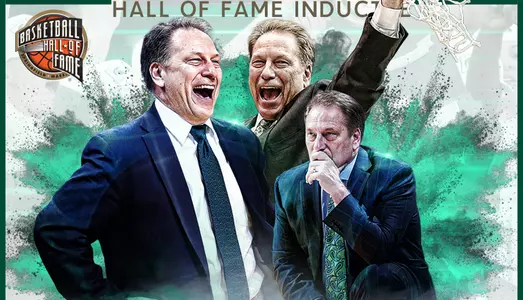
Editor's Note Coach Tom Izzo will be enshrined in the Naismith Memorial Basketball Hall of Fame Friday, Sept. 9. The enshrinement ceremony will be televised live by NBATV.
By Steve Grinczel, MSUSpartans.com Online Columnist
Tom Izzo left Steve Mariucci spellbound the first time their paths crossed.
"I knew right away that this guy was different," Mariucci says with a well-worn laugh of confirmation. "And, that he must really take pride in what he does."
Izzo and Mariucci were fifth-graders growing up in Iron Mountain at the time.
"I was playing basketball against him, and he was so much better than everybody else at that stage," Mariucci recalls. "This guy's dribbling with both hands and if I remember correctly he was dribbling behind his back. In warmups, you'd watch him and he's shooting the right-hand layups and then he'd be on the left side, dribbling left-handed and shooting the left-hand layups.
"And I'm like, geesh, I don't even know the rules to this game yet and look at what he's doing. I was at the Catholic school on the north side; he was at the public school on the west side. So we competed against each other in basketball, Little League baseball, football, everything. We were competitors initially – we were not friends."
An enduring relationship formed when Izzo and Mariucci were united at Iron Mountain High, the only secondary school in the mining town of 8,000 located on the western edge of the Upper Peninsula.
"We became teammates and then captains of all the teams together," Mariucci says. "I could see as time went on, when many of us were going to the lake on summer vacation, he was going to the basketball camps.
"He was just kind of wired that way at a real young age. He also worked a job, too, for his grandfather, Tony Izzo & Sons. So, he had that blue-collar work ethic all the way up like many of us did in Iron Mountain, but he took it a different level."
As the years passed, Izzo and Mariucci were the best of friends and the friendliest of rivals starring in their respective sports – basketball and football – at Northern Michigan University. They served as the best man in each other's wedding and raced to the top levels of their professions.
Izzo parlayed his humble, salt-of-the-earth beginnings into a 22-year (and counting) stint as the championship coach of the Michigan State basketball team while Mariucci became a collegiate head coach at the University of California before holding top jobs in the NFL with the San Francisco 49ers, whom he guided to four playoff appearances in six seasons, and the Detroit Lions from 2003-05.
While neither has yet to collect on a childhood bet of whom will coach the Notre Dame football team first, Izzo will get a leg up on his long-time pal and confidant when he is inducted into the Naismith Memorial Basketball Hall of Fame in Springfield, Mass. on Friday.
And from his VIP seat during the Enshrinement Ceremony at Springfield Symphony Hall -- the Greek Revival performing arts center that's so far in so many ways from the U.P. -- Mariucci will share in the reaching of his best friend's latest milestone as only he can.
"You know, it's well-deserved, because he belongs there, but I don't think about his seven Final Fours, really. I don't think about his coach-of-the-year awards," says Mariucci, momentarily pausing to tamp down his emotions. "I go back to fifth grade. I go back to high-school football, basketball and track. I go back to where it started."
***
In a career marked by remarkable achievement almost every step of the way, Izzo adds another by joining Mike Krzyzewski (Duke), Jim Boeheim (Syracuse), Roy Williams (North Carolina), Rick Pitino (Louisville) and John Calipari (Kentucky) as the only active Division I men's coaches in the hall, which encompasses all levels of basketball -- men's and women's, high school, collegiate, professional and international.
Izzo coached the Spartans to the 2000 national championship, is only the second coach to take seven teams to the Final Four in a 17-year span since the NCAA Tournament expanded to 64 teams in 1985 and this season will be looking to extend his all-time Big Ten-best streak of consecutive NCAA Tournament appearances to 20. He has seven regular-season Big Ten championships, five Big Ten Tournament crowns, has the second-most Big Ten wins in conference history and is an eight-time national coach of the year recipient.
Retired MSU head basketball coach Jud Heathcote, who hired the persistent Izzo as an embarrassingly underpaid part-time Spartan assistant in 1983 and then prevailed on the school administration to make Izzo his successor 12 years later, notes how hard work and circumstances have aligned for his protégé.
"I think that's a good word, ‘circumstances,' " says Heathcote. "Circumstances brought me to Michigan State. I still remember some guys asking me, ‘How in the world could you get the Michigan State job coming from Montana?' I just said it was my personality, and walked away."
Circumstances.
Then, in 1985, Izzo begrudgingly accepted an assistant-coaching position at Tulsa, only to return to East Lansing a few weeks later when Heathcote's top assistant, Mike Deane, took the head-coaching job at Siena College.
"Tom didn't want to leave and take the Tulsa assistant job, but we forced him to go, saying ‘You just can't keep spending all your money, going into debt and having no income,'" Heathcote remembers. "So he took it reluctantly, but when the job opened up after Mike left it was a no-brainer for him to come back."
Circumstances.
"Then, you know, he struggled those first two years (as the MSU head coach) and had to settle for the NIT," Heathcote says. "When I would come back, people wanted me tarred and feathered because they figured I got him the job when he wasn't good enough to do it.
"But since then, it's been an unbelievable run."
And if some things did just happen to fall in place for Izzo by being in the right place at the right time, Heathcote says he moved the vast majority into position by sticking to a sound plan which he carries out with hard work and determination.
"In a five-year period, my last two years at Montana and first three at Michigan State, I got four conference championships," says Heathcote, whose Magic Johnson-led Spartans captured the 1979 NCAA championship. "So when we won the nationals, I thought, hey, this is a big deal but it isn't as big as people are making it because we'll be back here again.
"Well, we never made it. Then, I look at Tom, who has been to seven Final Fours, and people don't realize how hard it is to get to just one. It's just an unbelievable record. I use Tom's quote, because he's said this so many times, that leadership and chemistry will more games than talent. He really works hard to find leaders on his team, to make a family atmosphere, and although it's impossible anymore to subjugate the egos of today's players he does a good job of putting it in the proper perspective."
Under the circumstances, Heathcote's assessment of Izzo's accomplishments is comprised of several layers.
"We have what we call the coaching profession, but it's turned almost into a business now instead of a camaraderie, and I'm not sure that's the right direction," Heathcote says. "You could say I could look at him like a son or a confidant, but I just look at him as a great friend and a fellow coach, and proud of the magnificent job he's done.
"I get some credit for that because I worked hard to get him the job, but he's doing the job."
***
In a span that began in 1982 and lasted until the mid-1990s, recruiters from big-name programs invaded Michigan to mine an inordinate amount top-flight talent including the likes of: Derrick Coleman, Anderson Hunt, Willie Burton, Terry Mills, Mark Macon, Doug Smith, Glen Rice and Roy Marble.
They were not coming to Detroit to bird-dog Steve Smith, an unheralded prospect playing in near obscurity at Detroit Pershing. Consequently, Izzo, who had embraced his position as Heathcote's recruiting coordinator with typical vigor, had Smith pretty much all to himself.
And what Izzo saw was an unconventional 6-foot-8 point guard out of mold cast at MSU by Magic Johnson, who redefined the position from 1977-79.
"We had a period in the state of Michigan when we probably had the best players, by far, of any state per capita," says Smith, who retired from a stellar 14-year NBA career in 2005 and is now a successful broadcaster with CNN, Turner and NBA-TV. "It was just a hotbed. In some ways it was great because as a youngster you could say, I play basketball in Detroit and the guy around the block, Willie Burton, just signed with Minnesota or another guy around the block got drafted No. 2.
"If coaches stayed a month, they got a chance to see 15-20 potential pros whether they were in 10th grade or 12th grade. Everybody went to the big-name places where guys were playing, the St. Cecilia's, the big tournaments, the summer leagues, versus where I could be playing at a gym in the deep East Side, in a little high school tournament.
"And only Tom was there."
The recruitment and signing of Smith represented a key pivot point in the Spartan program because it marked the beginning of the use of contemporary recruiting methods while establishing Izzo as a shrewd evaluator of talent.
Until Izzo and Michigan State showed interest in Smith, he was mainly targeted by Mid-American Conference-level schools. Then-Michigan coach Bill Frieder "didn't know anything about me," Smith says. "Missouri came in on me eventually, but it was too late.
"From my knowledge, I was the first recruit that Tom signed when he was an assistant coach. I probably wouldn't have been on the map if it wasn't for Tom. I don't think I'd be where I am today if not for him. You can make it from anywhere, but getting that opportunity to be on that Big Ten platform, and playing at that university, not knowing if anyone else would have let me be a 6-8 point guard…, I owe Tom and Coach Heathcote a lot."
What sold Smith on MSU was Izzo's personality, as much as anything.
"As a high-school kid you hear so many people telling you everything - ‘You're the best thing since sliced bread' -- but he never sold me on something that was too much," Smith says. "All he'd says is, this is where we think you are and here's the opportunity versus, ‘Hey you're gonna come in and start.' It was basically the truth and I think that's why people have always respected Tom. He's been the same genuine person, same consistent person, same loyal person since being an assistant coach with Jud to being one of the top college coaches in history.
"For Jud to have so much success, putting Michigan State basketball back on the map, and then having a guy like Tom Izzo, who wasn't he most popular choice to succeed Jud, and take the program where it is now – I say it's got to be one of the top two or three premier programs in the country."
Smith says he's living proof of Izzo's hall-of-fame touch.
"Not doubting my ability, but I wouldn't think my junior year anyone would have said I'd be the No. 5 pick in the 1991 NBA Draft," Smith says of where he was selected by Miami after his senior year. "There are so many teams where you say, they have a fantastic team or have this player who's a sure pro.
"I think Tom has gotten more underrated players and underrated teams to reach their potential, and then go above their potential, than any coach in the country. He's now in the elite class of all classes and what I love about it is he has a chance still, however long he intends to coach, to even add to this. He has a lot left, which is unbelievable for the guy I know who was chasing me around little gyms on the East Side of Detroit. For me to be such a small part of it brings such a smile on my face and is a story I can share with my kids and others, especially guys who love the game of basketball.
"But I also say, he belongs in the hall of fame as a person – on the first ballot. He's done it all the right way."
***
The first impression Indiana head coach Tom Crean formed of Izzo back in the early ‘80s is no different than a budding young coach might have of him today, with one exception.
"I met Tom after being an observer at a MSU practice after asking Mike Deane if I could come," Crean says. "I learned a ton, watched Scott Skiles practice, and met Mike and Tom. The mustache was intimidating – seriously, he was intense and energetic."
Crean joined Heathcote's staff as a graduate assistant coach in 1989. After he and the eventually clean-shaven Izzo became colleagues, they were so preoccupied with the tasks at hand the possibility of ever getting into the Hall of Fame someday was the furthest thing from their consciousness.
"We were working too hard to have dreams other than going after great players recruiting-wise, and working like crazy to make our own team better," Crean says. "Tom was such a leader and always in charge. We didn't want to let him down because he worked so hard to never let Coach Heathcote down."
And yet, the qualities that go into a hall-of-fame enshrinement were on display every day, especially after Izzo became Crean's boss.
"Organization and he always had a plan," Crean says. "If it was summer camp or academics, he was never going to let something go undone. His determination to make everyone, no matter what your role, feel a part of it was amazing. He's a tremendous, detailed coach and I've never seen a guy so consumed with doing everything to prove Michigan State was right in hiring him.
"He never sees himself at the level he has earned and he also has empathy for every position as a player and as a coach because he's been in all those positions. He never let the sun go down on an issue, question or problem and I'm sure he still never does. I've been honored to watch Carl and Dorothy Izzo's son live out all the values and characteristics that they instilled in him. He deserves a legacy because he's helped so many people along the way build futures and careers. His ability to dream big has only been surpassed by his ability to achieve those dreams."
***
The victories, the championships, the trophies and the awards may be what have gotten Izzo into the Hall of Fame. However, it's generally agreed that he may be just as deserving for other roles he's played, such as putting MSU in the national spotlight while the athletic department transitioned out of a tumultuous period, and by being an overwhelmingly positive face of the university as a whole.
But, as Heathcote says: "What you do locally never gets you into the Hall of Fame. That's usually ignored by everybody, including the media. I don't think that's a saleable attribute, but there's no question he has helped the university stay in people's eyes."
On the other hand, who's to say a hall-of-fame performance has to be limited to words and numbers written on a plaque?
Certainly not Spartan football coach Mark Dantonio, who was hired in 2007 based on national search that included Izzo's insight and input. Dantonio's program, with three Big Ten championships and an appearance in the College Football Playoff, has built on the successes established across the street in the Breslin Center.
"Tom has been always more than just a basketball coach," says Dantonio. "He's been a mentor, a friend, a great supporter for us, for myself, my family. So it goes beyond the winning and losing. I think at the end of all this he's getting honored for his wins.
"But he'll be defined by many more things beyond that at a later time."