Michigan State Athletics Announces 2026 Hall of Fame Class
7/16/2026
EAST LANSING, Mich. - Six exceptional athletes from across six decades and one championship coach make up the Michigan State Athletics Hall of Fame Class of 2026. Lindsay Bowen (women’s basketball), Dan Currie (football), Tico Duckett (football/men’s track & field), Walt Drenth (men’s and women’s cross country and track & field), Sue Latter-Addison (women’s cross country and track & field), Kalin Lucas (men’s basketball) and Leah O’Connor (women’s cross country and track & field) will be inducted into the Hall of Fame in September.
The Hall of Fame Induction Ceremony and Celebration will take place on Friday, Sept. 11. Tickets for the ceremony can be purchased through MSUSpartans.com. There will also be a special recognition of the 2026 MSU Athletics Hall of Fame Class during the Michigan State-Eastern Michigan football game at Spartan Stadium on Saturday, Sept. 12. The MSU Athletics Hall of Fame, located in the Clara Bell Smith Student-Athlete Academic Center, opened on Oct. 1, 1999, and displays plaques of the 193 previous inductees. The charter class of 30 former Spartan student-athletes, coaches and administrators was inducted in 1992.
Below are the bios for the Michigan State Athletics Hall of Fame Class of 2026:
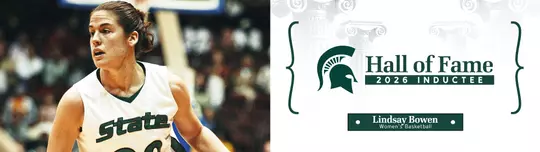
Lindsay Bowen
Women’s Basketball (2002-06)
Dansville, Mich.
The photo is iconic. Lindsay Bowen on the back of MSU teammate Liz Shimek celebrating the Spartans taking down the mighty Lady Volunteers of Tennessee in the 2005 NCAA Tournament National Semifinal game. Bowen was an integral part of the 2005 squad that was the first Michigan State women’s basketball team to reach the Final Four.
Now, Bowen will add another honor to her resume as a member of the Michigan State Athletics Hall of Fame.
“I was very shocked. I did not expect that, but obviously very happy, excited, and honored to get to be in the MSU Athletics Hall of Fame. That's so cool,” said Bowen after being informed. “I've grown up a Spartan fan since I was really young. I dreamed of going to Michigan State. That was always my dream, but I never dreamt that I would be Hall of Famer.”
Two members of that 2005 team, Shimek and Kristin Haynie are already members of the Michigan State Athletics Hall of Fame, and now Bowen will join her teammates.
“Yes, it's such an honor and a privilege to have played with a lot of those young ladies. And Kalisha Keane is also in the Hall of Fame, and so it's just really, really a special honor and really cool to be honored alongside them,” she said.
The 2005 season was the most successful year in MSU women’s basketball history, under the direction of Joanne P. McCallie, Coach P to her players. The Spartans ended the year ranked No. 2 in the final USA Today/ESPN Coaches poll, earning their highest-ever national ranking.
The win against No. 1-seed Tennessee at the time tied what was the largest comeback in women’s basketball Final Four history. The Spartans trailed by 16 points with fewer than 15 minutes remaining in the game and battled back for the 68-64 victory. It was one of several marquee wins for Michigan State that season, including non-conference wins over UConn and Notre Dame.
“What really stands out was we beat USC, by I think two points at the buzzer, to be in the Sweet 16 for the first time ever. The game at Stanford also stuck out to me because we beat them and went to the Final Four for the first time in school history. And then obviously the Tennessee game was big time because we were down by 16 and we came back and we beat them to put us into the National Championship game.”
MSU averaged 71.0 points per game, while allowing only 58.2. Those stats were bolstered by a 67-51 win over No. 11 UConn on Dec. 29, 2004, as the 10th-ranked Spartans not only won on the Huskies’ tough home court, but also dealt them their worst home loss in 12 years.
“In 2005, I was a junior. So, the two seasons leading up we were building something special. When that third year hit, we all had kind of talked about how we want to build this program into a championship program, and we went to work,” said Bowen. “We all were just a solid, hard-working group of young women and we made it work. It's kind of cool, we were small-town girls, and we just kind of fought together. I think once we started winning in the beginning, we told ourselves, ‘we could play with anybody.’ That’s when it took off because I think in the non-conference season, we played some really tough teams, and we beat them. That was a really good start to our season.”
During her senior season in 2006, Michigan State continued to flex its muscles. The No. 4-seeded Spartans reached the Regional Semifinals, before falling to Duke. The team went 23-10 overall and finished third in the Big Ten.
Bowen currently stands fifth all-time in Michigan State history in points scored with 1,739 points. She ended her MSU career as the school record holder in 3-pointers made with 294, which lasted until Tori Jankoska broke the record with 320 (2013-17). To this day, Bowen remains the Spartan career leader in minutes with 4,611, a testament to her hard-working nature.
Among the many accolades collected during her tenure at MSU, Bowen was named a Wooden Award Finalist in 2005. She was also a four-time Big Ten honoree (2003-06). She started her Spartan career with a bang, winning 2003 Big Ten Freshman of the Year honors.
Bowen is very aware that her success as a Spartan and beyond was not done alone. She had a team of people in her corner to help her find success along the way.
“First and foremost, obviously my parents. I wouldn't be where I am today without their love, without their support, and just being with me every step of the way. So, I would say them first,” said Bowen. “Obviously, Coach P, she was a pivotal coach and figure in our lives that helped us get to the success that we had. My high school coach, Stuart Thorburn, I just want to thank him for always pushing me in high school, and just being a really solid person and coach all around. Then obviously, all my teammates, we had so many awesome memories. They've been amazing Spartan sisters to me my whole career, and, even now, we continue to talk.”
After completing her playing and coaching career, Bowen shifted gears and is now a mindset and mental performance coach for athletes. She helps athletes build confidence and helps them increase focus in their games. Her ultimate goal is to help athletes get out of their own heads, providing examples from her own career as an athlete, as well as other athletes that she has seen along the way.
Now, that advice and coaching is coming from a Spartan Hall of Famer.
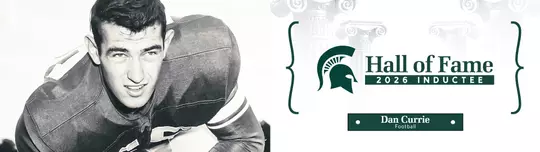
Dan Currie
Football (1955-57)
Detroit, Mich.
Dan Currie, who passed away at the age of 82 in 2017, takes his place among the all-time Spartan greats posthumously as part of the MSU Athletics Hall of Fame Class of 2026.
A three-year letterwinner for the Spartans (1955-57) under Hall of Fame Coach Duffy Daugherty, Currie helped lead the Spartans to National Championships in 1955 and 1957 and earned consensus first-team All-America honors as a center while being named the team’s MVP in 1957.
“Just excited and grateful,” said Tom Currie, who is the second oldest of six children in the family, upon hearing the news that his father had been named to the MSU Athletics Hall of Fame. “I’m amazed by the MSU Athletics staff for taking the time and effort to look back and honor some older players that maybe have fallen off the radar.”
Currie was a three-year starter on the offensive line, playing guard as a sophomore (235 minutes) and junior (272 minutes) before playing center his senior season.
During his first season earning a letter, Currie helped the Spartans to a win in the 1956 Rose Bowl over UCLA as MSU went 9-1 overall and finished No. 2 in the national polls (AP, UPI). The Spartans were also selected National Champions by Boand. He was one of four sophomores on the Spartans to start in the 1956 Rose Bowl Game and played 56 minutes in the victory over the Bruins, more than any other Spartan in the game, and also recorded an interception.
As a junior in 1956, Currie was named second-team All-Big Ten as a guard as the Spartans closed the season ranked No. 9 by AP and No. 10 by UPI with a 7-2 record.
Currie earned first-team All-America honors his senior year at center in 1957 as selected by the Associated Press, Football Writers Association, International News Service, Football Coaches Association and NBC. He was also named recipient of the Governor’s Award, which is annually awarded to the team’s most valuable player, and was a consensus first-team All-Big Ten selection.
A stalwart performer on both sides of the ball, logging a total of 284 minutes, Currie’s blocking helped the Spartans to a No. 1 ranking in the Big Ten in both total offense and scoring in 1957. Defensively, he was the catalyst from his linebacker post of a group that stood No. 1 in the league in rushing defense and total defense, and led the team with three interceptions. He was also a defensive captain.
The Spartans finished the season ranked No. 3 in the final Associated Press and United Press International polls with an 8-1 record (5-1 Big Ten) and were crowned National Champions by Dunkel. Currie finished eighth in the 1957 Heisman Trophy voting, a testament to his impact on the Spartans that season. He even finished just one point shy of being named the Big Ten Player of the Year.
Former MSU Hall of Fame Coach Duffy Daugherty said in 1957 that Currie was “the finest center in collegiate football and perhaps the best ever at Michigan State.” Daugherty also commented that he would not trade Currie for any other linebacker in the country.
“My father always talked about Duffy,” said Tom. “I think Duffy meant a lot to my dad – even a little more than just his coach, sort of like a father figure on campus. I remember that. My dad was pretty close with George Perles too. Most of my Michigan State memories were my dad talking about his teammates and the coaching staff.”
Following his All-America senior season, Currie appeared in the North-South All-Star Game and also the College All-Star Game on Aug. 15, 1958, in Chicago, as the college all-stars defeated the 1957 pro champion Detroit Lions, 35-19. He was also selected for the Senior Bowl and Hula Bowl all-star games.
Currie was chosen in the first round of the NFL Draft by Green Bay (No. 3 overall) in 1958. He earned first-team NFL All-Pro honors three times at linebacker (1961-63) during a seven-year stint with the Packers (1958-64) and was a member of two NFL Championship teams (1961, 1962) under legendary coach Vince Lombardi. He also played in the Pro Bowl in 1960.
Currie had a 30-yard interception return in the 1962 NFL Championship Game as the Packers defeated the New York Giants, 16-7, in Yankee Stadium. He also started at linebacker in Green Bay’s 37-0 shutout over the Giants in the 1961 NFL Championship Game. Prior to the 1961 NFL Championship game, he graced the cover of Sports Illustrated (Dec. 18, 1961).
Tom said that when his father played for the Packers that the family would live in Green Bay for three months out of the year during football season, then move back to Metro Detroit the rest of the year.
Currie finished his nine-year pro career with the Los Angeles Rams (1965-66).
As part of the observance of the 75th anniversary of the Big Ten in 1970, each school named an all-time team, followed by an all-time Big Ten team. Currie was voted to the all-time Spartan team and also earned honorable mention for the all-time Big Ten squad.
A native of Detroit who attended St. Anthony High School, Currie was inducted into the Packers Hall of Fame in 1984.
“One thing I’ve thought about is how proud my grandparents (Dan’s parents, Arthur and Bernice) would be about this honor,” said Tom. “Their three sons that grew up were all very good athletes. My dad’s older brother (Walter Miles Currie) was a standout football player at U of D (University of Detroit Mercy). And his younger brother (Michael Currie) lettered at Michigan State in the early 60s. My grandparents would be really proud. I know my grandfather, when his sons were in their athletic primes, he took a lot of pride in that, it was such a big thing for him. So I think a lot about them with this honor.”
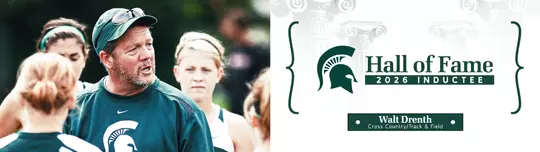
Walt Drenth
Cross Country/Track and Field (Coach 2004-20)
Charlevoix, Mich.
One of the most decorated head coaches in Michigan State Athletics history, former Director of Track & Field and Cross Country Walt Drenth will be immortalized in the Michigan State Athletics Hall of Fame in 2026.
“This doesn’t happen without the support of my wife and family,” said Drenth. “Coaching is very demanding of time and energy, and to be able to do it at a high level is quite a privilege. After all of the time I was gone and the demands of coaching, I can’t say enough about their contributions.”
Hired as the head men’s cross country coach in 2004 and later appointed as the director of men’s and women’s track & field and cross country in 2006, Drenth led Michigan State to heights that few coaches have reached in Big Ten history, ranking third all-time with five women’s cross country conference titles (2010, 2011, 2013, 2014, 2019) in addition to the 2015 Big Ten women’s outdoor track & field championship. His 2014 NCAA women’s cross country national championship stands today as the most recent national team title at MSU.
“I feel a great sense of gratitude for the people that I worked with at Michigan State,” said Drenth. “The athletes, the staff, and everyone who helped us become competitive. You don’t become competitive in a vacuum, so I’m grateful for all of the people at MSU that chose to surround themselves within our program.”
Throughout his tenure as a Spartan, Drenth was a six-time Big Ten Coach of the Year (Women’s XC - 2010, 2011, 2013, 2014, 2019; Women’s Outdoor Track & Field – 2015), a five-time Great Lakes Region Coach of the Year (Women’s XC – 2006, 2007, 2010, 2014; Men’s XC – 2017) and the 2014 U.S. Track & Field and Cross Country Coaches Association (USTFCCCA) Women’s National Coach of the Year.
“The relationships are what I take away from my time at Michigan State,” Drenth said. “The culmination of things that were able to happen are the result of mentoring amazing people, and phenomenal parents, that can have a cumulative effect of a lot of positive influences. For me, one of the great joys of coaching was just watching amazing people grow and recognizing that great people can come from anywhere if they put the work in.”
On the track and the course, Drenth’s student-athletes combined for two individual NCAA titles, 37 Big Ten titles, 51 NCAA Championships berths and 180 All-American honors. In the classroom, Michigan State tallied 18 Academic All-American teams, 81 individual Academic All-Americans and 729 Academic All-Big Ten honorees. Throughout Drenth’s tenure, his philosophy was to help student-athletes become the best version of themselves as not only athletes, but as people and students, too.
The 2014-15 season was a highlight of Drenth’s career, where he saw Michigan State capture two Big Ten titles and a national championship in one year. The women's cross country team winning the 2014 B1G title set the stage for another historic performance at the NCAA Cross Country Championships, where MSU placed four individuals in the Top 21 and recorded 85 points to capture the first national championship in women's program history.
Later in the year, distance runner Leah O'Connor-Falland captured her second career individual NCAA title, winning the women’s mile in record time at the 2015 NCAA Indoor Track & Field Championships.
Drenth and the Spartans closed out the 2015 season back in East Lansing where they earned the Big Ten women’s outdoor title on their home turf at Ralph Young Field. O’Connor-Falland turned in yet another historic performance for Drenth’s Spartans, winning the Big Ten 3,000-meter steeplechase, the 1,500-meter and 5,000-meter races. Michigan State’s women posted 128 team points, winning the conference title by 31 points.
“Winning the women’s Big Ten Outdoor championship was a really special moment in my career,” explained Drenth. “It was very hard. My first year at Michigan State we were last at the Big Ten Outdoor Championships for the women, and to see them grow and to see a staff buy into an idea that you could be more than that, I think was probably as hard as anything. We were able to get a group of kids that believed and worked, and grew, and to see the program become competitive was gratifying.”
O’Connor-Falland will be inducted alongside Drenth in the Michigan State Athletics Hall of Fame Class of 2026.
“I think it’s really cool to be going in at the same time as Leah,” said Drenth. “She’s certainly well deserving as there are not many people in any conference that score 30 points and to win every event she contested. She was a huge contributor to that Big Ten Championship and part of our group that really bought into the vision.”
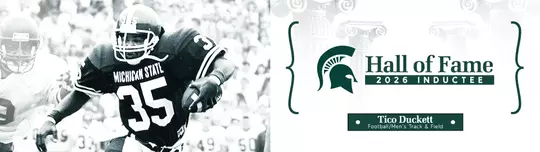
Tico Duckett
Football (1989-92)/Track & Field (1989-92)
Kalamazoo, Mich.
Although he is a local businessman and not an author, if Tico Duckett were to write an autobiography about his time as a football and track & field student-athlete at Michigan State and his career in the Green and White, he would title it “100 Percent Spartan.” Now he has the final chapter to that book with being inducted into the Michigan State Athletics Hall of Fame.
“That’s what I would call it, because that’s what you are when you spend a lot of time on the field and on the track as well, playing all those years of Spartan football and lettering in track four years in a row, you become a 100 percent Spartan,” said Duckett. “It would have at least one chapter for each year and all the experiences, including scoring the winning touchdown to beat Michigan my sophomore year when they were number one in the country, and including being a Heisman Trophy candidate, and capping it off with 1,000-yards rushing three years in a row.”
Coming to Michigan State as a highly touted football player and sprinter from Loy-Norrix High School in Kalamazoo, Duckett redshirted his first season at MSU, before seeing limited action as a redshirt-freshman in 1989.
In 1990, Duckett burst onto the scene, rushing for nearly 1,400 yards and 10 touchdowns, including the game-winning score from 9-yards out with 1:59 left in a 28-27 Victory for MSU over No. 1 Michigan on Oct. 13, 1990 in Ann Arbor. Duckett finished as the Big Ten’s leading rusher and No. 6 in the nation with 125.1 yards per game, while the 1,394 yards ranked fifth on MSU’s single-season rushing list. Duckett capped the season earning first-team All-Big Ten honors and was named the Big Ten Offensive Player of the Year. Along with all the individual honors, Duckett also helped Michigan State to the 1990 Big Ten co-championship, finishing 8-3-1 and No. 16 in the AP Poll.
As a junior in 1991, Duckett added another All-Big Ten award, garnering second-team honors, after finishing second in the B1G and 12th in the NCAA in rushing at 109.5 yards per game. Duckett ended with 1,204 rushing yards, ranking seventh at the time on MSU’s rushing list for a single-season.
Entering his senior season of 1992, Duckett was a candidate for the Heisman Trophy, Doak Walker Trophy and All-America consideration, as the Big Ten’s leading returning rusher. Duckett didn’t disappoint, leading the Spartans with 1,021 yards, becoming the first MSU rusher to have three 1,000-yard seasons. He is still one of just two Spartans to do so, joined by Sedrick Irvin (1996-99). Additionally, Duckett is still one of just three Spartans with more than 4,000 rushing yards for their career, joining Spartan greats and fellow MSU Athletics Hall of Famers Lorenzo White and Javon Ringer.
On the track, Duckett was fifth in the 55-meter dash with a time of 6.44 at the 1989 Big Ten Indoor Championships, and sixth in the 100-meter dash at the 1989 B1G Outdoor Championships with a time of 10.77.
Duckett was considered an “old school” running back during his football playing days, and his playing style was matched by his attire, as he wore the same shoulder pads that White wore during his career (1984-87), and emulated him in everything he did.
“I’ve always tried to make sure that I lived up to the Lorenzo White standard,” said Duckett. “And that continues today, as I know that he had a heck of a speech during his MSU Hall of Fame induction.”
Along with White, Duckett has memories of his coaches and his teammates that made a lasting impact on his playing career, as well as his time growing up and as an adult. Duckett is appreciative of everyone that helped him develop on and off the field.
“I’m just so thankful for my football coach George Perles, and my track coach, Jim Bibbs, along with all my position coaches and support staff on my Spartan football and track teams, and all my teammates, family and friends for helping me become not just the athlete, but the person that I am today,” said Duckett.
Now as an adult and after a well-decorated athletic career full of accolades, Duckett’s long list has a new top honor.
“This is number one for sure, it ranks at the top no question,” said Duckett. “Any time you’re inducted into any kind of Hall of Fame, whether it’s sports or something else, it’s just an exclamation point on your career. It’s that final drop in your career, and it’s something that nobody can take away from you, you’ve earned it.
“This puts a bookend on my career at Michigan State, and it just helps me feel as if I’m part of history. It is the final chapter of my story as a Spartan. I remember coming here at 17-18 years old, just getting started, and now at 56, I get my last accolade from Michigan State, and it’s just an incredible feeling.”
And while he’s not a writer, Duckett is more than excited for this last chapter of the book on his Spartan career.
“I’m thrilled to be part of such an elite class of the Michigan State Athletics Hall of Fame, it’s an extremely huge honor for me,” Duckett said. “It’s something that not everyone gets into, so I’m beyond thrilled to be a part of it.”

Sue Latter-Addison
Track & Field/Cross Country (1975-78)
Clarkston, Mich.
A pioneer in the 1970s for women’s sports, Sue Latter-Addison, a conference champion, All-American and former head coach, can now call herself a member of the Michigan State Athletics Hall of Fame.
As a standout at Clarkston High School in the early 1970s, Latter-Addison captured state titles in the 440-yard dash and 880-yard run at the first Michigan girls high school state meet as a junior in 1973. Since Clarkston did not have a girls track team, Latter-Addison trained with the boys team, allowed by an upheld ruling in the 6th U.S. Court of Appeals in 1972 that gave high school girls the option to compete in varsity, non-contact sports with boys in Michigan. She moved to shorter distances her senior year, finishing second in both the 100 and 200-meter dashes at the Michigan state meet in 1974.
Originally set to attend Central Michigan, Latter-Addison arrived at MSU in the fall of 1974 after a Title IX ruling gave her the opportunity to run on the track team coached by MSU Athletics Hall of Famer Dr. Nell Jackson.
“Dr. Nell Jackson called and said, ‘Hey, we have a track program’ and I changed schools two to three months before coming. It was a different time. There was no recruiting,” remembered Latter-Addison
Under the direction of legendary MSU track & field coach Jim Bibbs, Latter-Addison found early success at MSU. As a freshman at the AIAW Championships in 1975, she placed sixth in the 440 and was a part of the Spartans’ medley relay team that finished second in the nation. With encouragement from Jackson and Bibbs, Latter-Addison moved up to 800 meters.
The move proved to be a good one. In the 1977 Big Ten Championships, she won the 440-yard and 880-yard titles and was part of the first-place mile relay, helping MSU to its first team title. Nationally, she would go on to finish third at the AIAW Championships in the 800. A week later, she won the 800 at the U.S. Track & Field Federation Championships. Her breakout moment, however, came still later that summer at AAU Nationals, where she captured the national title in the 800 in a time of 2:03.75, finishing ahead of two Olympians. That time still stands as the MSU record in the event nearly 50 years later.
“My junior year, when I got third at the AIAW Championships and then to top it off winning USA Nationals, was just sort of like a storybook thing,” said Latter-Addison. “It’s sort of unbelievable that you’re trying a new event for the first year and you end up winning. I hadn’t done it since high school.”
Latter-Addison’s win at the national championships gave her the opportunity to run on the world stage that season, qualifying for the World Cup held in Germany and competing in the World Student Games in Bulgaria.
She took that experience and posted another strong season in 1978. Serving as team captain, she won three Big Ten titles at the conference’s first indoor championship. Individually, she captured both the 400 and 800 crowns, while also running a leg on the winning 4x440 yard relay team. At the Big Ten Outdoor Championships later that spring, she took first in the 800, bringing her career total to seven Big Ten titles (five individual and two relays).
Latter-Addison was also a member of the women’s cross country team. While the 5,000 meter races were significantly longer than her signature track events, her drive and determination allowed her to make a positive contribution. During the 1978 season, she was often among the top scoring Spartans.
After graduation, Latter-Addison pursued a professional career in track & field and coached as a graduate assistant at MSU, completing her master’s degree in athletic administration in 1981. She moved to Eugene, Oregon, to train under Bill Bowerman and later was coached by Luis DeOliveira, running for Nike’s Athletics West team.
While running as a professional, Latter-Addison was a member of six U.S. national teams and was ranked as the No. 1 miler in the country in 1986. She qualified for two Olympic Trials in the 1,500-meter run in 1984 and 1988, narrowly missing the Olympic team in 1984 with a fourth-place finish.
“One thing I learned at Michigan State was tenacity,” said Latter-Addison. “I missed the Olympic team (in 1984) by three tenths of a second. I made a lot of national teams, but not that one. Even though I was probably depressed for a month, it helps you in your coaching because you realize you’re only as good as your last race. There’s going to be ups, there’s going to be downs, there’s going to be injuries, but if you love the sport, you do it for more than just the wins.”
Latter-Addison ran professionally while working as the head women’s cross country and track & field coach at Brown and as an assistant coach at the University of Colorado, where she coached two All-Americans and four Big Eight champions. Her professional career came to an end while she coached at Florida State. Her daughters, Rebecca and Laura, were born in Tallahassee.
Latter-Addison later served as the head coach at Wheaton College in Chicago, where she was named the 1999 Division III Midwest Women’s Cross Country Coach of the Year. She also worked as an assistant coach at Hope College and at the high school level in West Michigan after returning to the state in 2000.
She credits Dr. Nell Jackson for her success as an athlete and a coach.
“I owe a lot to her (Dr. Nell Jackson),” said Latter-Addison. “She was at the forefront, especially being a black female athlete in her decade. She was quiet, unassuming, and led by example. With women’s athletics taking off at Michigan State and everywhere else, I do owe her a lot.”
Over 50 years after first arriving on campus, Latter-Addison will return this fall to join Jackson, Bibbs and several other legendary track & field athletes and coaches in the MSU Athletics Hall of Fame.
“I’m really excited about it,” said Latter-Addison. “It’s an honor to be in any college’s Hall of Fame, especially one like Michigan State’s. I never wanted to leave Michigan State.”

Kalin Lucas
Men’s Basketball (2007-11)
Detroit, Mich.
The day he got the phone call, former Michigan State men’s basketball standout Kalin Lucas admitted he wasn’t having the best day.
It was the day after the 2026 NBA Draft and he was watching a replay of the night most kids dream of when they grow up playing basketball. For Lucas, it brought back memories of those days 15 years prior when he was not selected in the draft. Even after a 14-year professional career that took him around the world playing the game he loves, that moment still hurts at times.
And then his phone rang. It was his former coach, Spartans head man Tom Izzo, and they were finally connecting after playing phone tag. Lucas thought Coach Izzo needed him to reach out to a current player and offer some advice. Instead, that call turned his day around when Izzo told Lucas that he was joining Michigan State’s Athletic Hall of Fame as part of its 2026 class.
“I won’t lie, I wasn’t having a great day,” said Lucas. “That call from Coach Izzo turned it into a day that I won’t forget.”
And when he had a chance to sit down – after he called his mother, Tina, and his father, Ken, to tell them the news – the concept of “Hall of Famer” took him back to when he first committed to Michigan State.
“I just remember him (Coach Izzo) being super excited, me having my family up here, us being in the video room,” recalled Lucas. “Once I told him, ‘Yeah, this is where I want to be,’ he jumped up in the air so excited that my little brother started crying because he didn't know what was going on. He thought something bad had happened, but no, Coach (Izzo) was just super excited. That was the first thing that came to mind. And even right now, every day now I'm waking up just thinking about different memories. Thinking about the hard work, the grind. It's super exciting.”
That hard work and grind helped make Lucas one of the all-time greats in Michigan State history.
One of just eight players in MSU basketball history to be named the Big Ten Player of the Year (2009), Lucas helped lead the Spartans to back-to-back Final Fours in 2009 and 2010. He was a three-time All-Big Ten selection, including consecutive first team honors, and was the team’s leading scorer in three-straight years, one of just five players in program history to lead the team in scoring for at least three years (Shawn Respert did it four times).
Lucas still ranks fifth all-time in scoring at Michigan State with 1,996 points and is one of just seven players in program history to score at least 1,900. When he graduated, he was sixth all-time in assists and still ranks 10th in program history with 558, leading the team as a sophomore and a junior.
“What's really big for me is just knowing the people that came before me,” said Lucas. “I knew coming to Michigan State wasn't going to be an easy task, especially having some of the greatest point guards to ever play the game come before me, from Magic (Johnson) to Scott Skiles and Mateen Cleaves. It just goes on and on. So, me knowing that, I knew I had to come here and represent. For them, for myself, and for my family. And for sure, you got to win. If you want to put that jersey on, winning has to come with it. To be honest, I'm still reflecting, and it still feels a little weird, honestly.”
Of the many memories he has from his career, two from his freshman year stick out the most. He scored 18 points and had six rebounds against Texas in the Spartan Clash at the Palace of Auburn Hills early in the year and then his first taste of March Madness later that year, beating a talented Pitt team in the second round and losing to Memphis in the Sweet Sixteen.
“That game against Texas was my coming-out party and where everything just came together for me,” said Lucas. “And that first taste of March Madness, if you win, you keep going and if you lose, it’s over. And Coach may not even remember this, but against Memphis, he put me back in with maybe two minutes left in a game we were down pretty good and I just remembered thinking, ‘we are coming back here next year and we’re going to make it.’”
Lucas and the Spartans did come back the next year, winning the Big Ten and advancing to the 2009 Final Four. Although just a sophomore, Lucas earned a spot on the All-Midwest Regional Team and the NCAA All-Tournament Team as MSU appeared in the National Championship Game.
The Spartans were poised to do it again in 2010, but the junior guard tore his Achilles in the second round of the NCAA Tournament and had to watch the team’s run to the Final Four from the sidelines. He came back as a senior and led the team in scoring at 17.0 points per game, solidifying a four-year career that ranked among the best in program history.
“When you're in college and when you're young, stuff is moving so fast and quick, you don't even really know everything that you did,” explained Lucas. “I didn't even really know, ‘Wow, I had this many points. I did this in assists. I was in the top five in this.’
“It was just me going out there, just putting everything I had on the line, just blood, sweat, and tears. So you really don't sit back and think about it until you're done, and that’s including my years overseas. And now to think about the opportunities I had and what I was able to do, I’m really proud.”
Lucas admits that it will be overwhelming when he returns to campus for his official induction into the Michigan State Athletics Hall of Fame. He will have his parents here, along with his brother, his grandmother (Mae Sturdivant), his soon-to-be wife Kaitlyn and his sons, Kalin Jr. and Kru, along with so many of his teammates.
“It's going to be emotional,” said Lucas. “But I think it's going to be cool too, just because it's around the time of Grind Week. That will make it even more special. All the guys are going to be back, all the players I’ve played with, past players that I’ve watched and got a lot of respect for, and I think it's going to be just a whole big event.”
It has been a long journey for Lucas, from the time he was recruited to State by Izzo from Orchard Lake St. Mary’s, to his career at MSU and his injury and then a professional career that took him to seven different countries, and now, to the Hall of Fame.
“Coach Izzo was the main reason I went to Michigan State because I knew the kind of coach he was and I knew he was going to hold me accountable,” said Lucas. “I didn’t want anything to be handed to me and once I got here and saw his work ethic, I said that I’m going to try to work just as hard. One of my goals was to make sure nobody was in the gym or in the Breslin Center more than me besides Izzo.”

Leah O’Connor-Falland
Women’s Cross Country/Track & Field (2011-15)
Croswell, Mich.
On the cross country trail, indoor or outdoor track, there wasn’t a race that Leah O’Connor-Falland didn’t dominate during her time at Michigan State. Under the guidance of fellow MSU Athletics Hall of Fame Class of 2026 inductee and former Director of Cross Country/Track & Field Walt Drenth, O’Connor-Falland etched her name in the MSU record books time and time again.
“Without exaggeration, Walt (Drenth) taught me some of the most important lessons of my young adult life, lessons that still echo in my mind more than a decade later,” said O’Connor-Falland. “Ironically, one of the greatest was learning to slow down. He taught me to be brave in the face of the unknown, to embrace discomfort, to trust the process, and to remember to breathe. Those things sound simple, but they're not. Above all, he taught me that asking for help isn't a weakness, it's part of becoming the best version of yourself. His legacy extends far beyond the years we spent together, but I'm incredibly proud to be inducted alongside him and to celebrate the impact he's had on generations of athletes.”
In the fall of 2014, O’Connor-Falland helped lead the Spartans to their first-ever NCAA National Championship in women’s cross country and their second-straight Big Ten Championship. Named the Big Ten Women’s Cross Country Athlete of the Year, O’Connor-Falland saved arguably the best performance of her MSU career at the conference championship race, as the three-time first-team All-Big Ten selection (2012-2014) shattered her career-best mark in the 6K with a time of 19:26.30 to finish first overall. O’Connor-Falland was also named the Great Lakes Region Women's Athlete of the Year, becoming the first Michigan State women's athlete to win the award since Emily MacLeod in 2009 and 2010, after taking first place at the regional meet and helping MSU to a first-place showing. O’Connor-Falland completed her unforgettable cross country season by earning All-America honors after placing 17th at the NCAA Championships, as the Spartans won the NCAA title with 85 points, the lowest point total since 2008.
One of O’Connor-Falland’s top accomplishments was being the only woman to win the Big Ten 3000m steeplechase title four-straight years. She also captured first-team outdoor All-American honors three-straight years (2013-15, plus second team honors in 2012) and first-team indoor All-American honors in both 2014 and 2015.
During the 2015 Big Ten Outdoor Track & Field Championship held in East Lansing, O’Connor-Falland captured her fourth-straight Big Ten 3,000-meter steeplechase championship with a time of 9:51.38, becoming the conference's first-ever four-time champion in the event. At the time, she was the first Spartan track athlete to win four Big Ten titles in the same event since Odessa Smalls won the 200-meter dash from 1984-87. The Spartans won their first Big Ten Championship since 1982 with 128 points with O’Connor-Falland scoring 30 points on her own.
In the same championship, O’Connor-Falland also went on to claim her second career titles in the 1,500-meter and 5,000-meter races. The three conference championships brought her career total to 10, the second-most in program history, earning her Big Ten Athlete of the Year and Big Ten Athlete of the Championships honors.
She was also named the Big Ten Indoor Athlete of the Year and Championships in 2015 after winning the women's mile run with a meet record time of 4:32.29. She went on to win the mile run at the NCAA Indoor Track & Field Championships on March 14, posting the fastest time (4:27.18) in NCAA Championships history and breaking her own school record. Her NCAA record stood until 2024.
“Those big wins are incredible. In the moment, you try to be a sponge and soak up as much of the joy as you can. You celebrate, and then it's back to work,” said O’Connor-Falland. “What I remember most are the people and the discipline: the icy rush of running through blizzards in East Lansing, eerie early morning long runs in the dark and gathering every weekday at 3 p.m. inside Jenison Field House.
“I was lucky to have teammates who shared that sense of adventure. We were willing to show up every day with no guarantee that any of it would pay off because we genuinely enjoyed being in it together. Looking back, I'm just filled with gratitude. It was a special place, at a special time.”
Throughout her Spartan career, she accumulated several awards, including being the Big Ten Indoor and Outdoor Athletes of the Year in both 2015.
She made it very clear that she did not reach these peaks alone. It took a village to help her climb to the top of the mountain.
“First and foremost, my family. I grew up as one of six kids, surrounded by an incredible extended family who always believed in me and gave me the confidence to chase big dreams” said O’Connor-Falland. “I'm also deeply grateful to my teammates and coaches at Michigan State. Success in a sport that looks so individual is never really individual. Every workout, every race, every difficult season is carried by the people around you. I especially want to thank Kim McGreevy and Lisa Breznau. They invested in me not just as an athlete, but as a person, and that kind of belief has a lasting impact.
“One of the biggest things sport has taught me is that we aren't simply the product of talent or toughness. We become who we are because of the people who nurture us, challenge us, and refuse to let us give up on ourselves. No one gets very far alone, and I feel incredibly fortunate for the community that carried me along the way.”
After retiring from competitive running, Falland chose a change of pace by moving to Australia with her husband.
“Life has taken me a long way from East Lansing. I now live in the Barossa Valley in South Australia with my husband and our three-year-old son, River,” said O’Connor-Falland. “Like many former athletes, I've had to rediscover who I am beyond competition. These days I work in marketing, spend my spare time renovating our 1950s home, caring for a growing collection of animals, tending a small orchard, and chasing after a very adventurous little boy.
“Australia has given me a slower pace of life and a new perspective. A recent diagnosis of endometriosis reminded me that, while running will always be part of who I am, it may not have been the kindest career for my long-term health. These days, success is measured less by finish lines and more by time with the people I love.”