Michigan State University Athletics
Q&A With Women's Golfer Ann Marie Kersten
4/15/2002 12:00:00 AM | Women's Golf
April 15, 2002
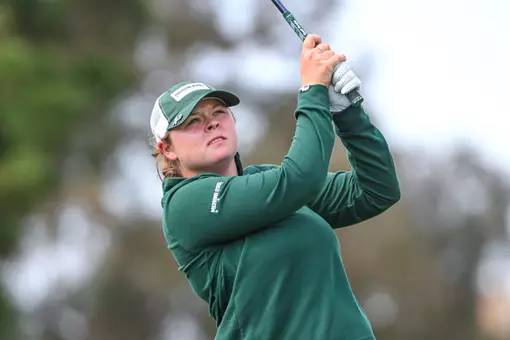
EAST LANSING, Mich. - The Spartan women's golf team has three players who are regularly featured in the line-up. With all but one tournament so far this year limiting the number of competitors from each team to five, earning one of those last two spots is a daunting task. Among the group vying for a spot is junior Ann Marie Kersten. The engineering major is a native of Oak Harbor, Ohio, and has competed in 34 career rounds.
Question: How would you describe the qualifying process?
A.K.: I think the whole idea behind qualifying is to make us better players and to get us ready for the tournament. You need to be very focused on getting the job done because you want to be playing for the team.
Q: How would you say a qualifying round differs from a tournament round?
A.K.: It's really different because you're competing against your own teammates in a qualifying round. You really have to be focused to shoot the numbers so you can make it to the tournament. It's hard because, obviously, you're competing against your teammates and they're some of your best friends. You're out there and you want to play the best that you can and beat them. When you get to a tournament, it's a very different experience because you're rooting for them.
Also with qualifying, you are playing your own home course and you're expected to play it well because you've played it so many times. I guess it's a little bit different when you're qualifying too because there are a lot of other factors that go into it like schoolwork. You come straight from class to the course and you play and then you go home and study. When you're at a tournament, you just focus on golf.
Q: How does the qualifying process differ from February to April?
A.K.: When we can't qualify, it's coach's decision. The first spring tournament is based on the scoring averages from the fall and everything that happened in the fall. This year for the second tournament it was coach's decision. The third tournament we still couldn't qualify and it was coach's decision. Then we started qualifying over spring break. On spring break it's more like summer. You can forget about your schoolwork, we get up at 7 a.m. every morning to golf and play all day.
Q: What would you say you learn from a qualifying round?
A.K.: Every time you go out to play, you can learn a lot about your game. Every day is different. It depends on how you are playing and how you are hitting the ball. Going into the last tournament, I was hitting the ball awful. I qualified because I figured out a way to get around the course not hitting the ball very well. Every time you go out there, you are learning new shots and new things are happening. The amazing thing about golf is that you can never practice every single shot, so every time you go out to play is a learning experience.
Q: Not always guaranteed a spot on the traveling roster, how do you deal with the pressure of competing for an opening?
A.K.: You kind of have to forget about that. If you're worried about not qualifying for a tournament, you are not going to play well. You have to trust the reality that you might not qualify and then go out there and try to play the best that you can. If you're worried about not qualifying - this has happened to people in the past but you get to a point where you put so much pressure on yourself because you are expected to qualify, then when you don't it's a very bit letdown. The fact of the matter is that it's not guaranteed and you still need to go out and play.
Q: With three players - Emily Bastel, Stacy Snider and Allison Fouch - consistently in the line-up this season, what have you learned from them to help you with your own game?
A.K.: We just had a team meeting and we were talking about everyone's approaches to the game and what they learned in the last tournament. You can learn a lot by talking to people about their mindsets - that's the biggest thing that a really good player can teach you is how to think out on the golf course. Emily said that she had a lot of trouble when she was playing really well consistently to continue to play well for the rest of the round. She said she would get a little uptight. Her philosophy was to not be afraid to play well. I think that is really important. Everyone needs to realize that when you are playing well, it's OK. You need not to be afraid to keep playing well and to play better.
You can also learn a lot from people's short games just by watching. Allison (Fouch), for example, practices a lot. Just by watching her you can learn some different ways to practice your short game or any other part of your game and different ways to get yourself mentally prepared as well.
Q: What specific things are you working on in your game to improve this season?
A.K.: My biggest problem was my short game from last year. I had a lot of trouble with it in competition. I worked on it a lot in the fall and it really improved. So far this spring, it hasn't been as good as I would like. Now that we're getting to practice outside, it's getting better. That's the main thing that I focus on is my short game, because it's the most important part of the game.