Michigan State University Athletics
Women's Tennis Looking To Fine-Tune Their Training
1/9/2006 12:00:00 AM | Women's Tennis
Jan. 9, 2006
EAST LANSING, Mich. - The Michigan State women's tennis team is doing all it can to become the most well-conditioned team in the Big Ten. Along with training regiments specifically designed for each player, MSU's tennis team has taken fitness tests to monitor their conditioning and how they can improve as athletes. These tests also allow each player's workout plan to be unique their body. The women's tennis program isn't the only sports team to take advantage of the departments involved in sports science on campus. Many other teams such as the men's basketball team and hockey team also take part in these tests.
"What we are trying to do is see the strength and efficiency of their heart and lungs," said tennis coach Tim Bauer. "It also helps us know how their training is going and whether they're improving or not. We also do body composition testing, just to get some benchmarks of where everyone is at."
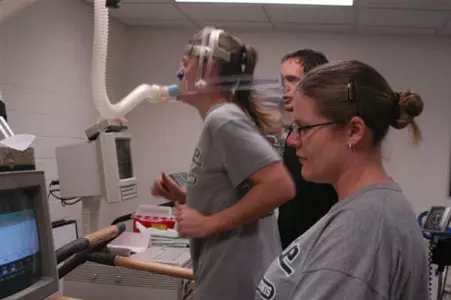
This is the first team of Bauer's that he has put through these tests. Not only does he have an interest in the results from a coaching standpoint, but Bauer also studied and earned a degree in health and exercise science from Furman University and a master's degree in exercise and sports fitness from the University of Florida. One of the tests that especially interests Bauer is an aerobic capacity test, which is called a VO2 max test. In this test, an athlete pushes their body and air supply to failure to see the amount of oxygen their body can process.
Not only is the tennis team looking for a leg up in the Big Ten in the area of fitness, but also they are looking to gain a mental advantage as well. All of these athletes are also highly competitive with each other. This fact seems to push the players to work harder to out do each other. Coach Bauer also sees the testing as giving a mental edge on the court. If a player knows they have improved and followed their training regiment, they will carry that confidence onto the court.
The fitness tests reflect the athletes' style of play as well. Coach Bauer explained how these tests can offer answers to not only training questions, but how athletes can best take advantage of their skills.
"These tests should show that their heart and lungs are pretty congruent with the style of play they have," said Bauer. If you have somebody who has great endurance, but they play very short points, that's unmatched. You want those things to match up and play to a player's strengths. If they are physically fit, you want them to impress that upon the people that they are playing."
Although these fitness tests are beneficial to fine-tuning an athletes' body, it is not an easy or fun test by any means. Freshman Stephanie Kebler (Okemos, Mich.), who took a fitness test like this for the first time, described the test as "something you would see in a Gatorade commercial." The athlete also cannot breathe through their nose during this test and must breathe into a mouth tube.
"I didn't know what to expect until I got here," said Kebler. "I didn't know what this was or that we had to get hooked up to this whole deal. I thought they were just going to see if we were in shape, not check every little thing. I didn't know it would be this in-depth."
All of these tests are done in the fitness lab at IM Circle on the corner of West Circle Dr. and Kalamazoo St. The fitness lab is run by Dr. Jim Pavarnik, who received his Ph.D from Indiana University and has been at Michigan State since 1994 with the Kinesiology Department.
"I work with everyone," said Pavarnik. "I work with the sports medicine doctors, athletic trainers, strength and conditioning coaches and head coaches. Frequently, we'll have a sit-down meeting so we're all on the same page."
This is something that is refreshing not only in Pavarnik's eyes, but in Bauer's as well. Although it may seem like common sense, not all college sports programs work as well with their kinesiology department as the athletic teams seem to do here at Michigan State. Both Pavarnik and Bauer see the relationship as something that should be natural since it benefits both parties.
"The relationship we have with athletics is incredible," said Pavarnik. "When I talk to my colleagues around the country, they are sometimes amazed. It's because we don't walk in there and say 'Hi, I'm a scientist and I'm going to tell you what to do.' I think coaches here trust us because we've been honest with them, we share information and we don't use players. We're here to help."
The tennis team is looking to build on these tests to have a successful spring season. With hard work using the results from their testing, the MSU's women's tennis team is looking to compete for a Big Ten title. With the help of Jim Pavarnik and his staff, the training regiments given to the athletes should help them accomplish this goal.
The spring season for the Spartan's women's tennis team will begin on Jan. 13, 2006 at 7:00 p.m. in Nashville, Tenn. as Michigan State takes on Montana State.
.jpg&height=340&type=webp)