Michigan State University Athletics
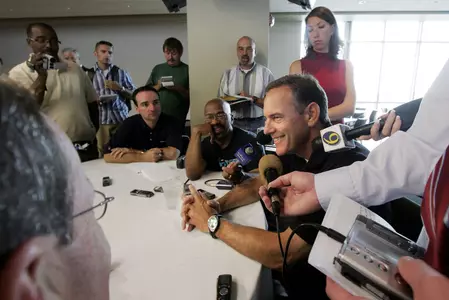
Mark Dantonio Weekly Press Conference Transcript
10/8/2007 12:00:00 AM | Football
Oct. 8, 2007
Coach Dantonio Press Conference (All-Access)
COACH DANTONIO: Obviously, it was a very disappointing weekend, and I guess the first thing I think we all have to realize is that life can throw you curve balls sometimes, and you need to be able to pick yourself up. It was a very difficult Sunday for our football team, as well as for the coaches, but you move forward, you move on with the process.
We've talked all along about the fact that there will be growing pains within this program, and I think that this is one of them. You know, I wish it was different for our football team. We were sort of playing pretty well for the first four games, and then boom, hit Wisconsin, now we hit this. It's a little bit different type of situation because one side of the ball played very well, but the other side did not and part of the special teams played very, very well.
What we need to do first of all is go back and critique what we did, and we'll take a very systematic approach in terms of how we handle this, critique what we did, look for things that are what we call CQ, which would be clinic quality, which is done exactly the way we want it done, offensively, defensively and special teams, and then going about looking at the things that we weren't successful at. And as I said in the press conference on Saturday, critique it in terms of was that a structural mistake, in other words, what they did structurally against us, could we not defend it; was it a mental mistake; or was it a physical mistake, and make decisions based on those things.
This program is still going to be measured on toughness, and we have to make sure that we're playing with great effort and great toughness on every single play. So within that there's an accountability and there's a responsibility that starts with me, and it runs throughout our entire program. We need to look at the film, which we've done already, and be accountable for it, be responsible for it from the top to the bottom, from the guy who didn't play a play to the guy that coached the football team and down. We just need to make sure that we're constantly harping on do your job, just do your job to the best of your abilities.
I think when you look at our football team on Saturday, you see three different aspects. You look at the offense and you see a team that scored 41 points, had a great individual effort by Javon Ringer, great individual effort by Devin Thomas, outstanding protection, I think, for the most part by our offensive line, and we were hitting on all cylinders when you look at it in a lot of respects.
We had, I believe, 11 explosive plays, which is a large amount, and some of them went the distance. So when you look at the offensive side of things, I guess you would ask were we right at the end of the game, and that would be your only concern, no turnovers.
When you look at our special teams, obviously we didn't perform well at punt, so that's a concern. It was a fundamental breakdown, I guess, when you look at (the blocked punt) it. As I just indicated, it was a physical breakdown and mental breakdown. But the kickoff team and kickoff return team (produced) big plays on both ends of that.
The punt return team was probably a disappointment, and that would have been structural problem because we didn't handle what we were doing and no big plays resulted, other than we roughed the punter, which was a mental error.
If you look at our field-goal/extra-point team, one point makes all the difference in the world. If you look at that football game and come up with one point and what happened at the end of the game, we win that football game. But it is what it is, and we've got to get our kicks up and we've got to be more solid at the point of attack. We got knocked out of there, and I would say that's a physical error, not mental.
When you look at our defense, I think you've got a combination of things basically. You've got some areas where physically we should have made the play on the deep balls that were thrown that resulted in the long touchdown passes. Players were there, they need to make plays. You've got some structural errors that resulted by maybe what they were doing relative to what we were doing, and those are coaching errors and those need to be corrected.
And then you've got some physical errors or mental errors where we have guys that are young that are playing certain positions that are out of position based on what they're trying to accomplish, whether it's rerouting a receiver or whether it's playing in a bubble or whether it's stepping back in the box to play the run, whatever it is, but you've got a combination of things there, and probably the biggest concern that you have is a lack of effort at times, which is troubling to me as a coach.
When you look at that aspect, I think the thing that comes back to me all the time as a defensive coach is when you're not successful, you need to be able to slow the game down. You need to slow it down, so that you're able to take a good, clear picture of what to do. You need to know what to do in order to play faster and with more aggression.
Obviously, there were some issues where we didn't maybe know what to do quite to the full extent, whether it's because of a different formation or whether it was because of a misalignment or whatever it is, and so we don't play quite as hard. That's coaching, we're going to address that aspect, address it with the players, but that's troubling because we always pride ourselves in going hard.
I think when you look at the entire football game, especially on defense, it's a confidence issue at times, and confidence is a very fragile thing. And in two cases, two scenarios you look at it and say you're dealing with 18 to 22 year old people; confidence is a very fragile concept. But then when you look on the flipside of it, young people are very, very, very resilient, and they can bounce back very quickly, so from that standpoint I think it's a very positive thing.
We have to break old habits, and I'm not saying in terms of looking back in the past and saying we've got all these different bad habits, but individually as football players we have to break habits. We have to have guys make plays when they're capable of making them and our good players have to come through in those situations, and somebody has got to be able to stop the tide from turning on the defensive end of the field in that case when we get into a game like that.
It's a lot easier for me to say it than for us to do. I think things come at you very, very fast in life, things come at you very, very fast out on the football field, and it's a blur to you. It just becomes a blur to you, and you don't realize you're not maybe going as hard as you need to go. But nevertheless when you get a picture of it later the next day and you slow it down, I think the realization is there that we can play better, and we need to play better.
In terms of our program right now, we're in this for a long term program, and if you would look at our program right now and say where are you at after six years, six games going into this at 4-2, if you would have said to me last spring, hey, you're 4-2 going into your seventh game, I think right now you would say, okay, what games did we lose, which games did we win, and you'd make an assumption about, hey, we're not playing that awful.
The trouble is the last two games were Big Ten games which are the most critical games that we play, and we had opportunities to win those games at the end. We had opportunities throughout the game to put us over the hump and we don't make the plays to get over the hump, we don't make the calls to get over the hump, we don't coach to get over the hump, and consequently we lose those football games in a situation where we can maybe win them, and that's what's frustrating.
But we're all growing, including myself. We're all trying to get to the point where we're going to be successful. But this is a long term project, and as I said earlier when I took the job and throughout, there are going to be growing pains. There are going to be times where we're asking each other what happened, I wish this, I wish that, if it only would have been, and there's going to be times when you lay in bed on Sunday morning and you don't want to get out of bed, and that was one of those days.
With that in mind, we can't change what's just happened. It's in the record books and it'll be written about and talked about, but it's in the past. But what we can learn from is what has happened, and we can continue to look towards the future and try to build on this.
I think that any program that is trying to make their way back up is going to have some times when they struggle, but you're going to have to build on those struggles and you're going to have to show them that if this technique was played in this way correctly or if you would have played it this way or turned into the receiver this way instead of backing up on a ball this way, you make the play. It's as simple as that.
This game is about this big in certain instances. It's a game of inches. I think it's a game of technique and aggression, controlled aggression, and you better have your aggression, you better go through people, you better play the ball in the deep part of the field, you better take your proper steps because one step crossing over as opposed to shuffling makes all the difference in the world if you're an outside backer playing the spread. When you turn your shoulders and you run down the line of scrimmage, there's an issue. If you stay square and come down the line of scrimmage, there's no issue. So it's things as simple as that.
We've got young people playing. We played three freshmen, one defensive lineman and then one guy, Michael Jordan, who had never really played. O.G. (Ogemdi Nwagbuo) had a little surgery on his hand and was out most of the game. He wanted to play more, but nevertheless we played with the young players up front, we played with a true freshman at corner which hurt us somewhat on third down, and then we played with a true freshman at outside backer and a red-shirt freshman at the other outside backer. You know, we made some errors, so that's where we're at with that.
As far as where we're going, Indiana will be a great challenge for us. They've got a great, outstanding quarterback, and he's got all kinds of statistics to back it up. Kellen Lewis runs it, passes it. They've got a great wide receiver in James Hardy. They're a spread offense conceptually.
Their defense is anchored by Greg Middleton, who's one of the leaders in sacks in the nation. As a team, they lead the nation in sacks. I think they're very fundamentally sound. They have nine guys back on defense, and I believe maybe eight back on offense, so they're an experienced football team. They have a field-goal kicker in Austin Starr that's kicked 12 out of 13. So they're going to be a challenge.
Where we're at? I like our focus. I've never questioned our focus. I've never questioned our attitude as players. Nobody feels worse than our players do right now. The stats that we have right now indicate Michigan State and Indiana are stacked on top of each other, second and third or fourth and fifth in almost every statistic.
They run the spread offense. In one case, you'd say that's an issue, and in another case, you'd say we've had a week of practice against it and we can be better at it. I would prefer to take that look at it.
Offensively, we've got to protect our quarterback and allow him to make plays. Indiana's special teams are very solid, and I think Bill Lynch has done an outstanding job. I believe he went there in 2005 with Coach (Terry) Hoeppner, so he's in the third year of the program, and you can see it. You can see that their players are playing harder. You can see that their players have developed and they know what they're doing.
It'll be a great Homecoming game, and it's a night game. From my side of things when I've been here for the evenings at Spartan Stadium, it's been a great environment, it's been a live environment, and our players will come to play.
With that I'll take some questions.
Q. When you said that it was a difficult Sunday, do you mean in terms of the exercise that you all went through in practice or the emotion?
COACH DANTONIO: It was an emotional day. When you come off a game like Wisconsin and everybody is patting you on the back and saying it's okay, it's okay, you played well up in Madison, tough environment, fifth-rated team, you guys are all right.
Then we come and play a Northwestern team who had some things to prove of their own, and the thing that you can say about this conference, much like I used to say about the BIG EAST Conference, it's a very well coached conference, and everybody is going to have a plan. How you execute that plan is going to make all the difference in the world. And in the end, they executed their offensive plan. We executed our offensive plan, but in the end, they won the game.
But I would say it was a tough day emotionally. It was not a tough day physically for us, it was a very tough day emotionally for us. But as I said before, you know, young people are resilient, and we'll move on.
This football team is not a lost football team. There's not going to be finger pointing, there's not going to be abusiveness towards them. We're going to correct in a way that allows them to grow as people, and we're going to build up young people, we're not going to tear them down.
Q. Did the tackling issues the other day kind of come out of nowhere for you? Does that get contagious in a game, and do you do any extra tackling work this week in practice?
COACH DANTONIO: I guess, yeah, we'll continue to tackle during practice and make it even more live. But we tackle every day. We tackle the safeties every day, we do bubble drills, try to get them on the ground, different things that put them in their positions.
But I think you have to realize when we step on the field, there's a game speed that the opposing team brings to the field, and you can only get so much in practice from your scout teams or whoever. We're not going to sit there and tackle Javon Ringer in the open field during practice. We're going to go against our scout team players, and it's not the same.
When the ball gets in space in the spread offense, you've got to get them on the ground in space. But you've got to give yourself a chance to get them on the ground, as well, because we were out of position at times and little things such as your initial steps or your initial alignment doesn't give you a chance to make those plays.
Structurally there were issues, as well.
Q. Talk about your concern about the field goals in the Big Ten. I mean, games are so close and we're struggling at field goals.
COACH DANTONIO: Well, we've had two blocked, once against Pitt, once against Indiana, a field goal and then one extra point. We critique everything. Field goals a lot of times are one of those big six critical to winning issues that we talk about all the time. We've got to get the ball up. Brett (Swenson) has to get it up more consistently. I think he's a good kicker, but he's got to get the ball straight up.
And then at the point of attack, they put Corey Wootton over our left guard, and he beat our left guard. He knocked him back and got his feet up underneath him and got up and was able to nick it and block it.
Q. Were you able to read anything in your team during the game that they were reeling or back or their heels, or was it the same kind of forward mentality that they have all had all along?
COACH DANTONIO: I sort of sensed on the sideline that there wasn't maybe as much juice on the sideline as a total team. But I certainly felt like our offense came out every series with execution in mind and they were very up tempo and enthusiastic. And on the defensive side of the ball, obviously we were reeling a little bit. I don't think things like that happen. Not reeling, but as we approached the second half, we came out every series ready to play, enthusiastic about that, with the mindset, and got them in the third down plenty of times. But we couldn't get off the field on third down. Really, I mean, it was almost unbelievable.
Some of it was physical, some of it was mental, and some of it a couple times may have been structural. We got them in the third-down situations, but you have to play the ball in the deep part of the field. There were two touchdowns, we have a punt blocked to get the ball on the 31 yard line. As bad as we were playing, we don't have the punt blocked going into the game at halftime at 13-13, it may be a different game.
But we just needed a couple stops, but every time we got the couple stops it just seemed like at that point they got a couple stops, and we could never really inch over the top and give ourselves any type of breathing room. You've got to give our players credit because every single time, you want to talk about handling adversity, every single time they had an answer, and our offense answered every single time with the exception of at the end. So that was a positive.
Q. As you try to change the mindset here, if that is indeed one of the goals, maybe it's not, but when players hear and read a newspaper headline that said, "Same Old Spartans," how do you filter that out? I know you talk a lot about the inner circle with us, but does that creep in? Is it a subconscious with your players? How concerned are you about that?
COACH DANTONIO: I'm not really concerned what's written in the papers to be honest with you. I don't have time to read the papers. Nothing personal.
We invest our time in knowing what really is the truth to the best of our ability, and I know if a guy has shut it down or if he hasn't shut it down. When I look in my players' eyes, I don't see that, and when I look into our coaches' eyes, I don't see that. You know, I see hurt, but I don't see a lack of faith. I don't see a lack of faith.
Those are things that we try to build over the course of time, and those are things that maybe take a little bit more because you're going to stub your toe a number of times along the way. We're going to deal with the problems, and we're going to work through them. We've lost two close games. If we would have won two close games, who knows what everybody would be printing, but we would have the same problems. If we would have won this football game 42-to-41, we'd still be sitting here with the same problems defensively that we're talking about, we just would have won the game and the picture would be completely reversed about how we're able to handle adversity and how we're able to get it done and not the other way. It's the same thing with the Wisconsin game.
So all over the country right now people are reeling and other people are doing a little bit better. In Illinois, they're saying, wow, things have gone this way; and maybe in Iowa City, they're saying things have gone that way, and in Georgia or Southern Cal. So all over the country I think this is occurring.
I think the true measure of your success as a program is what are you going to do now and where are you going to go and how are you going to react when things are tough, and how are you going to react when the walls are crumbling down around you a little bit or when you face some tough times. I think that will be our truest test.
And those times are coming. I've always said that those times were going to come and we're going to find out who's with us and we're going to find out who's got both feet in the circle and who's got one in and one out. We're going to work with the ones that have both in. I don't see anybody on our football team that doesn't have both in, but we'll find out.
Those are tests in life; those just aren't tests on the football field or for this Big Ten season. Those are tests that they'll have to deal with their entire lives, so it's a learning experience and a life lesson.
Q. Otis Wiley has been a leader for you and a playmaker. What do you see from him and how do you correct the slow start that he's had?
COACH DANTONIO: As I've said before, Otis Wiley is a tremendous young man, and he has tremendous ability. But the bottom line is you've got to be able to make a play coming out of the middle of the field like that, two times, one time in the deep hash, two deep coverage, and one time in the middle of the field. You've got to be able to make the plays. He didn't make those plays, so I would say right now if I looked at Otis, his confidence is shaken. He doesn't need people tearing him down, he needs them building him up.
But at the same time, you have to be accountable. There is accountability, and as I said, structural, physical and mental errors, and we have to examine those things and make decisions. There are always going to be consequences. Let's face it, if this happens four years in a row, I'll be a consequence, which we don't want to happen.
But anyway, life is going to go on for Otis. He's got a tremendous faith, and I have faith in him that he'll rise up. Things go in cycles. Guys have opportunities. They maybe lose a couple snaps, re prove themselves, get back on the horse, redevelop confidence. He has great ability, so it's just a matter of him playing through this. But I think it's a tough day for him, too.
Q. You talked about the players handling adversity and staying in the circle and staying together. Obviously, this week there was some criticism that was going around. How are you guys as coaches and you handling all of this?
COACH DANTONIO: Well, in terms of outside criticism or just in terms of what happened?
Q. Both.
COACH DANTONIO: Just in terms of what happened, you know, it's got to start with me. If I walk in there hang dogging it, it's going to filter down. Well, we don't have a chance. I'm not going to walk in there like that. I've been in tough situations before. We've been in tough situations in Cincinnati, we've been in tough situations at Ohio State, been in tough situations here as an assistant. I've been on all ends of the spectrum in that capacity.
I think if I've learned anything from the people that I've worked for, it's that you have to persevere, you always have to reset your goals, you have to rechallenge people and refocus on the end goal, and you have to continue to move it forward. And you can't get despondent over something and lose faith.
I mean, in terms of the outside criticism, as I said before, everybody has a job to do, and I'm a big boy. We can handle it, so we'll keep moving forward.
FastScripts by ASAP Sports....