
Michigan State University Athletics
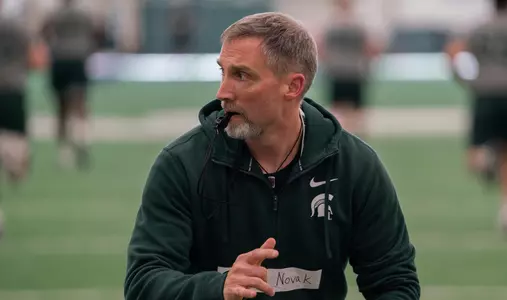
Spartan Football Update: Strength and Conditioning Coach Jason Novak Media Teleconference Transcript
4/30/2020 1:40:00 PM | Football
EAST LANSING, Mich. – Jason Novak, the Michigan State head strength and conditioning coach for football, answered questions from reporters on a media teleconference on Wednesday afternoon.
Novak, who enters his first year as the head coach of strength and conditioning for the football program in 2020, took over for 25-year head strength and conditioning coach Ken Mannie, who announced his retirement in February.
A transcript from the call is below:
Michigan State Head Strength and Conditioning Coach (Football) Jason Novak
On how much of a challenge is it to try to stay on top of guys and make sure they're doing their work...
I think the biggest challenge, honestly, is everybody's figuring this out together for the first time. There's no playbook for it, there's no blueprint for it, and everybody's trying to figure out what the best practices are, and the big thing for me is, as far as communicating with the players, getting training and workouts and plans and things like that to them, but it's got to be things that they can do, you know, things that they have access to. The big thing for me is, if I write a program, it can be the greatest program I can come up with, but if they can't do it as where they're located right now then it's not very valuable to our program, so trying to find out what those things are, and then just being a source of support and resources for the guys, like 'Hey, tell me what you have access to' and let's build something off of that. And so that can look 105 different ways right now with what we're going through.
On guys working out with different kinds of equipment (tires, milk jugs, water bottles, etc.) and how to mitigate the weight...
Yeah, I would say one of the biggest things with that is, obviously, we're probably limited with the access to traditional bars and dumbbells and lifting the pounds that they're used to and things like that. So, in doing that, finding out what they do have access to, and then writing programs based off more...it's more volume based, because, to me it's not exactly this way but, you can lift 300 pounds one time or you can lift 30 pounds 10 times and it's still 300 pounds. Now the training effect of that is different, but trying to encourage them that, 'hey look, number one, we got to make sure that our legs are in shape, we got to make sure that we're used to the volume of work and sending them things, putting ideas out there that will allow them to do that.' And then getting creative everything from, you know backpacks full of can goods, water jugs, like you said with milk jugs and things like that. Everything becomes a tool at our disposal at that point, what you have access to around the house. Especially that they can't go to...a lot of places can't go to parks now, and things like that, to use a jungle gym or monkey bars and things like that.
On looking back at the last few years at injuries and if he has looked at that...
Honestly, I haven't looked back at that so much yet. Just in terms of...I got there the last week in February, we had a week's worth of training before everything got shut down. Our sole focus has been on taking care of the players and trying to communicate with them and get them what they need, to be a resource. I have not looked back as far as the injury rates or specific injuries in previous years. The biggest thing, with regards to that, is with us, as far as building a program and what not, the ultimate factor is making sure and monitoring workloads, making sure that the guys are prepared for the volumes of practice and games and things like that. A lot of that starts off from a standpoint of addressing it where they are when we get them. Again, you can't just accelerate yourself right in to where we would be whenever this breaks like we've been training all spring or all summer. We're going to have to address it from a 'where are we now' and then 'how do we accelerate that safely and appropriately to make sure that the guys are set up for success and not at risk of injury.'
On how difficult it is to put workouts together with guys he isn't familiar with...
Yeah, that a good question. A lot of it has to do with...one, finding out, the original thing we have to do...find out what the guys has access to. If you can put them into groups of... 'hey coach, I've got access to pretty much everything in my basement or garage' to 'I have access to some dumbbells, some rubber bands, a suspension trainer', things like that. The third group would be 'hey, I don't have anything but my body weight.' So kind of categorizing it like that. And then writing programs that are a little bit generic in a sense based off what they have access to. Then the other thing is, safety being the most important factor of not sending them things that are very technical, because a lot of times these guys, they're training with not having eyes on them doing this stuff. So you have to be very careful of that, so we have not sent things that are very technical, it's been volume based as far as higher reps, things like that, lower load. With the conditioning side of it, you know, maintaining our running, maintaining our change of direction as best we can. It has had to be a little more vanilla, I would say that across the board as a profession, it's had to be that way just because of what our players have access to and what it safe for them to be doing. I would never encourage our guys to be participating in highly technical exercises or training without having eyes on them that can protect them from being safe.
On how long a team needs to prepare to start the season...
I know that there's been several models put out there from various professionals and conferences and things like that. You've heard everything from a four-week model to a six-week model to having six weeks of preparation going into a camp situation. I think a lot of that is very dependent on how quickly you can get back. Also too, I think there's a geographic component to that as well, as far as where in the country you're located, based on what you've had access to. I know in some areas of the country, gyms have opened up this week and guys are going to have access to that, where as other parts of the country are completely shut down still, with regards, I would say, I would leave that speculation to the professionals and the medical side of that. The selfish strength coach part of me is I want as much time as possible, right, I want the full spring and the whole summer and all of that. We're obviously not going to get that and I would defer to the time that we get from the medical people on that to not speculate.
On his thoughts on guys going to public gyms once they open back up...
You know, that's a touchy subject, right, because what are the rules, what are the parameters. A big thing for us, I know that we were so concerned with and we've been continually talking about, is sanitation of the equipment and things like that. To me, I would say with our guys right now, our focus has been solely on staying the course of what we have going on right now with the equipment they have. I have not encouraged anybody, 'hey, as soon as the gym opens up, let's get in it' because, again, I don't want to be sending them technical training when I don't know what eyes are on them and I know I can't see them, nor can I have them send any information back to me, saying 'show me you doing this exercise.' We're not allowed to do that. That's probably a big concern to me, is jumping right back into it and going into gyms and things like that, that we're just not aware of the circumstances or the environment that we would be sending them to.
On messages he conveyed about what he wanted coming into this job...
The big thing when I interviewed was, obviously knowing coach (Mel) Tucker, I had known Coach Tucker as far as NFL circles when he was with the (Jacksonville) Jaguars and I was with the (Tennessee) Titans. Knowing his name and his track record of success in the league and then also collegiately. Then, getting to actually sit down and talk with him and hear his vision of the program and where he wants it to go and the belief system that he has. I mean it was one of those deals where it's like 'where do I sign right now?' I got so excited in talking to him. For me, one of the big factors for me is he believes in strength and conditioning as an important part of the football program. It's important to him and he understands it, he has a lot of knowledge about it and for me, that was really exciting because I was talking to a man that really understood what this phase of the program was about and the importance of it and the support that he has given me and my staff, it's been wonderful. On top of that, my gosh, it's Michigan State, it's Spartan Stadium, it's 'Go Green!' That in it of itself, I mean how could you not jump at the opportunity to be a part of that program and a part of this University and the fan base. Everything that goes with it, it's a dream come true for me - a hundred percent.
On former strength coach Ken Mannie and what he knows about him...
Coach (Ken) Mannie... two parts to Coach Mannie. One, I've known Coach Mannie for probably the last five or six years from my time at Central Michigan University. I would come down to Michigan State, we'd go to the clinics and things like that, then we became friends through that process. Then, in the process of me coming to Michigan State, I think probably the best thing I can say about that transition and how he treated me... like just absolute one hundred percent class the entire time. The way that the transition has taken place, how willing... we've had conversations several times since we've all been on this lock down period and then I got to spend quite a bit of time with him my first couple of weeks there on campus. I mean, so appreciative of him, his willingness to ease this transition and help me through things and be a sounding board. He gave the opportunity, he said 'look, if you got any questions, you want to talk about anything, I'm always available to you.' He's just been wonderful to me, I'm very appreciative of him and so that has been an ideal situation as far as transition would go.
On transitioning to the program with current members of the strength and conditioning staff like Lorenzo Guess…
It's a huge help, right. Because you know, you think about it from the guys walking in the weight room the first day when I was there. You don't know any of their names yet, you're trying to put names with faces, you're trying to know backgrounds, everything about them. You have guys in the room, hey, they can tell who they are, they can tell you a little background information on them. It's huge. I think also too, from a continuity standpoint, it's important because those players have longstanding relationships with a Lorenzo Guess, like you mentioned. They have longstanding relationships with those guys and they've leaned on them and so it's important for there to be some continuity with that. It's been really good, those guys, we've had conversations throughout the entire time of this break and it's been wonderful just kind of talking through what we want to do and how we want to build it and where we want to go when we get back together.
On working at IMG Academy and what he got out of it...
The biggest thing for me, with regard to IMG Academy, the thing that that afforded me was IMG is one of the premier sports training academies, facilities in the world. With that, the access that they have to technology and sports science and the most cutting edge methods of training; the cool thing about that place, you had, in the summer time, you have everywhere from campers who are nine, 10 years old all the way up to professional organizations with English Premier League, NFL, United State National soccer teams. The gamut of athletes that were there was phenomenal. Then, incorporating the technology pieces and the science behind the training, that was something...there's very few places that you can get that all in one roof. Gatorade Science Institute is there on campus as well, so you had access to some of the information that they were building. And so to me, that was one of those things where I was like, this is an opportunity for me to grow in this profession and learn the things and get my hands on the things that maybe I haven't had access to at other places and really accelerate my learning in this profession and then be able to apply it down the road when I get that opportunity.
On concerns of guys not having access to all the fitness items they may need...
I would say the concern...the maximal strength efforts. Those are going to be of concern because a lot of the guys are not going to have access to that. The biggest thing is your tolerance for volume when you get back. Coach Tucker had made mention in team meetings that 'hey guys, we control our readiness.' And so, with that kind of backdrop with that being the building block, so what we've tried to do is, we control our reaction to the volume increase when we get back. So we have to prepare ourselves. You know, if you're going from a basement level to a balcony level overnight when this thing breaks, well you're going to be more susceptible to fatigue and things like that. Whereas what we are trying to do is elevate our baseline as best we can, as high as we can so that the change in volume is not so extreme when we do get the chance to get back together. It's not the amount of workload that really gets to people, it's the spikes in workload that really play the biggest factors. Going from zero to 1,000 or 100 miles an hour, that's where people are at risk. It's not staying at 75 miles an hour for a sustained period of time. So that's what we've been trying to do is like 'hey guys, look, we've got to control what we can control' which is our readiness for the volumes and the speed that we are going to move at and things like that. If we can do that, we'll give ourselves a chance when we get back together to tolerate the workload put on us a little bit better.
Novak, who enters his first year as the head coach of strength and conditioning for the football program in 2020, took over for 25-year head strength and conditioning coach Ken Mannie, who announced his retirement in February.
A transcript from the call is below:
Michigan State Head Strength and Conditioning Coach (Football) Jason Novak
On how much of a challenge is it to try to stay on top of guys and make sure they're doing their work...
I think the biggest challenge, honestly, is everybody's figuring this out together for the first time. There's no playbook for it, there's no blueprint for it, and everybody's trying to figure out what the best practices are, and the big thing for me is, as far as communicating with the players, getting training and workouts and plans and things like that to them, but it's got to be things that they can do, you know, things that they have access to. The big thing for me is, if I write a program, it can be the greatest program I can come up with, but if they can't do it as where they're located right now then it's not very valuable to our program, so trying to find out what those things are, and then just being a source of support and resources for the guys, like 'Hey, tell me what you have access to' and let's build something off of that. And so that can look 105 different ways right now with what we're going through.
On guys working out with different kinds of equipment (tires, milk jugs, water bottles, etc.) and how to mitigate the weight...
Yeah, I would say one of the biggest things with that is, obviously, we're probably limited with the access to traditional bars and dumbbells and lifting the pounds that they're used to and things like that. So, in doing that, finding out what they do have access to, and then writing programs based off more...it's more volume based, because, to me it's not exactly this way but, you can lift 300 pounds one time or you can lift 30 pounds 10 times and it's still 300 pounds. Now the training effect of that is different, but trying to encourage them that, 'hey look, number one, we got to make sure that our legs are in shape, we got to make sure that we're used to the volume of work and sending them things, putting ideas out there that will allow them to do that.' And then getting creative everything from, you know backpacks full of can goods, water jugs, like you said with milk jugs and things like that. Everything becomes a tool at our disposal at that point, what you have access to around the house. Especially that they can't go to...a lot of places can't go to parks now, and things like that, to use a jungle gym or monkey bars and things like that.
On looking back at the last few years at injuries and if he has looked at that...
Honestly, I haven't looked back at that so much yet. Just in terms of...I got there the last week in February, we had a week's worth of training before everything got shut down. Our sole focus has been on taking care of the players and trying to communicate with them and get them what they need, to be a resource. I have not looked back as far as the injury rates or specific injuries in previous years. The biggest thing, with regards to that, is with us, as far as building a program and what not, the ultimate factor is making sure and monitoring workloads, making sure that the guys are prepared for the volumes of practice and games and things like that. A lot of that starts off from a standpoint of addressing it where they are when we get them. Again, you can't just accelerate yourself right in to where we would be whenever this breaks like we've been training all spring or all summer. We're going to have to address it from a 'where are we now' and then 'how do we accelerate that safely and appropriately to make sure that the guys are set up for success and not at risk of injury.'
On how difficult it is to put workouts together with guys he isn't familiar with...
Yeah, that a good question. A lot of it has to do with...one, finding out, the original thing we have to do...find out what the guys has access to. If you can put them into groups of... 'hey coach, I've got access to pretty much everything in my basement or garage' to 'I have access to some dumbbells, some rubber bands, a suspension trainer', things like that. The third group would be 'hey, I don't have anything but my body weight.' So kind of categorizing it like that. And then writing programs that are a little bit generic in a sense based off what they have access to. Then the other thing is, safety being the most important factor of not sending them things that are very technical, because a lot of times these guys, they're training with not having eyes on them doing this stuff. So you have to be very careful of that, so we have not sent things that are very technical, it's been volume based as far as higher reps, things like that, lower load. With the conditioning side of it, you know, maintaining our running, maintaining our change of direction as best we can. It has had to be a little more vanilla, I would say that across the board as a profession, it's had to be that way just because of what our players have access to and what it safe for them to be doing. I would never encourage our guys to be participating in highly technical exercises or training without having eyes on them that can protect them from being safe.
On how long a team needs to prepare to start the season...
I know that there's been several models put out there from various professionals and conferences and things like that. You've heard everything from a four-week model to a six-week model to having six weeks of preparation going into a camp situation. I think a lot of that is very dependent on how quickly you can get back. Also too, I think there's a geographic component to that as well, as far as where in the country you're located, based on what you've had access to. I know in some areas of the country, gyms have opened up this week and guys are going to have access to that, where as other parts of the country are completely shut down still, with regards, I would say, I would leave that speculation to the professionals and the medical side of that. The selfish strength coach part of me is I want as much time as possible, right, I want the full spring and the whole summer and all of that. We're obviously not going to get that and I would defer to the time that we get from the medical people on that to not speculate.
On his thoughts on guys going to public gyms once they open back up...
You know, that's a touchy subject, right, because what are the rules, what are the parameters. A big thing for us, I know that we were so concerned with and we've been continually talking about, is sanitation of the equipment and things like that. To me, I would say with our guys right now, our focus has been solely on staying the course of what we have going on right now with the equipment they have. I have not encouraged anybody, 'hey, as soon as the gym opens up, let's get in it' because, again, I don't want to be sending them technical training when I don't know what eyes are on them and I know I can't see them, nor can I have them send any information back to me, saying 'show me you doing this exercise.' We're not allowed to do that. That's probably a big concern to me, is jumping right back into it and going into gyms and things like that, that we're just not aware of the circumstances or the environment that we would be sending them to.
On messages he conveyed about what he wanted coming into this job...
The big thing when I interviewed was, obviously knowing coach (Mel) Tucker, I had known Coach Tucker as far as NFL circles when he was with the (Jacksonville) Jaguars and I was with the (Tennessee) Titans. Knowing his name and his track record of success in the league and then also collegiately. Then, getting to actually sit down and talk with him and hear his vision of the program and where he wants it to go and the belief system that he has. I mean it was one of those deals where it's like 'where do I sign right now?' I got so excited in talking to him. For me, one of the big factors for me is he believes in strength and conditioning as an important part of the football program. It's important to him and he understands it, he has a lot of knowledge about it and for me, that was really exciting because I was talking to a man that really understood what this phase of the program was about and the importance of it and the support that he has given me and my staff, it's been wonderful. On top of that, my gosh, it's Michigan State, it's Spartan Stadium, it's 'Go Green!' That in it of itself, I mean how could you not jump at the opportunity to be a part of that program and a part of this University and the fan base. Everything that goes with it, it's a dream come true for me - a hundred percent.
On former strength coach Ken Mannie and what he knows about him...
Coach (Ken) Mannie... two parts to Coach Mannie. One, I've known Coach Mannie for probably the last five or six years from my time at Central Michigan University. I would come down to Michigan State, we'd go to the clinics and things like that, then we became friends through that process. Then, in the process of me coming to Michigan State, I think probably the best thing I can say about that transition and how he treated me... like just absolute one hundred percent class the entire time. The way that the transition has taken place, how willing... we've had conversations several times since we've all been on this lock down period and then I got to spend quite a bit of time with him my first couple of weeks there on campus. I mean, so appreciative of him, his willingness to ease this transition and help me through things and be a sounding board. He gave the opportunity, he said 'look, if you got any questions, you want to talk about anything, I'm always available to you.' He's just been wonderful to me, I'm very appreciative of him and so that has been an ideal situation as far as transition would go.
On transitioning to the program with current members of the strength and conditioning staff like Lorenzo Guess…
It's a huge help, right. Because you know, you think about it from the guys walking in the weight room the first day when I was there. You don't know any of their names yet, you're trying to put names with faces, you're trying to know backgrounds, everything about them. You have guys in the room, hey, they can tell who they are, they can tell you a little background information on them. It's huge. I think also too, from a continuity standpoint, it's important because those players have longstanding relationships with a Lorenzo Guess, like you mentioned. They have longstanding relationships with those guys and they've leaned on them and so it's important for there to be some continuity with that. It's been really good, those guys, we've had conversations throughout the entire time of this break and it's been wonderful just kind of talking through what we want to do and how we want to build it and where we want to go when we get back together.
On working at IMG Academy and what he got out of it...
The biggest thing for me, with regard to IMG Academy, the thing that that afforded me was IMG is one of the premier sports training academies, facilities in the world. With that, the access that they have to technology and sports science and the most cutting edge methods of training; the cool thing about that place, you had, in the summer time, you have everywhere from campers who are nine, 10 years old all the way up to professional organizations with English Premier League, NFL, United State National soccer teams. The gamut of athletes that were there was phenomenal. Then, incorporating the technology pieces and the science behind the training, that was something...there's very few places that you can get that all in one roof. Gatorade Science Institute is there on campus as well, so you had access to some of the information that they were building. And so to me, that was one of those things where I was like, this is an opportunity for me to grow in this profession and learn the things and get my hands on the things that maybe I haven't had access to at other places and really accelerate my learning in this profession and then be able to apply it down the road when I get that opportunity.
On concerns of guys not having access to all the fitness items they may need...
I would say the concern...the maximal strength efforts. Those are going to be of concern because a lot of the guys are not going to have access to that. The biggest thing is your tolerance for volume when you get back. Coach Tucker had made mention in team meetings that 'hey guys, we control our readiness.' And so, with that kind of backdrop with that being the building block, so what we've tried to do is, we control our reaction to the volume increase when we get back. So we have to prepare ourselves. You know, if you're going from a basement level to a balcony level overnight when this thing breaks, well you're going to be more susceptible to fatigue and things like that. Whereas what we are trying to do is elevate our baseline as best we can, as high as we can so that the change in volume is not so extreme when we do get the chance to get back together. It's not the amount of workload that really gets to people, it's the spikes in workload that really play the biggest factors. Going from zero to 1,000 or 100 miles an hour, that's where people are at risk. It's not staying at 75 miles an hour for a sustained period of time. So that's what we've been trying to do is like 'hey guys, look, we've got to control what we can control' which is our readiness for the volumes and the speed that we are going to move at and things like that. If we can do that, we'll give ourselves a chance when we get back together to tolerate the workload put on us a little bit better.



Monday, September 28
Saturday, September 26
Thursday, September 24
Monday, September 21