
Michigan State University Athletics
The Journey from Obscurity to National Prominence
6/29/2021 12:58:00 PM | Women's Soccer
MSU Women’s Soccer Beginnings.
It was a typical hot and sunny day in Chico, CA when Annie Kurz picked up her office phone to an unknown caller. From the other line Julie Gnau practically shouted the words she had dreamed of hearing for nearly five years: "We got it, Annie! WE GOT IT!"
The year was 1985, and the Michigan State University women's soccer team had just been granted varsity status. This groundbreaking announcement made MSU the second Big 10 school after University of Wisconsin to have a women's varsity soccer program, setting the standard for the region.
However, it was not the university that paved the way for this remarkable achievement. Instead, it was Annie, Julie, and dozens of teammates who between 1979 and 1985 poured their literal, blood, sweat and tears into fighting for the recognition they deserved.
This is their story.
Back in the fall of 1978, two MSU freshmen named Nancy Hanna and Jody Peebles—fresh off successful high school soccer careers—arrived on campus eager to join a collegiate team. Unfortunately, one didn't exist. New to campus and with few connections, they were unable to recruit the requisite number of female soccer players to form a club. Undeterred, they scrabbled together a few players and signed up for the only available campus soccer league - the men's intramural league.
As Nancy shared with the university newspaper at the time, "It was sort of a spur-of-the-moment thing. We really didn't know how to get a women's soccer program started, so we got a bunch of friends together that we knew from high school and became the only women's team in the IM league. We only won one game, but we gave the men some strong competition. We eventually want women's soccer to be regarded as a varsity sport at MSU. The interest is definitely there, so we hope to someday form a league with other Michigan schools."
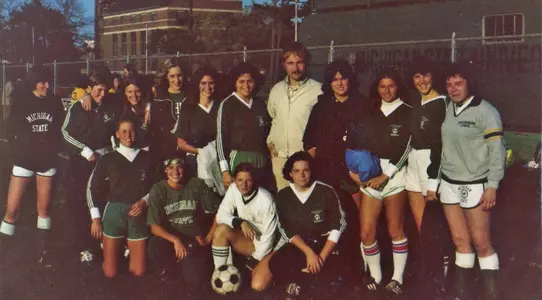
Quite a vision from this ambitious college freshman. As it turned out, with the exposure gained in the intramural league and campus newspaper, this vision was shared by dozens of female soccer players. By the spring of 1979, just a few short months later, they had recruited 53 players to form two full squads, one recreational and the other competitive. The second squad became the university's first-ever women's soccer club, and immediately began building a reputation for itself.
Of course, to compete, they needed competition. Many of the players' high school soccer teammates were scattered across different universities throughout the Midwest, and they were hungry for the chance to match up. Nancy also connected with the soccer coaches at the University of Michigan, Oakland University, and Kalamazoo College, all of whom were interested in forming a league. So why not play each other?
With four universities on board, Nancy and her freshman co-captain Julie Ebling proposed a competitive eight-game schedule for the spring season. Their first matchup: U of M. The result: a 4-1 sweep. Charlie Van Nederpelt, the club's first coach, was impressed with this initial success: "The team played extremely well together in their first competition ever. They showed surprisingly good team spirit and they were all cheering each other on. The team has come a long way in a short period of time."
Along with Nancy, Jody, and Julie were numerous talented players including Andrea Pfahler, Peg Freeman, Debbie Pacheco, Gail Cronin, Caroline Chipinsky, Kathy Lund, Karen Brink, Sue Ann Kopmeyer, Karen Knight, Jenny Stewart, Laurel Klepinger, Linda Huff, Ellen Black, and Michelle Diegelman. Together, these women finished their first season undefeated, taking home the unofficial prize of "state champions" in the culminating tournament.
With an exhilarating start to their club career, Nancy shared, "We hope to become a full-fledged member of the sports scene at MSU. But right now, we're running into the problem of not getting enough support from the University. It may take a while before we're accepted as a varsity team."
And indeed, it did.
Fast forward a full year to 1980. MSU women's soccer was dominating the newly formed Midwestern Women's Intercollegiate Soccer League, which has grown to include a total of five universities in the region. Standout sophomore Debbie Pacheco would become the first team member to receive All-American honors for her performance in the fall of that year. And still, MSU women's soccer remained a club sport.
In The State News, Debbie shared, "We could be even better as a varsity sport. People would be more dedicated and we wouldn't have to pay for our own transportation and uniforms." Most of the schools in the league did not have varsity status, but Pacheco pointed out a noticeable difference in the ones that did. According to her, "They attract a better variety of players and the teams are usually stronger because of their regular practice schedules and a greater commitment to the team."
In the fall of the same year, two new players were recruited—bright-eyed and passionate individuals who would become powerful advocates for the team over the next five years. Their names were Julie Stachecki and Annie Kurz. Pictured here with their coach, Michael Thaut on the occasion of his receiving his PhD in Music.
Over the next year, Julie and Annie contributed equal amounts of energy on and off the field, coordinating schedules and pushing recruitment of fresh talent. In the Fall of 1982, they were joined by several talented freshmen including powerhouse forward Julie Gnau, and Caroline Trout whom by the end of that first season helped the team earn an overall record of 5-1-1. MSU placed second in the league that year, behind the University of Cincinnati, where women's soccer was already reaping the benefits of being an institutionally supported varsity sport.
By the fall of 1982, it had been three years since the creation of the women's club team. Despite groundbreaking leadership in forming the first-ever intercollegiate women's soccer league and an impressive winning record, MSU women's soccer remained unfunded and unrecognized by the university athletics department. There was clearly no lack of talent or tenacity - so what was holding them back?
As Julie puts it, it was time to begin "knocking down the wall." It was time to take their game—on and off the field—to the next level.
The game changer came in the form of Michael Thaut, a PhD student in MSU's School of Music. As it turned out, music was just one of this man's many talents. Before coming to study in the United States, Michael played semi-professional soccer in Hamburg, West Germany.
In the fall of 1982, Michael arrived on the MSU campus and started looking for pickup games to join. It wasn't long before he began hearing about the women's team. And soon thereafter, Annie met him on the sidelines during a men's soccer practice to interview him to become their new coach.
"Because Charlie Van Nederpelt had moved away from the area, I knew I needed to get back to campus as soon as possible in the early Fall to find a new coach. Luckily, Michael was interested and presented a strong case for why he should be the new coach. What I learned later was I had found a great coach!"
From day one as head coach, Michael imposed a strict regimen of practices five days a week, with heavy conditioning that often began at 7:00am in the weight room. Over the next few months, he taught the team to play a multi-functional game with flexibility between positions with priority given to speed and fast passing. Julie Gnau described this well roundedness as a notable advantage that quickly gave the team an edge over their competition.
As Michael explains, "I tried to create a sort of professional structure for a club sport...We did everything like we were a varsity team—a very successful varsity team—except technically, on paper, we were club."
In October of 1982, The State News, a continuous source of campus press for MSU women's soccer, wrote, "With the combination of experienced players, an ambitious coach and a strong positive attitude among teammates, the team looks forward to another successful season." In the same article, Annie—now a three-year veteran and league co-commissioner with teammate Linda Huff—called their lineup "one of the best we've had in years."
She couldn't have been more correct. By the end of the 1982 season the club was ranked 15th in the nation and had received an invitation from the NCAA to participate in the women's soccer championships. However, because MSU women's soccer was still unrecognized as a varsity sport, the team was ineligible to compete.
After practice, Michael, Julie, and Annie would descend the stairs to the local El Azteco's basement restaurant to pound nachos and develop a game-plan for elevating the club to varsity status. This frequent weeknight ritual became just as therapeutic as it was strategic. They went over new plays, analyzed game performance, and came up with every idea they could to crack the code of winning varsity status.
After months of strategy sessions and far too many nachos, they had prepared a pitch for the MSU Athletic Council. As the 1982 academic year drew to a close, they brought the pitch directly to the council and MSU Athletic Director Doug Weaver. Referencing soccer's explosive growth as a national sport, and the women's team record (which spoke for itself) they justified the request for elevating the team to varsity status. As if swatting a fly, the council dismissively rejected the club's proposal, citing its inability to meet necessary criteria—namely, scheduling Division I competition that would bring in revenue.
It was true that athletic programs nationwide were experiencing shrinking revenues from a switch to cable programming and fewer advertisers. Then Councilmember L.V. Manderschied said, "We are very aware of their wishes. But looming on the horizon is a major concern about funding for varsity sports. It is hard to justify adding more at a time when revenues are declining."
So the argument was that women's soccer wasn't profitable. But in reality, this was as Michael Thaut puts it, "a false argument. And that's why we didn't buy it. They shouldn't make millions in revenue." After all, this was college sports.
Despite the ongoing struggle with their alma mater, the team didn't let it dampen their spirits. Most importantly, they remained committed to each other as a team.
Star forward Julie Gnau attributes much of this positivity to Julie Stachecki and Annie Kurz's energy: "an energy that was just so amazingly wonderful as leadership to keep that program and that momentum going… Teams are successful when you have that chemistry and that leadership. [They] made it fun, but [they] held us all accountable."
Accountable for showing up to early morning and after-dark practices in below freezing weather, which—due to men's varsity taking priority field times—caused them to consistently miss dorm dinner hours. Accountable for juggling university classwork with none of the academic exceptions often made for varsity athletes. Accountable for scraping together the cash needed to make it to away games, where their lodging was often friends' dorm floors or family friends' couches.
As Annie recalls, one time "we were playing a series of teams in the Cincinnati area, but there was no way we could afford a hotel in Columbus or Cinci. As it happened, my dad's old fraternity brother from University of Cincinnati lived in the area and let the whole team crash in his living room."
Far from glamorous, they made it work. In 1983 their record was 14-3-1, demonstrating just how much the team was accomplishing with little institutional support.
Joe Baum, the men's varsity soccer coach, was thrilled at the women's resilience. An early champion of the club's formation, Baum continued to help the MSU women's soccer team by collaborating on field time, securing equipment, and providing moral support. He was quoted in 1984 as saying "They are a very dedicated bunch of athletes who work very hard, sometimes under adverse conditions."
As it turned out, struggling to get field access for practices and sleeping on floors before big games were only some of the adverse conditions facing the team. Worse still was the intimidation by other athletic programs to avoid pulling the Title IX card—something that would have been a real legal challenge to the MSU Athletic Council. For example, a coach of another varsity women's team, afraid of having to split funding with women's soccer, all but threatened the club to remain complacent with its lesser status.
Ultimately, rather than empowering female athletes to use Title IX to advocate for equal recognition and support, the MSU athletics department was turning women's sports against each other and failing to reward stellar performance that had set MSU apart on a regional and national scale.
To save face and stave off a Title IX lawsuit, the MSU Athletic Council made a show of considering the club's request by making them jump through a series of successively more absurd hoops. Theoretically, once these criteria had been met, the question of varsity could be revisited.
The lowest bar was setting up a schedule against the other varsity teams in the region, which by this time included Miami University in Ohio, the University of Cincinnati, Xaiver University, Kalamazoo College, and the University of Wisconsin (currently the only Big 10 women's soccer program). And of course, beating all of them. Which, of course, with the powerful new additions of players Mary Wujkowski, Julie Bessell, Julie Brasseur, and Lisa Nightingale, they did.
But each time they satisfied the requirements, the council would pile more on. This time, they were asked to prove that there was sufficient supply (athletes) and demand (audience) for women's soccer, ensuring a varsity program would be sustainable. Michael, Julie, and Annie and Linda began tracking down the number of women's recreational teams in the country, visiting high schools to gauge recruitment potential, and gathering evidence about the growing investments being made in women's varsity squads.
Somehow, despite satisfying all of the criteria set forth by the Athletic Department required to elevate a club sport to varsity status, the Athletic Department continued to deny this privilege. In a 1984 letter from Athletic Director Doug Weaver to MSU President Cecil Mackey, he defended the council's decision to deny the team varsity status—a decision, he wrote, that "was made in the best interest of the Department of Intercollegiate Athletics."
As if national recognition for a powerhouse athletic program in a burgeoning sport, which had lost only nine games between 1982 and 1984, could be against the interests of MSU athletics.
It seemed like the crusade was doomed to go on forever.
In early October of 1984, in an article titled W-soccer Itching for Big League, student columnist Tom Sussi wrote: "If someone representing the MSU women's soccer club approaches you for your signature on a petition, sign it. I don't care if you're sick of signing your John Hancock to save the Michigan bullfrog or the pigeon-toed whitetail deer. This is for a good cause, folks. The club desperately wants to become a full-fledged varsity team. It wants to be acknowledged by the National Collegiate Athletic Association. It wants to be able to travel to away games without having to sleep on family friends' living room floors. It wants to win this University a national championship, and you know how scarce those things have been around this place lately."
Caroline Trout, President of the Club in 1984 petitioned the ASMSU for funding for travel, uniforms and communications (long distance charges) to the tune of $775. It wasn't until Spring of 1985, however when the team was finally clad in funded team jerseys and were staying at motels instead of dorm room floors. The only problem was it was a one-time funding.
By this point, the team had proven that soccer on a national level—with the growing number of schools forming varsity programs—was here to stay. It was then that the council added yet another requirement: to host a Big 10 tournament and win it.
And so, at the culmination of the 1984 fall season, which MSU finished with a 15-2-2 record (placing first in the Michigan Women's Intercollegiate Soccer Conference, Big Ten East Division and Big Ten), the MSU women's club soccer team hosted a Big 10 postseason tournament. MSU progressed to the finals to take on the University of Minnesota. After shoveling snow off the lines on the pitch, based on German ingenuity MSU returned to an indoor space to warm up for the competition. "It was the first time we'd ever played in snow," Annie remembers.
Taking the field warmed-up, strong, and prepared, MSU women played their hearts out. They scored one epic goal and held the 1-0 lead until the whistle blew at the 90-minute mark. Michael recalls that "the winning goal came off a header from a corner kick, a set play we had practiced 10,000 times." Big Ten Tournament Champions! Their fate had finally been decided.
How proud they were to deliver the news to the Athletic Department, clearing the last hurdle on the club-to-varsity journey. And then, they received word that the MSU Athletics Council would not, after all, award their years of successful hoop jumping with varsity recognition. It was the third official denial in three years.
At this point Michael looked Julie and Annie square in the face and said, "this is unacceptable." And it was. If the university's own athletics department could not see what a tremendous opportunity this was - not only to support a winning team but to lead the nation in recognizing and supporting women's sports and the fastest growing sport in the nation for all genders - the club would have to take things to a higher level.
Julie Stachecki, now a four-year member, said, "We played it their way; now we're going to play it whatever way we can."
On October 4, 1984, Julie and Annie, clad in power suits and accompanied by the full team in uniform, marched into Michigan State University's Board of Trustees monthly meeting. They had just five minutes to make their pitch in the meeting's student comment period, and they were ready.
With journalists and TV cameras trained on the team, Julie and Annie began the speech they had rehearsed with their Coach countless times in the days prior. In the first two minutes, Julie presented the team and their tremendous record of accomplishments. In the final three, Annie made the case for women's soccer as a varsity sport at MSU. Their prepared packet of supporting information included signed petitions representing MSU fellow students who supported elevating women's soccer to varsity status.
When they finished, the room was silent. Without acknowledging their presentation, President Cecil Mackey turned to his secretary to ask for the next agenda item. To his left, a board member spoke up: "Excuse me Mr. President, I just have to say: That was the most professional student comment period we've ever had."
And with that, they filed respectfully out of the room.
They had done everything they had been asked, satisfied all the criteria laid out for elevating a club to varsity status, and more. Yet Julie and Annie, after five years with MSU women's soccer club, would graduate that December of 1984 without receiving a decision nor a varsity letter. Nor would any of their predecessors, nor the women filling their sizable shoes.
The following spring season, Julie Gnau and Caroline Trout had taken up the mantle of MSU women's soccer and continued to lead the team to win after win throughout the region. The club participated at the WAGS tournament in Washington, DC, attracting national recognition for their outstanding performance. According to Coach Thaut, "We had a great year, played at the famous WAGS tournament against nationally ranked powerhouses like Central Florida (U.S. National Soccer player Michelle Akers' school) and lost only 2-1, hit the cross bar at the end and lost in the Big Ten Final, by one point to Minnesota. At the WAGS tournament, the former director of the National German Coaching Program introduced himself to me in the hotel, stating that he was on an official mission checking out the Women Soccer development in the US and complimented me on the tactical and technical 'maturity' of my team about which he was very surprised. I answered him in German and things became quickly clear to him. I can't think of a bigger compliment what we had accomplished in those years."
So Gnau brought the case before the MSU Athletic Council yet again, arguing that enough money had been pledged from private donations to fund their $2,500 annual budget for several seasons and the MSU Women's Soccer team was playing successfully at a national level.
While awaiting a decision from the Board of Trustees and action by the Athletic Department, she attended a meeting in the state capitol to rally for support. Rather than storm the capitol with Title IX guns blazing, Julie Gnau remembers that "We approached it as: This is a sport that is up and coming," and deserves to be recognized.
It was a day in April 1985, when Julie Gnau received the call. It was the reporter from the State News that often called for quotes and details on the weekend's games. But this wasn't one of those calls. This time he was calling about the word that Varsity status was being awarded to MSU Women's Soccer! As soon as she hung up the phone, she immediately dialed Chico, CA.
"We got it, Annie! WE GOT IT!"
Annie could hardly believe her ears. More than half a decade since its inception - having made a name for itself both on campus and around the country - MSU women's soccer was finally receiving the recognition and varsity status it deserved.
This would mean new cleats and official MSU uniforms every year. It would mean busses to take them to games all over the Midwest, and hotel beds to sleep in. It would mean letters of varsity athletic participation for players who dedicated their lives to MSU soccer, bringing pride to their university community.
Michael Thaut finished his doctoral program in Music that year, leaving MSU with a 57-11-5 record as the club's coach. He stayed on to coach in the Fall of 1985, prior to Varsity being in effect, and left for a position in Music at the University of Colorado by Fall of 1986. Before departing, Michael shared, "I'm very pleased with the [Varsity] decision. I've been promoting it for three years now and I guess everything just fell into place. I think that several variables demonstrated that the program was of consistent quality over a number of years and not just a one-year thing. There was consistency in winning, coaching and attendance which was looked at, as well as being nationally competitive."
In 1985, soccer was the fastest growing sport in the nation, while women's soccer was the fastest growing team sport on the college level. The number of NCAA member institutions sponsoring women's soccer grew from 64 teams in 1980, to 163 in 1984. Even with the long overdue announcement, MSU became the second Big 10 school to have a women's varsity soccer program (second only to Wisconsin, who MSU had in fact beat the previous year).
The first varsity letters were awarded to MSU women's soccer players in the fall of 1986, and the program, 35 years later is still thriving. It all came down to the tremendous talent, effort, and dedication demonstrated by the club team's earliest leaders. The camaraderie and passion they shared for their team, and for the game was rewarded with varsity status.
As Michael said, "At the end, making it varsity was just acknowledging reality."
The year was 1985, and the Michigan State University women's soccer team had just been granted varsity status. This groundbreaking announcement made MSU the second Big 10 school after University of Wisconsin to have a women's varsity soccer program, setting the standard for the region.
However, it was not the university that paved the way for this remarkable achievement. Instead, it was Annie, Julie, and dozens of teammates who between 1979 and 1985 poured their literal, blood, sweat and tears into fighting for the recognition they deserved.
This is their story.
Back in the fall of 1978, two MSU freshmen named Nancy Hanna and Jody Peebles—fresh off successful high school soccer careers—arrived on campus eager to join a collegiate team. Unfortunately, one didn't exist. New to campus and with few connections, they were unable to recruit the requisite number of female soccer players to form a club. Undeterred, they scrabbled together a few players and signed up for the only available campus soccer league - the men's intramural league.
As Nancy shared with the university newspaper at the time, "It was sort of a spur-of-the-moment thing. We really didn't know how to get a women's soccer program started, so we got a bunch of friends together that we knew from high school and became the only women's team in the IM league. We only won one game, but we gave the men some strong competition. We eventually want women's soccer to be regarded as a varsity sport at MSU. The interest is definitely there, so we hope to someday form a league with other Michigan schools."
Quite a vision from this ambitious college freshman. As it turned out, with the exposure gained in the intramural league and campus newspaper, this vision was shared by dozens of female soccer players. By the spring of 1979, just a few short months later, they had recruited 53 players to form two full squads, one recreational and the other competitive. The second squad became the university's first-ever women's soccer club, and immediately began building a reputation for itself.
Of course, to compete, they needed competition. Many of the players' high school soccer teammates were scattered across different universities throughout the Midwest, and they were hungry for the chance to match up. Nancy also connected with the soccer coaches at the University of Michigan, Oakland University, and Kalamazoo College, all of whom were interested in forming a league. So why not play each other?
With four universities on board, Nancy and her freshman co-captain Julie Ebling proposed a competitive eight-game schedule for the spring season. Their first matchup: U of M. The result: a 4-1 sweep. Charlie Van Nederpelt, the club's first coach, was impressed with this initial success: "The team played extremely well together in their first competition ever. They showed surprisingly good team spirit and they were all cheering each other on. The team has come a long way in a short period of time."
Along with Nancy, Jody, and Julie were numerous talented players including Andrea Pfahler, Peg Freeman, Debbie Pacheco, Gail Cronin, Caroline Chipinsky, Kathy Lund, Karen Brink, Sue Ann Kopmeyer, Karen Knight, Jenny Stewart, Laurel Klepinger, Linda Huff, Ellen Black, and Michelle Diegelman. Together, these women finished their first season undefeated, taking home the unofficial prize of "state champions" in the culminating tournament.
With an exhilarating start to their club career, Nancy shared, "We hope to become a full-fledged member of the sports scene at MSU. But right now, we're running into the problem of not getting enough support from the University. It may take a while before we're accepted as a varsity team."
And indeed, it did.
Fast forward a full year to 1980. MSU women's soccer was dominating the newly formed Midwestern Women's Intercollegiate Soccer League, which has grown to include a total of five universities in the region. Standout sophomore Debbie Pacheco would become the first team member to receive All-American honors for her performance in the fall of that year. And still, MSU women's soccer remained a club sport.
In The State News, Debbie shared, "We could be even better as a varsity sport. People would be more dedicated and we wouldn't have to pay for our own transportation and uniforms." Most of the schools in the league did not have varsity status, but Pacheco pointed out a noticeable difference in the ones that did. According to her, "They attract a better variety of players and the teams are usually stronger because of their regular practice schedules and a greater commitment to the team."
In the fall of the same year, two new players were recruited—bright-eyed and passionate individuals who would become powerful advocates for the team over the next five years. Their names were Julie Stachecki and Annie Kurz. Pictured here with their coach, Michael Thaut on the occasion of his receiving his PhD in Music.
Over the next year, Julie and Annie contributed equal amounts of energy on and off the field, coordinating schedules and pushing recruitment of fresh talent. In the Fall of 1982, they were joined by several talented freshmen including powerhouse forward Julie Gnau, and Caroline Trout whom by the end of that first season helped the team earn an overall record of 5-1-1. MSU placed second in the league that year, behind the University of Cincinnati, where women's soccer was already reaping the benefits of being an institutionally supported varsity sport.
By the fall of 1982, it had been three years since the creation of the women's club team. Despite groundbreaking leadership in forming the first-ever intercollegiate women's soccer league and an impressive winning record, MSU women's soccer remained unfunded and unrecognized by the university athletics department. There was clearly no lack of talent or tenacity - so what was holding them back?
As Julie puts it, it was time to begin "knocking down the wall." It was time to take their game—on and off the field—to the next level.
The game changer came in the form of Michael Thaut, a PhD student in MSU's School of Music. As it turned out, music was just one of this man's many talents. Before coming to study in the United States, Michael played semi-professional soccer in Hamburg, West Germany.
In the fall of 1982, Michael arrived on the MSU campus and started looking for pickup games to join. It wasn't long before he began hearing about the women's team. And soon thereafter, Annie met him on the sidelines during a men's soccer practice to interview him to become their new coach.
"Because Charlie Van Nederpelt had moved away from the area, I knew I needed to get back to campus as soon as possible in the early Fall to find a new coach. Luckily, Michael was interested and presented a strong case for why he should be the new coach. What I learned later was I had found a great coach!"
From day one as head coach, Michael imposed a strict regimen of practices five days a week, with heavy conditioning that often began at 7:00am in the weight room. Over the next few months, he taught the team to play a multi-functional game with flexibility between positions with priority given to speed and fast passing. Julie Gnau described this well roundedness as a notable advantage that quickly gave the team an edge over their competition.
As Michael explains, "I tried to create a sort of professional structure for a club sport...We did everything like we were a varsity team—a very successful varsity team—except technically, on paper, we were club."
In October of 1982, The State News, a continuous source of campus press for MSU women's soccer, wrote, "With the combination of experienced players, an ambitious coach and a strong positive attitude among teammates, the team looks forward to another successful season." In the same article, Annie—now a three-year veteran and league co-commissioner with teammate Linda Huff—called their lineup "one of the best we've had in years."
She couldn't have been more correct. By the end of the 1982 season the club was ranked 15th in the nation and had received an invitation from the NCAA to participate in the women's soccer championships. However, because MSU women's soccer was still unrecognized as a varsity sport, the team was ineligible to compete.
After practice, Michael, Julie, and Annie would descend the stairs to the local El Azteco's basement restaurant to pound nachos and develop a game-plan for elevating the club to varsity status. This frequent weeknight ritual became just as therapeutic as it was strategic. They went over new plays, analyzed game performance, and came up with every idea they could to crack the code of winning varsity status.
After months of strategy sessions and far too many nachos, they had prepared a pitch for the MSU Athletic Council. As the 1982 academic year drew to a close, they brought the pitch directly to the council and MSU Athletic Director Doug Weaver. Referencing soccer's explosive growth as a national sport, and the women's team record (which spoke for itself) they justified the request for elevating the team to varsity status. As if swatting a fly, the council dismissively rejected the club's proposal, citing its inability to meet necessary criteria—namely, scheduling Division I competition that would bring in revenue.
It was true that athletic programs nationwide were experiencing shrinking revenues from a switch to cable programming and fewer advertisers. Then Councilmember L.V. Manderschied said, "We are very aware of their wishes. But looming on the horizon is a major concern about funding for varsity sports. It is hard to justify adding more at a time when revenues are declining."
So the argument was that women's soccer wasn't profitable. But in reality, this was as Michael Thaut puts it, "a false argument. And that's why we didn't buy it. They shouldn't make millions in revenue." After all, this was college sports.
Despite the ongoing struggle with their alma mater, the team didn't let it dampen their spirits. Most importantly, they remained committed to each other as a team.
Star forward Julie Gnau attributes much of this positivity to Julie Stachecki and Annie Kurz's energy: "an energy that was just so amazingly wonderful as leadership to keep that program and that momentum going… Teams are successful when you have that chemistry and that leadership. [They] made it fun, but [they] held us all accountable."
Accountable for showing up to early morning and after-dark practices in below freezing weather, which—due to men's varsity taking priority field times—caused them to consistently miss dorm dinner hours. Accountable for juggling university classwork with none of the academic exceptions often made for varsity athletes. Accountable for scraping together the cash needed to make it to away games, where their lodging was often friends' dorm floors or family friends' couches.
As Annie recalls, one time "we were playing a series of teams in the Cincinnati area, but there was no way we could afford a hotel in Columbus or Cinci. As it happened, my dad's old fraternity brother from University of Cincinnati lived in the area and let the whole team crash in his living room."
Far from glamorous, they made it work. In 1983 their record was 14-3-1, demonstrating just how much the team was accomplishing with little institutional support.
Joe Baum, the men's varsity soccer coach, was thrilled at the women's resilience. An early champion of the club's formation, Baum continued to help the MSU women's soccer team by collaborating on field time, securing equipment, and providing moral support. He was quoted in 1984 as saying "They are a very dedicated bunch of athletes who work very hard, sometimes under adverse conditions."
As it turned out, struggling to get field access for practices and sleeping on floors before big games were only some of the adverse conditions facing the team. Worse still was the intimidation by other athletic programs to avoid pulling the Title IX card—something that would have been a real legal challenge to the MSU Athletic Council. For example, a coach of another varsity women's team, afraid of having to split funding with women's soccer, all but threatened the club to remain complacent with its lesser status.
Ultimately, rather than empowering female athletes to use Title IX to advocate for equal recognition and support, the MSU athletics department was turning women's sports against each other and failing to reward stellar performance that had set MSU apart on a regional and national scale.
To save face and stave off a Title IX lawsuit, the MSU Athletic Council made a show of considering the club's request by making them jump through a series of successively more absurd hoops. Theoretically, once these criteria had been met, the question of varsity could be revisited.
The lowest bar was setting up a schedule against the other varsity teams in the region, which by this time included Miami University in Ohio, the University of Cincinnati, Xaiver University, Kalamazoo College, and the University of Wisconsin (currently the only Big 10 women's soccer program). And of course, beating all of them. Which, of course, with the powerful new additions of players Mary Wujkowski, Julie Bessell, Julie Brasseur, and Lisa Nightingale, they did.
But each time they satisfied the requirements, the council would pile more on. This time, they were asked to prove that there was sufficient supply (athletes) and demand (audience) for women's soccer, ensuring a varsity program would be sustainable. Michael, Julie, and Annie and Linda began tracking down the number of women's recreational teams in the country, visiting high schools to gauge recruitment potential, and gathering evidence about the growing investments being made in women's varsity squads.
Somehow, despite satisfying all of the criteria set forth by the Athletic Department required to elevate a club sport to varsity status, the Athletic Department continued to deny this privilege. In a 1984 letter from Athletic Director Doug Weaver to MSU President Cecil Mackey, he defended the council's decision to deny the team varsity status—a decision, he wrote, that "was made in the best interest of the Department of Intercollegiate Athletics."
As if national recognition for a powerhouse athletic program in a burgeoning sport, which had lost only nine games between 1982 and 1984, could be against the interests of MSU athletics.
It seemed like the crusade was doomed to go on forever.
In early October of 1984, in an article titled W-soccer Itching for Big League, student columnist Tom Sussi wrote: "If someone representing the MSU women's soccer club approaches you for your signature on a petition, sign it. I don't care if you're sick of signing your John Hancock to save the Michigan bullfrog or the pigeon-toed whitetail deer. This is for a good cause, folks. The club desperately wants to become a full-fledged varsity team. It wants to be acknowledged by the National Collegiate Athletic Association. It wants to be able to travel to away games without having to sleep on family friends' living room floors. It wants to win this University a national championship, and you know how scarce those things have been around this place lately."
Caroline Trout, President of the Club in 1984 petitioned the ASMSU for funding for travel, uniforms and communications (long distance charges) to the tune of $775. It wasn't until Spring of 1985, however when the team was finally clad in funded team jerseys and were staying at motels instead of dorm room floors. The only problem was it was a one-time funding.
By this point, the team had proven that soccer on a national level—with the growing number of schools forming varsity programs—was here to stay. It was then that the council added yet another requirement: to host a Big 10 tournament and win it.
And so, at the culmination of the 1984 fall season, which MSU finished with a 15-2-2 record (placing first in the Michigan Women's Intercollegiate Soccer Conference, Big Ten East Division and Big Ten), the MSU women's club soccer team hosted a Big 10 postseason tournament. MSU progressed to the finals to take on the University of Minnesota. After shoveling snow off the lines on the pitch, based on German ingenuity MSU returned to an indoor space to warm up for the competition. "It was the first time we'd ever played in snow," Annie remembers.
Taking the field warmed-up, strong, and prepared, MSU women played their hearts out. They scored one epic goal and held the 1-0 lead until the whistle blew at the 90-minute mark. Michael recalls that "the winning goal came off a header from a corner kick, a set play we had practiced 10,000 times." Big Ten Tournament Champions! Their fate had finally been decided.
How proud they were to deliver the news to the Athletic Department, clearing the last hurdle on the club-to-varsity journey. And then, they received word that the MSU Athletics Council would not, after all, award their years of successful hoop jumping with varsity recognition. It was the third official denial in three years.
At this point Michael looked Julie and Annie square in the face and said, "this is unacceptable." And it was. If the university's own athletics department could not see what a tremendous opportunity this was - not only to support a winning team but to lead the nation in recognizing and supporting women's sports and the fastest growing sport in the nation for all genders - the club would have to take things to a higher level.
Julie Stachecki, now a four-year member, said, "We played it their way; now we're going to play it whatever way we can."
On October 4, 1984, Julie and Annie, clad in power suits and accompanied by the full team in uniform, marched into Michigan State University's Board of Trustees monthly meeting. They had just five minutes to make their pitch in the meeting's student comment period, and they were ready.
With journalists and TV cameras trained on the team, Julie and Annie began the speech they had rehearsed with their Coach countless times in the days prior. In the first two minutes, Julie presented the team and their tremendous record of accomplishments. In the final three, Annie made the case for women's soccer as a varsity sport at MSU. Their prepared packet of supporting information included signed petitions representing MSU fellow students who supported elevating women's soccer to varsity status.
When they finished, the room was silent. Without acknowledging their presentation, President Cecil Mackey turned to his secretary to ask for the next agenda item. To his left, a board member spoke up: "Excuse me Mr. President, I just have to say: That was the most professional student comment period we've ever had."
And with that, they filed respectfully out of the room.
They had done everything they had been asked, satisfied all the criteria laid out for elevating a club to varsity status, and more. Yet Julie and Annie, after five years with MSU women's soccer club, would graduate that December of 1984 without receiving a decision nor a varsity letter. Nor would any of their predecessors, nor the women filling their sizable shoes.
The following spring season, Julie Gnau and Caroline Trout had taken up the mantle of MSU women's soccer and continued to lead the team to win after win throughout the region. The club participated at the WAGS tournament in Washington, DC, attracting national recognition for their outstanding performance. According to Coach Thaut, "We had a great year, played at the famous WAGS tournament against nationally ranked powerhouses like Central Florida (U.S. National Soccer player Michelle Akers' school) and lost only 2-1, hit the cross bar at the end and lost in the Big Ten Final, by one point to Minnesota. At the WAGS tournament, the former director of the National German Coaching Program introduced himself to me in the hotel, stating that he was on an official mission checking out the Women Soccer development in the US and complimented me on the tactical and technical 'maturity' of my team about which he was very surprised. I answered him in German and things became quickly clear to him. I can't think of a bigger compliment what we had accomplished in those years."
So Gnau brought the case before the MSU Athletic Council yet again, arguing that enough money had been pledged from private donations to fund their $2,500 annual budget for several seasons and the MSU Women's Soccer team was playing successfully at a national level.
While awaiting a decision from the Board of Trustees and action by the Athletic Department, she attended a meeting in the state capitol to rally for support. Rather than storm the capitol with Title IX guns blazing, Julie Gnau remembers that "We approached it as: This is a sport that is up and coming," and deserves to be recognized.
It was a day in April 1985, when Julie Gnau received the call. It was the reporter from the State News that often called for quotes and details on the weekend's games. But this wasn't one of those calls. This time he was calling about the word that Varsity status was being awarded to MSU Women's Soccer! As soon as she hung up the phone, she immediately dialed Chico, CA.
"We got it, Annie! WE GOT IT!"
Annie could hardly believe her ears. More than half a decade since its inception - having made a name for itself both on campus and around the country - MSU women's soccer was finally receiving the recognition and varsity status it deserved.
This would mean new cleats and official MSU uniforms every year. It would mean busses to take them to games all over the Midwest, and hotel beds to sleep in. It would mean letters of varsity athletic participation for players who dedicated their lives to MSU soccer, bringing pride to their university community.
Michael Thaut finished his doctoral program in Music that year, leaving MSU with a 57-11-5 record as the club's coach. He stayed on to coach in the Fall of 1985, prior to Varsity being in effect, and left for a position in Music at the University of Colorado by Fall of 1986. Before departing, Michael shared, "I'm very pleased with the [Varsity] decision. I've been promoting it for three years now and I guess everything just fell into place. I think that several variables demonstrated that the program was of consistent quality over a number of years and not just a one-year thing. There was consistency in winning, coaching and attendance which was looked at, as well as being nationally competitive."
In 1985, soccer was the fastest growing sport in the nation, while women's soccer was the fastest growing team sport on the college level. The number of NCAA member institutions sponsoring women's soccer grew from 64 teams in 1980, to 163 in 1984. Even with the long overdue announcement, MSU became the second Big 10 school to have a women's varsity soccer program (second only to Wisconsin, who MSU had in fact beat the previous year).
The first varsity letters were awarded to MSU women's soccer players in the fall of 1986, and the program, 35 years later is still thriving. It all came down to the tremendous talent, effort, and dedication demonstrated by the club team's earliest leaders. The camaraderie and passion they shared for their team, and for the game was rewarded with varsity status.
As Michael said, "At the end, making it varsity was just acknowledging reality."


Wednesday, September 09
Monday, August 31
Monday, August 10
Friday, November 28