Michigan State University Athletics
1966 Game of the Century Revisited - Sidebar No. 1
9/19/2006 12:00:00 AM | Football
Sept. 19, 2006
By Jack Ebling, Online Columnist
George "Mickey" Webster and Charles "Bubba" Smith grabbed the headlines for Michigan State in 1966. Charlie "Mad Dog" Thornhill and Jess Phillips were terrors on a terrific defense then, too.
But if every great team has unsung heroes and every big game has big-play performers, the Spartans had tackle Jeff Richardson and end Phil Hoag at just the right moments on Nov. 19. Without their game-saving tackles in "The Game of the Century," a maddening 10-10 tie with Notre Dame would have been something much, much worse.
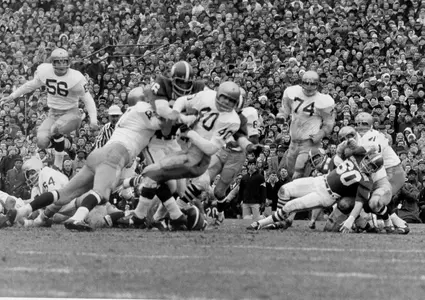
With MSU holding a precarious 10-7 lead, Richardson stopped Coley O'Brien's scramble on third-and-3 from the hosts' 10-yard line - a play O'Brien still insists should have won the game.
"Coley waited, looked for a receiver and set out around right end with Hoag in pursuit," author Mike Celizic wrote in his book, "The Biggest Game of All," in 1991. "He ran past Bubba, who was rushing up the middle. He ducked inside of (George) Chatlos, who made a diving swipe at his ankle. Only one man was left to beat, Jeff Richardson, who was coming at him from the middle. O'Brien, who thought the end zone was his, cut back to the right and tried to ward off Richardson with his left arm. But Richardson managed to get an arm around his waist and pulled him down at the line of scrimmage for no gain. It was the last play of the third quarter and one of the biggest of Richardson's life."
The Fighting Irish would tie it on Joe Azzaro's 28-yard field goal on the first snap of the fourth quarter. But it was Hoag's turn to shine 10 minutes later when Notre Dame had second-and-8 at the 16, needing only a few yards to make Azzaro automatic. Instead, a busted trap play off left tackle left Azzaro with a 41-yard kick that slid wide-right.
"(Dave) Haley never had a chance," Celizic wrote. "Hoag was on him as soon as he got the handoff, and with more pressure coming from the backside , Haley was a dead duck. Hoag dropped him on the 24 for an 8-yard loss. On the State sideline, hope, which had been nearly extinguished, was suddenly renewed, while on the other side Azzaro knew it would come down to his right foot after all."
Richardson and Hoag will be back this weekend for the 40th anniversary of a game that refuses to go quietly to the archives. Tuesday afternoon, Richardson reflected on the players, the coaches and the game that make this year's reunion a can't-miss event.
"The first thing I remember was the demand for tickets," said the Big Ten's heavyweight wrestling champ in 1965 and an All-American on the mat the next two years. "They were going for $500 apiece, which was a lot of money in those days. Some guys were buying tickets for their family, some just to resell.
"When you went to class, the other students didn't bother you much. But it was easier to go to class than to stay in your dorm room or apartment. Someone got a hold of all the players' numbers. And the phone calls never stopped."
Richardson, a converted offensive lineman from Johnstown, Pa., shared a meet-you-at-the-quarterback mentality with Smith, Thornhill and Webster, among others. That ferocious pursuit and Smith's full-force hit forced starting quarterback Terry Hanratty to the sidelines - and might have been the worst thing to happen to the Spartans.
"We weren't ready for O'Brien," Richardson said. "He was much quicker than Hanratty. We all met in the backfield and shook hands over Hanratty. When O'Brien came in, that changed. But we still hit them wherever they went. Phillips put so many forearms into (All-America receiver) Jim Seymour, he couldn't catch the ball."
The biggest catch of the day might have been Gene Washington's 42-yard reception of a Jimmy Raye pass to set up the Spartans' first touchdown. It might have been Bob Gladieux's grab of an O'Brien pass over Phillips' outstretched fingers for a 34-yard Irish TD. Or it might have been the way Richardson roared over and caught O'Brien, who was about to break free at the 10.
"My adrenaline was pumping so fast on that play I'll never forget it," said Richardson, a 6-foot-3, 257-pounder in his playing days. "When he rolled out, no one was close to him. I really stretched it out to catch him. That was the fastest anyone had seen me run. And I used to run the 100 and 220 in high school."
It was the most vivid memory of a solid career, but not the first one. Richardson recalled his first varsity snap against Illinois in 1964, when he was sent in by Duffy Daugherty to stop a drive at the 2-yard line.
"I'm playing middle guard, and my job is to key on the fullback," Richardson said. "I look over and see Dick Butkus at center, with frozen blood all over his face. Yeah, the guy scored on the next play."
Richardson and Daugherty hailed from the same county in Pennsylvania. But the two guys who had the greatest impact on the defense in Richardson's eyes were Webster, from South Carolina, and fire-breathing coordinator Hank Bullough, an Ohio native.
"George was an unbelievable ballplayer, just unbelievable," Richardson said. "You can have all the rest. Webster changed the game. I don't know how he did it. But I know they'll never have another one like him. He was a perfectionist, the spirit of the defense and the other one Duffy called on to keep some guys out of trouble."
The worst trouble an MSU player could have in those days was to get Bullough mad, which happened all too often at practice. Richardson is still cleaning the tobacco stain off his face from one harangue.
"Hank was a lot like Bill Cowher of the Steelers," Richardson said. "He had this big mouthful of tobacco and was always spitting on you. He'd always have a piece of tobacco hanging off his chin. But we used to practice under this rack of iron piping, about 4 feet off the ground. Whoever hit the hardest and moved his feet the fastest came out the other end. If that wasn't you, when Hank finished screaming, the next guy you went against got beat up."
While four Spartans were taken in the first eight picks of the 1967 NFL Draft, Richardson's draft concerns after the Notre Dame game involved a military physical. He spent six years in the National Guard and retired three years ago as a vice president of Pathmark, an East Coast grocery chain.
At 330 pounds these days, Richardson has sampled more than his share of products. But he's excited about returning home to watch the 3-0 Spartans and to reminisce with teammates.
"I watched them play Eastern Michigan and was pretty impressed by what I saw against Pitt," he said. "Then, I watched Notre Dame play. My first thought was that they could be beat and weren't a No. 2 team in the nation. Maybe they were in '66. But we'll talk about that when we all get together. And I'll look up in the sky and say hi to Coach."