Michigan State University Athletics
1966 Game of the Century Revisited - Sidebar No. 2
9/21/2006 12:00:00 AM | Football
Sept. 20, 2006
By Jack Ebling, Online Columnist
Legend has it that Notre Dame finished No. 1 in 1966 because its walking wounded staged a gallant comeback, scored the final 10 points and tied Michigan State in "The Game of the Century" at Spartan Stadium.
The problems with that thinking are that the hosts shouldn't be penalized for sending star quarterback Terry Hanratty and All-America center George Goeddeke to the sideline with crushing hits and that the Spartans had their share of injuries, too.
Nowhere was that more evident than at fullback, where two-time All-American Bob Apisa could barely move heading into the game and carried just twice with a bum knee and where sophomore Regis "Reggie" Cavender played with excruciating pain.
The only time Cavender's bruised ribs didn't scream for mercy and his first-quarter shoulder injury stopped stabbing him? When he scored the day's first points and his team's only touchdown on a 4-yard smash early in the second quarter.
"We had a lot of guys dinged up, too," Cavender said Wednesday. "Practices in those days were at least 70-percent contact. Today, those percentages are flipped. But for a game like that, you strapped it up and played. With the injury I had, I struggled just to come out of my stance. The pain took your breath away."
Fighting Irish defensive end Alan Page took the rest of Cavender's freedom of movement by slamming down on an inside stunt on the last play when the score was 0-0. Page drove through a block so hard he shattered Cavender's left shoulder pad.
"I'd just gained 11 yards for a first down at the 9, then picked up another 5 to their 4," Cavender said. "The next play was Power Left, and got a stalemate with Page (as Clinton Jones was stopped for no gain). When I got up, my shoulder was on fire."
Cavender hobbled to the huddle, wincing noticeably. When right guard Mitch Pruiett asked, "What's wrong?" Cavender gasped, "I've got to get out of here. My shoulder's hurt." To which Pruiett responded, "My shoulder hurts, too. There's no time for pain!"
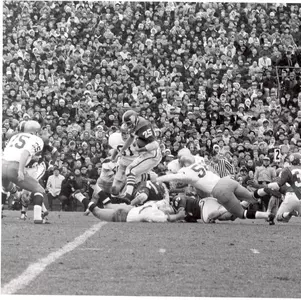
He couldn't have been more correct. When Jimmy Raye got the play from the sideline, the call was for Cavender to slam off right tackle in a Split-T formation. If the Spartans were going to score a TD, it had to be then. And No. 25 had to be the one.
As the ball was snapped, Cavender stepped forward, then veered to the right. His first move sucked All-America linebacker Jim Lynch into the pile. When Cavender turned to take the handoff from Raye, Pruitt and tackle Jerry West created a crevice. That left one defender, safety Tom O'Leary, and one lead blocker in the 205-pound Jones.
Along came Jones, and a long scoreless tie was about to end. Cavender knew he would score the instant he reached the line of scrimmage. To make sure of that, he dove to a spot 6 inches deep in the end zone and landed precisely where he had planned.
"I'm just glad the play was called to the right," Cavender said. "My left arm was useless. On a run to the left, I would've had to carry the ball in both arms. Going to the right, that wasn't a problem. And when I got up, for one brief moment, the pain was gone. The toughest part was when I came to the sideline and everyone whacked my shoulder or bumped my ribs. They said if I couldn't take a little celebration, I shouldn't visit the end zone."
Cavender threw cross-body blocks and hit with his hip the rest of the day. But the Spartans made it 10-0 on Dick Kenney's 47-yard field goal - not bad against a first-string defense that hadn't yielded a touchdown since its season-opener against Purdue.
"I was a blocking back, no question about it," Cavender said. "I'd had a successful career in high school (at Detroit Cathedral) running the ball. But as soon as I got to State in '65, they took the three biggest fullbacks and made them guards and linebackers, then turned the three biggest halfbacks into fullbacks."
Arriving in East Lansing at 200 pounds, Cavender fit the latter description and built his weight to 230 before line coach Gordie Serr said, "You're getting bigger. I've got a No. 60 jersey waiting for you!" Cavender came back the next year at 195.
Before that, he had caught the coaches' eyes with a brazen move that would later work for Kirk Gibson - challenging the most intimidating player on the team. The difference was that Gibson's attack on strong safety Tom Graves in 1975 was premeditated. Cavender's counter-assault on 6-foot-7, 295-pound destroyer Bubba Smith was for survival, as captured in Mike Celizic's book, "The Greatest Game of Them All."
Forget that Smith, a larger-than-life junior, delighted in hazing freshmen, Cavender in particular, with "Hey, Punk!" demands as he sprawled on the grass, slurping Popsicles. And that Cavender had answered, "You look like a beached whale. Why don't you do some work?" Smith only growled, "Tomorrow, Cavender. In the stadium."
It probably didn't help that a scout-team fullback was told to wear gold pants, like draping a bullfighter in a red suit, as MSU prepared for UCLA and Notre Dame. But before Cavender could stun the Irish, he had to practice self-preservation.
"We were running what they called an All-American scrimmage, where the offense was supposed to give the defense a look - a half-speed deal," Cavender said. "Suddenly, here comes Bubba full-speed. Nobody blocks him. He just levels me. And I said to our backfield coach, Al Dorow, `What's up?' All he said was, `Protect yourself!'"
Worse yet, Cavender was told to get back in the huddle. It was the same play with the same crash-test dummy potential - except for one thing. Cavender struck first.
"Here came Bubba again, bearing down for all he was worth," Cavender said. "I said to myself, `Not this time!' and drove into his ankles. I grabbed him, rolled around on the ground and got two good licks in before everybody separated us."
Suddenly, three fights broke out, and the scout team moved the ball 30 yards against arguably the greatest defense in college football history, one that held Notre Dame, Michigan and Ohio State to a combined minus-85 yards rushing. Defensive coordinator Henry Bullough was so made at his defense, it soon ran an almost-inhuman 100 100-yard sprints, Cavender said.
His own promising career ended prematurely when a fractured tibia covering a punt at Minnesota, then a clean break all the way through the bone, cost him his senior year. Cavender spent the next 25 years at Chrysler Corporation in sales training, then became the athletic director at Birmingham Brother Rice High four years ago.
"You can never take away the things that are accomplished," Cavender said. "They're locked up and stored forever. But there's a lot of truth to it when people talk about the value of the 10-10 tie. When the game ended and people sat there like someone had died, it was hard to see that. But we went down in the history books because of that. A lot of important lessons were learned."