Michigan State University Athletics
1966 Game of the Century Revisited - Sidebar No. 3
9/22/2006 12:00:00 AM | Football
Sept. 22, 2006
By Jack Ebling, Online Columnist
It was the first football or basketball game Brent Musburger had attended in East Lansing, a collision he can still see - and hear - nearly 40 years later.
When Notre Dame met Michigan State in "The Game of the Century" on Nov. 19, 1966, Brent Woody Musburger was a 27-year-old sportswriter for the now-defunct Chicago American.
Saturday night, after 38 years in local and network television, he'll be the lead voice for ABC when the 2-1 Fighting Irish and 3-0 Spartans collide again.
Musburger's first scheduled assignment at Michigan State was in 1963. But when President John F. Kennedy was assassinated on Nov. 22, the Illinois-MSU Big Ten title showdown was delayed five days. By the time the Fighting Illini beat the Spartans 13-0 on Thanksgiving Day, Musburger was back in Chicago, following the Bears' march to an NFL Championship.
That meant his first game in Mid-Michigan three years later was arguably the most important clash in college football history, a game that changed the way the sport was covered by print and broadcast outlets.
"It was my first big-time event," Musburger said here early Thursday evening. "Since then, I've been to Super Bowls, World Series and just about everything else. That game in East Lansing is one I've never forgotten. The mood and the feel around town were unlike any other. I was like a little boy on Christmas morning."
A graduate of Northwestern's prestigious Medill School of Journalism, Musburger had moved from an entry-level position as a score-taker for basketball games to a columnist's role at the American by 1966.
He was in the right place at the right time on Nov. 18 of that year but didn't realize the impact of what he'd seen. When Notre Dame's train arrived in Lansing, All-America halfback Nick Eddy slipped on the steps, reached for a railing and reinjured his right shoulder.
"I was there with two other reporters from Chicago and saw Eddy step off the train," Musburger said of an injury than opened the door for the next day's hero, Bob Gladieux. "I didn't think it was major."
He knew the atmosphere that weekend was as special as any the sport has seen. And the hitting on a cold, gray day reflected that rabid intensity from players and fans alike.
"Everyone was looking for tickets," Musburger said. "And when they give the attendance (80,011), that doesn't count all the people who came to the stadium and stayed outside. They never got in.
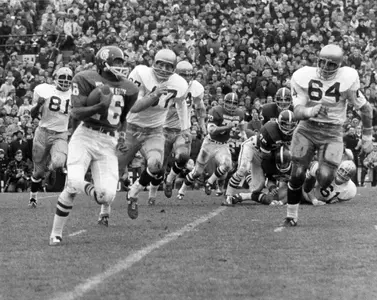
"But those who were there will never forget it. The hitting was fierce. I can still see the play when Jim Lynch intercepted the ball for Notre Dame and was creamed by Clint Jones. He landed on his helmet and fumbled the ball back. When Fred Stabley (MSU's legendary sports information director) led us down to the locker rooms, he said it was the hardest-hitting game he'd ever seen. When it ended, everyone was so dissatisfied."
Including Sports Illustrated's Dan Jenkins, who was irate at Ara Parseghian's don't-lose strategy his team fumbled and recovered a punt at the Irish 30 with 1:24 left. His famous lead in the next week's issue, a "Tie One for The Gipper" reference, is a journalistic classic.
"Old Notre Dame will tie over all," Jenkins wrote in the Nov. 28 issue. "Sing it out, guys. That is not exactly what the march says, of course, but that is how the big game ends every time you replay it. And that is how millions of cranky college football fans will remember it. For 59 minutes in absolutely overwrought East Lansing last week the brutes of Michigan State and Notre Dame pounded each other into enough mistakes to fill Bubba Smith's uniform - enough to settle a dozen games between lesser teams - but the 10-10 tie that destiny seemed to be demanding had a strange, noble quality to it. And then it did not have that any more. For the people who saw it under the cold, dreary clouds or on national television, suddenly all it had was this enormous emptiness, for which the Irish will forever be blamed."
"Dan was outraged that Ara hadn't thrown the ball downfield," Musburger said. "My take was a little different. Notre Dame had lost its center (All-American George Goeddeke). And Michigan State had moved Bubba over the nose. Bubba would've mauled the back-up center and killed (fill-in quarterback) Coley O'Brien. Ara knew he had another game to play (a 51-0 win at USC the following week) and wasn't about to lose it that way. They wound up as national champs."
Musburger had known Parseghian since they were a student reporter and head coach together in Evanston, Ill. He respected the third-year Irish leader before, during and after that game. And Parseghian`s story never changed, even when he returned to East Lansing three decades later to receive the Duffy Daugherty Memorial Award.
"I'd worked with Ara at Northwestern and always liked him," Musburger said. "I know he was hurt by everything that was said and written. He never said as much. And he never whined or cried about it. But the firestorm surprised him. They had a burning of all the Sports Illustrateds in South Bend."
The burning issue in 2006 is: "Is it better the game ended 10-10?" If Jim Seymour had gotten behind the Spartans' secondary for once and caught a touchdown pass to give the Irish a 17-10 win, or if George Webster and Charlie "Mad Dog" Thornhill had forced a turnover to set up a Dick Kenney field goal and a 13-10 MSU triumph, would we even be talking about it?
"That's a really good question," Musburger said. "I've wondered about that and don't now the answer. If MSU had pulled the upset, would it have carried all the way to this era? I don't know. I do know that game had more of an impact on college football television than anything else."
That impact has been overwhelmingly positive in Musburger's eyes. But what would you expect him to say? That his career highlight was playing himself in the cult classic, "Waterboy"?
"When I think back to the talent on the field that day, it's just stunning," he said. "Four of the first eight players in the NFL Draft were from Michigan State. Can you imagine that? But those of us in the television industry benefited the most from it. It changed the number of games you can see. And the shut-ins and people who can't get out have been able to see all the big games. You can thank Notre Dame and Michigan State, Ara and Duffy and a lot of great football players for that."