
Michigan State University Athletics
1965 And 1966 Football Teams Enter Athletics Hall Of Fame
9/12/2024 11:15:00 AM | Football
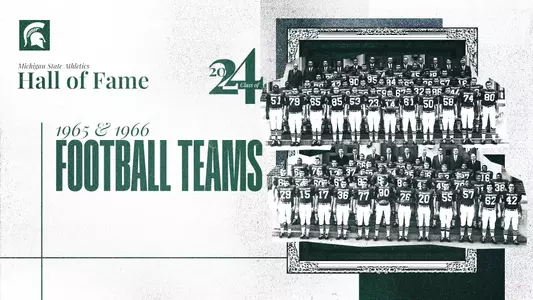
The 1965 & 1966 Michigan State football teams are among the 2024 inductees of the Michigan State Athletics Hall of Fame.
The 1965-1966 teams become the first teams inducted into the Hall of Fame, and they join Jessica (Beech) Bograkos (softball), Anson Carter (ice hockey), Darqueze Dennard (football), Beth (Rohl) Saylors (women's track & field), Laura (Kueny) Smith (women's golf) and Paul Terek (men's track & field).
The Hall of Fame Induction Ceremony and Celebration will take place on Friday, Sept. 13. There will also be a special recognition of the 2024 MSU Athletics Hall of Fame Class during the Michigan State-Prairie View A&M football game at Spartan Stadium on Saturday, Sept. 14.
The MSU Athletics Hall of Fame, located in the Clara Bell Smith Student-Athlete Academic Center, opened on Oct. 1, 1999, and displays plaques of the 180 previous inductees. The charter class of 30 former Spartan student-athletes, coaches and administrators was inducted in 1992.
Nearly 60 years later, the 1960s decade is still considered one of the most divisive and influential decades in world and U.S. history. It was an era accentuated with social and civil rights movements, cultural and counter-cultural movements. Right in the middle of it all was the 1965 and 1966 Michigan State Football teams, who were trailblazers in their own right.
This version of the Spartan football team, which won both the 1965 and 1966 National and Big Ten Conference Championships, was led by head coach Duffy Daugherty.
They sparked national changes in not just college football, but also college athletics, especially in the south. Daugherty was one of the first college football coaches to compile a roster consisting of a racially integrated team, including many Black players from the south, changing the college football landscape forever.
The 1967 NFL Draft included four Michigan State players in the top eight selections, and all four of them Black. The 1966 Spartans had five All-Americans and were captured in an iconic photo with Daugherty: running back Clinton Jones, fullback Bob Apisa, defensive end Bubba Smith, wide receiver Gene Washington and linebacker George Webster. While Jones, Smith, Washington and Webster are Black, Apisa is of American Samoan decent.
Jones equates what Daugherty spearheaded for himself and his teammates, along with Michigan State University as comparable to other Civil Rights movement trailblazers.
"What was accomplished here at Michigan State with the 1965 and '66 teams was equivalent of Jackie Robinson, Rosa Parks, or any other paradigm shift that's happened in the civil rights movement and also American history. And this is American history, not just Black history, but American history, and it is also unprecedented, of what happened in the time period that it did," Jones said. "That's something that for the most part is kind of an urban legend within Spartan Nation that has been reveled throughout the United States, as it should be. Anytime you have a paradigm shift like that it needs to be known and widely spread to the public. It needs to be known so people have a model of hope, courage and confidence to look at what's been done and what needs to be continued, and so that'll never happen again. Because what happened was not just about going undefeated, it's about the human relationships that would evolve and maintain and grow after that period of time as a result."
Another result of that is another trail blazed, as the 1965 and 1966 Spartan football teams are the first teams to be inducted into the MSU Athletics Hall of Fame.
"On behalf of the team, I to want to personally thank (Vice President and Director of Athletics) Alan Haller, the MSU Athletics administration, and the Hall of Fame committee for having the vision and the leadership to admit our two teams into the MSU Athletics Hall of Fame this year, and for that, we are forever grateful for that honor," said Ernie Pasteur, an offensive lineman on those teams, and a driving force behind the efforts to see the teams inducted.
"Ernie and his wife, Micki, did a ton of work in making this happen, and all of us are greatly appreciative of all their hard work," Jones said. Along with Pasteur and Jones, other football team committee members who worked hard behind the scenes to make the honor a reality include: Steve Juday, Jimmy Raye, Jerry West and Don Weatherspoon.
Both Jones and the two quarterbacks from those teams, Raye and Juday, are already in the MSU Athletics Hall of Fame as individuals, but they are all humbled by the honor of the teams being inducted.
"It's very humbling and a tremendous honor," Raye said. "I'm thrilled and excited about the prospects of the team being inducted together, because it was a unified team effort, and because of the time that it took place in the country, in Division I football. To be recognized for the accomplishments and the deeds that were accomplished with a fully integrated team in the middle 60s, I'm very, very proud to have been a part of that, and very proud for all my teammates that they get their duly deserved recognition and the induction into the MSU Athletics Hall of Fame. I think it's just a tremendous, tremendous honor, and I'm quite thrilled for everyone involved."
In addition to their off-the-field impact and influence, the 1965 and '66 teams had a major impact on their field, as they went 19-1-1 in the two seasons, on the way to winning the back-to-back conference and national titles. Their game against Notre Dame in 1966 played to a 10-10 tie, and is often referred to as "The Game of the Century."
The impact and influence from that game alone was felt around the world.
"That was a game that was shown more than the Super Bowl at that time, showing worldwide on military television, places like Japan, Vietnam and Europe; in Hawaii, they practically shut the state down so that they could see that game, and everyone watched these two teams come to a tie," Jones said. "That game got inside people's imaginations thinking about the possibilities, with the potential you have with an integrated and non-racial relationship between human beings."
Not just the potential of that moment and movement, but the potential of those teams began in 1963, which was the freshman season of several of the team members. They started their paths to success at Michigan State after being recruited by Daugherty, being brought to East Lansing from all over the United States, particularly southern states.
"I think everything that Coach Duffy Daugherty did was unique," Raye said. "I think it's something that should definitely be recorded in history, and something that was on the precipice of integrating college football throughout the country and particularly the South where I came from, with the Jim Crow Laws in effect, and Black athletes didn't have an opportunity to play Division I level football at Southern schools. I think Coach Duffy Daugherty should be recognized for his color blindness and his willingness to play and deal with the consequences of playing a fully integrated team. There are a lot of firsts that took place in that era at Michigan State, and I think that everything they're doing now to recognize that will stand in the history of Michigan State Athletics for all time. I'm just very, very, very appreciative of that."
Back when they were student-athletes, Raye, Pasteur and Jones, along with their teammates were appreciative of their coaches, specifically Burt Smith, then the freshmen coach, who welcomed them to East Lansing.
They were taken under the guidance and leadership of Coach Smith, who played the role of father, mother, brother and friend to all these players that had uprooted their lives, moving thousands of miles to an unfamiliar place and completely different environment, including different football backgrounds as well.
Pasteur grew up in Beaufort, North Carolina, and was one of 12 children, attending Black schools all the way through high school. He had looked at and was planning on attending one of the HBCUs in the area, before Daugherty brought him to Michigan State.
Raye was from Fayetteville, North Carolina, and was also planning on attending a southern school before Daugherty brought him to East Lansing, where he went on to become the first African-American quarterback from the South to win a National Championship.
Jones' road to East Lansing was a lot shorter of a journey, growing up in Ohio, but he didn't want to go to Ohio State, and jumped at the chance to come to MSU.
In that time, freshmen could not play on varsity, so Daugherty had freshmen practice and scrimmage against the varsity, something that was not commonplace among other football programs.
"We knew coming in that we were going to be special," Pasteur said. "Duffy would bring the freshmen class up to the practice field, and we would scrimmage against all the varsity big guys. We held our own against them, and as a matter of fact, we had some moments in there where we were the dominant team. That's when we, as freshmen, came together to form a team identity, and in turn, we bonded with our teammates in the class ahead of us. We came together to form our unified identity. We had lots of great individual players who were willing to give up the individual identity to win games, and that's what Duffy was hoping we would do."
Under Daugherty, players had individual success both athletically and academically, as 20 players earned All-Big Ten accolades in 1965, only to be topped by 21 earning all-conference recognition in 1966. Numerous academic All-Conference, All-Region and All-American accolades were earned, including two Academic All-Americans in each of the 1965 and '66 seasons.
While their individual honor collection was extensive, it was their coming together as a team that led to the team success, to the impact that they had on everyone else from those days to present day.
"It's an inconspicuous benefit to be a part of making history. I guess we had no idea," Jones said. "It's just surreal, also the magnitude of it, the eye of the storm and the magnitude of it all. At the time, the one thing was, every time we stepped on the field, we were prepared, not just the starter, nor the second team, but everyone was prepared. We practiced and prepared so much during the week and practices were so intense, that once we played another team, it was more of a practice for us because it felt that we had played a tough game against our teammates. Whenever Duffy had an idea about something, he had no idea of what was going to materialize from that, nothing else can happen or could have happened from that time, unless everyone and everything came together, and that's what we did. We came together to make it happen, and we're all in it together. From everything that happened during our playing days, to everything that happens now and the future. It's just an extreme honor to go into the MSU Athletics Hall of Fame that same way, all together."
Jones also emphasized how important it was for everyone to not just buy into Daugherty's vision, but to work together to carry that out.
"Everyone from President Hannah to Ken Earley, our equipment manager, and everyone in between worked together for our team to succeed. We were nothing if we didn't work together," Jones said.
A major influence on them coming together as a team was emphasized by the closeness of everyone, including both on and off the field physically and emotionally.
"At that time at Michigan State in the mid-60s there were around 40,000 students and there were less than 400 Black students. We were all united, and everyone cared for each other, I mean really, really cared for one another, and the community and student body really cared for each other and were unified and together," Jones said. "In 1963 the new dormitory called Wonders Hall opened and all the athletes stayed in that dormitory, wrestling, basketball, football, everyone. During that time period, I think we had at least seven National Championship teams, between wrestling, swimming, football and track & field. We had something like a renaissance, a new beginning. Everyone came together and just loved one another. It was magnificent."
Establishing and maintaining that togetherness left ever-lasting memories on the members of the teams.
"My favorite memory about our togetherness was the bus ride to Happy Valley, Pennsylvania on the way to play Penn State, (in the second game of the 1965), and it was our first big test on the road. I vividly remember the night before the game, when we got there following our bus ride after we had flown into Harrisburg, Pennsylvania and then took a bus ride up there. Duffy, who was from Barnesboro, Pennsylvania, was telling us all about the beautiful countryside we were going through. But then later that night we had a team meeting and Bob Viney took over the team meeting, and he gave a very inspirational speech, one that I can't repeat the words mostly, but he hadn't been recruited by Penn State, even though he was from Pennsylvania, and the talk he gave to the team that night was very emotional and impactful, and got us fired up for the game the next day. We won that game, and it kicked us forward on the road to the undefeated season, and I think it was that bond that we strengthened that night in Pennsylvania for playing for one another and playing together."
Raye also highlighted how everyone had a role, echoing what Coach Daugherty preached to his team.
"A perfect example of everyone having an important role was Eric Marshall," Raye said proudly. "He was an outstanding player and was the scout-team quarterback and he did such a great job of playing the quarterback of every opponent that we were going to face each week, and was one of the many team members that went above and beyond to help the overall success of those two teams, so for him to be going into the Hall of Fame as a member of these two teams is a further credit to everyone on the team having a role and everyone pulling in the same direction in order for the team to win."
The 1965 and '66 teams worked together in the same direction back then when they played, and now will be going in the same direction into the MSU Athletics Hall of Fame all together.
The 1965-1966 teams become the first teams inducted into the Hall of Fame, and they join Jessica (Beech) Bograkos (softball), Anson Carter (ice hockey), Darqueze Dennard (football), Beth (Rohl) Saylors (women's track & field), Laura (Kueny) Smith (women's golf) and Paul Terek (men's track & field).
The Hall of Fame Induction Ceremony and Celebration will take place on Friday, Sept. 13. There will also be a special recognition of the 2024 MSU Athletics Hall of Fame Class during the Michigan State-Prairie View A&M football game at Spartan Stadium on Saturday, Sept. 14.
The MSU Athletics Hall of Fame, located in the Clara Bell Smith Student-Athlete Academic Center, opened on Oct. 1, 1999, and displays plaques of the 180 previous inductees. The charter class of 30 former Spartan student-athletes, coaches and administrators was inducted in 1992.
Nearly 60 years later, the 1960s decade is still considered one of the most divisive and influential decades in world and U.S. history. It was an era accentuated with social and civil rights movements, cultural and counter-cultural movements. Right in the middle of it all was the 1965 and 1966 Michigan State Football teams, who were trailblazers in their own right.
This version of the Spartan football team, which won both the 1965 and 1966 National and Big Ten Conference Championships, was led by head coach Duffy Daugherty.
They sparked national changes in not just college football, but also college athletics, especially in the south. Daugherty was one of the first college football coaches to compile a roster consisting of a racially integrated team, including many Black players from the south, changing the college football landscape forever.
The 1967 NFL Draft included four Michigan State players in the top eight selections, and all four of them Black. The 1966 Spartans had five All-Americans and were captured in an iconic photo with Daugherty: running back Clinton Jones, fullback Bob Apisa, defensive end Bubba Smith, wide receiver Gene Washington and linebacker George Webster. While Jones, Smith, Washington and Webster are Black, Apisa is of American Samoan decent.
Jones equates what Daugherty spearheaded for himself and his teammates, along with Michigan State University as comparable to other Civil Rights movement trailblazers.
"What was accomplished here at Michigan State with the 1965 and '66 teams was equivalent of Jackie Robinson, Rosa Parks, or any other paradigm shift that's happened in the civil rights movement and also American history. And this is American history, not just Black history, but American history, and it is also unprecedented, of what happened in the time period that it did," Jones said. "That's something that for the most part is kind of an urban legend within Spartan Nation that has been reveled throughout the United States, as it should be. Anytime you have a paradigm shift like that it needs to be known and widely spread to the public. It needs to be known so people have a model of hope, courage and confidence to look at what's been done and what needs to be continued, and so that'll never happen again. Because what happened was not just about going undefeated, it's about the human relationships that would evolve and maintain and grow after that period of time as a result."
Another result of that is another trail blazed, as the 1965 and 1966 Spartan football teams are the first teams to be inducted into the MSU Athletics Hall of Fame.
"On behalf of the team, I to want to personally thank (Vice President and Director of Athletics) Alan Haller, the MSU Athletics administration, and the Hall of Fame committee for having the vision and the leadership to admit our two teams into the MSU Athletics Hall of Fame this year, and for that, we are forever grateful for that honor," said Ernie Pasteur, an offensive lineman on those teams, and a driving force behind the efforts to see the teams inducted.
"Ernie and his wife, Micki, did a ton of work in making this happen, and all of us are greatly appreciative of all their hard work," Jones said. Along with Pasteur and Jones, other football team committee members who worked hard behind the scenes to make the honor a reality include: Steve Juday, Jimmy Raye, Jerry West and Don Weatherspoon.
Both Jones and the two quarterbacks from those teams, Raye and Juday, are already in the MSU Athletics Hall of Fame as individuals, but they are all humbled by the honor of the teams being inducted.
"It's very humbling and a tremendous honor," Raye said. "I'm thrilled and excited about the prospects of the team being inducted together, because it was a unified team effort, and because of the time that it took place in the country, in Division I football. To be recognized for the accomplishments and the deeds that were accomplished with a fully integrated team in the middle 60s, I'm very, very proud to have been a part of that, and very proud for all my teammates that they get their duly deserved recognition and the induction into the MSU Athletics Hall of Fame. I think it's just a tremendous, tremendous honor, and I'm quite thrilled for everyone involved."
In addition to their off-the-field impact and influence, the 1965 and '66 teams had a major impact on their field, as they went 19-1-1 in the two seasons, on the way to winning the back-to-back conference and national titles. Their game against Notre Dame in 1966 played to a 10-10 tie, and is often referred to as "The Game of the Century."
The impact and influence from that game alone was felt around the world.
"That was a game that was shown more than the Super Bowl at that time, showing worldwide on military television, places like Japan, Vietnam and Europe; in Hawaii, they practically shut the state down so that they could see that game, and everyone watched these two teams come to a tie," Jones said. "That game got inside people's imaginations thinking about the possibilities, with the potential you have with an integrated and non-racial relationship between human beings."
Not just the potential of that moment and movement, but the potential of those teams began in 1963, which was the freshman season of several of the team members. They started their paths to success at Michigan State after being recruited by Daugherty, being brought to East Lansing from all over the United States, particularly southern states.
"I think everything that Coach Duffy Daugherty did was unique," Raye said. "I think it's something that should definitely be recorded in history, and something that was on the precipice of integrating college football throughout the country and particularly the South where I came from, with the Jim Crow Laws in effect, and Black athletes didn't have an opportunity to play Division I level football at Southern schools. I think Coach Duffy Daugherty should be recognized for his color blindness and his willingness to play and deal with the consequences of playing a fully integrated team. There are a lot of firsts that took place in that era at Michigan State, and I think that everything they're doing now to recognize that will stand in the history of Michigan State Athletics for all time. I'm just very, very, very appreciative of that."
Back when they were student-athletes, Raye, Pasteur and Jones, along with their teammates were appreciative of their coaches, specifically Burt Smith, then the freshmen coach, who welcomed them to East Lansing.
They were taken under the guidance and leadership of Coach Smith, who played the role of father, mother, brother and friend to all these players that had uprooted their lives, moving thousands of miles to an unfamiliar place and completely different environment, including different football backgrounds as well.
Pasteur grew up in Beaufort, North Carolina, and was one of 12 children, attending Black schools all the way through high school. He had looked at and was planning on attending one of the HBCUs in the area, before Daugherty brought him to Michigan State.
Raye was from Fayetteville, North Carolina, and was also planning on attending a southern school before Daugherty brought him to East Lansing, where he went on to become the first African-American quarterback from the South to win a National Championship.
Jones' road to East Lansing was a lot shorter of a journey, growing up in Ohio, but he didn't want to go to Ohio State, and jumped at the chance to come to MSU.
In that time, freshmen could not play on varsity, so Daugherty had freshmen practice and scrimmage against the varsity, something that was not commonplace among other football programs.
"We knew coming in that we were going to be special," Pasteur said. "Duffy would bring the freshmen class up to the practice field, and we would scrimmage against all the varsity big guys. We held our own against them, and as a matter of fact, we had some moments in there where we were the dominant team. That's when we, as freshmen, came together to form a team identity, and in turn, we bonded with our teammates in the class ahead of us. We came together to form our unified identity. We had lots of great individual players who were willing to give up the individual identity to win games, and that's what Duffy was hoping we would do."
Under Daugherty, players had individual success both athletically and academically, as 20 players earned All-Big Ten accolades in 1965, only to be topped by 21 earning all-conference recognition in 1966. Numerous academic All-Conference, All-Region and All-American accolades were earned, including two Academic All-Americans in each of the 1965 and '66 seasons.
While their individual honor collection was extensive, it was their coming together as a team that led to the team success, to the impact that they had on everyone else from those days to present day.
"It's an inconspicuous benefit to be a part of making history. I guess we had no idea," Jones said. "It's just surreal, also the magnitude of it, the eye of the storm and the magnitude of it all. At the time, the one thing was, every time we stepped on the field, we were prepared, not just the starter, nor the second team, but everyone was prepared. We practiced and prepared so much during the week and practices were so intense, that once we played another team, it was more of a practice for us because it felt that we had played a tough game against our teammates. Whenever Duffy had an idea about something, he had no idea of what was going to materialize from that, nothing else can happen or could have happened from that time, unless everyone and everything came together, and that's what we did. We came together to make it happen, and we're all in it together. From everything that happened during our playing days, to everything that happens now and the future. It's just an extreme honor to go into the MSU Athletics Hall of Fame that same way, all together."
Jones also emphasized how important it was for everyone to not just buy into Daugherty's vision, but to work together to carry that out.
"Everyone from President Hannah to Ken Earley, our equipment manager, and everyone in between worked together for our team to succeed. We were nothing if we didn't work together," Jones said.
A major influence on them coming together as a team was emphasized by the closeness of everyone, including both on and off the field physically and emotionally.
"At that time at Michigan State in the mid-60s there were around 40,000 students and there were less than 400 Black students. We were all united, and everyone cared for each other, I mean really, really cared for one another, and the community and student body really cared for each other and were unified and together," Jones said. "In 1963 the new dormitory called Wonders Hall opened and all the athletes stayed in that dormitory, wrestling, basketball, football, everyone. During that time period, I think we had at least seven National Championship teams, between wrestling, swimming, football and track & field. We had something like a renaissance, a new beginning. Everyone came together and just loved one another. It was magnificent."
Establishing and maintaining that togetherness left ever-lasting memories on the members of the teams.
"My favorite memory about our togetherness was the bus ride to Happy Valley, Pennsylvania on the way to play Penn State, (in the second game of the 1965), and it was our first big test on the road. I vividly remember the night before the game, when we got there following our bus ride after we had flown into Harrisburg, Pennsylvania and then took a bus ride up there. Duffy, who was from Barnesboro, Pennsylvania, was telling us all about the beautiful countryside we were going through. But then later that night we had a team meeting and Bob Viney took over the team meeting, and he gave a very inspirational speech, one that I can't repeat the words mostly, but he hadn't been recruited by Penn State, even though he was from Pennsylvania, and the talk he gave to the team that night was very emotional and impactful, and got us fired up for the game the next day. We won that game, and it kicked us forward on the road to the undefeated season, and I think it was that bond that we strengthened that night in Pennsylvania for playing for one another and playing together."
Raye also highlighted how everyone had a role, echoing what Coach Daugherty preached to his team.
"A perfect example of everyone having an important role was Eric Marshall," Raye said proudly. "He was an outstanding player and was the scout-team quarterback and he did such a great job of playing the quarterback of every opponent that we were going to face each week, and was one of the many team members that went above and beyond to help the overall success of those two teams, so for him to be going into the Hall of Fame as a member of these two teams is a further credit to everyone on the team having a role and everyone pulling in the same direction in order for the team to win."
The 1965 and '66 teams worked together in the same direction back then when they played, and now will be going in the same direction into the MSU Athletics Hall of Fame all together.




Monday, September 28
Saturday, September 26
Thursday, September 24
Monday, September 21