Michigan State University Athletics
Michigan State Welcomes 1965-66 Teams Back to Campus for 50-Year Reunion
10/2/2015 12:00:00 AM | Football

The 1965 Michigan State Spartans went 10-0 during the regular season and won the Big Ten and National Championship.
By Steve Grinczel, MSUSpartans.com Online Columnist
EAST LANSING, Mich. -- Michigan State's football team wasn't greeted with great anticipation heading into the 1965 season.
The Spartans were coming off a 4-5 record, hadn't won more than seven games since the 1957 National Championship season when they finished 8-1 and didn't appear in the Associated Press Preseason Top 10.
But there was a "little buzz" within Coach Duffy Daugherty's program, recalled Jimmy Raye, who as a sophomore would back up senior do-it-all quarterback Steve Juday.
Led in '64 by a talented crop of second- and third-year varsity letterwinners, the Spartans upset No. 2 Southern Cal, 17-7, and No. 10 Purdue, 21-7, at Spartan Stadium. And despite finishing with a losing record after dropping its last two games to Notre Dame and Illinois, MSU tied Ole Miss for 20th in the final United Press International coaches' rankings.
"Duffy always said to us when we came together as a group, that if we played our best, and played with enthusiasm and a love for each other, that our names would be written in indelible ink that would last a lifetime," said Raye. "I don't know how many guys in the room understood what indelible meant, because I sure didn't, but it has proven to be prophetic because it has lasted a very, very long time and will last a lifetime."
If not longer.
The '65 team staged one of the most profound and emphatic turnarounds in college football history when buoyed by a dominating defense it won all 10 of its regular season games to capture the UPI National Championship. The only stain on the Spartans' record that season was a turnover-plagued 14-12 loss to UCLA – a team it defeated 13-3 in the season opener – in the Rose Bowl after the final polls were already recorded, as was the custom in those days.
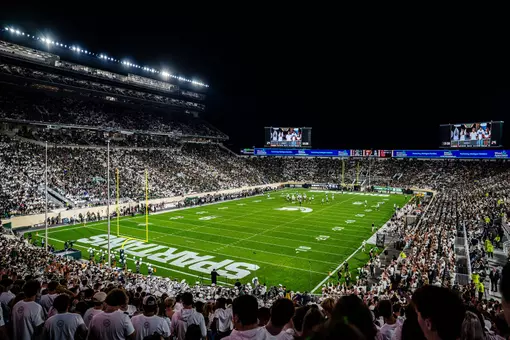
"Duffy's Giants" are celebrating their 50th anniversary along with their companion piece, the great 1966 Spartan National Championship team, this weekend. Players from both teams, who combined for a 19-1-1 record, will be honored during Saturday's 100th Homecoming game against Purdue in Spartan Stadium.
"It was a great time," said Raye, who is in his first year of retirement after a distinguished NFL coaching career and continues to work as a consultant with the league. "Little did we know when we were going through it that it would remain in so much esteem so many years later.
"But it was a great group of guys who came together with a common goal from all different parts of the country, and the parts some of us came out of were very different than where we ended up, at MSU. Some of us were from the segregated South and never had actually had much involvement with white people, or playing against white players or with black players."
Raye, whose journey from Fayeteville, North Carolina, and view of Daugherty's teams' social impact during the Civil Rights movement, is documented in the book, "Raye of Light," by Tom Shanahan.

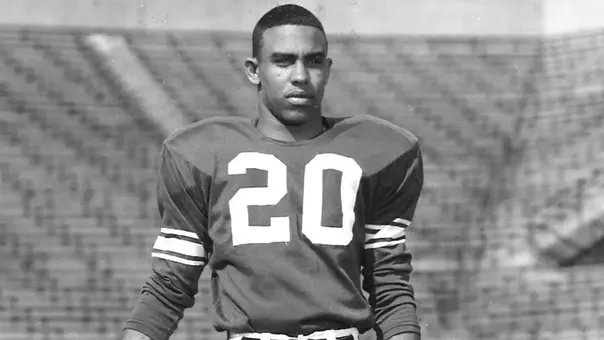
Jimmy Raye was the starting quarterback for the 1966 Spartans.
The '65 team had reason to be optimistic because Juday, standout linebacker Ron Goovert, ground-breaking defensive middle guard Harold Lucas and savvy defensive back Don Japinga were returning for their senior seasons, defensive stalwarts George Webster and Bubba Smith were highly touted juniors along with offensive stars Gene Washington at wide receiver and Clinton Jones at halfback and Raye was joined in the sophomore class by hard-charging fullback Bob Apisa.
"We thought we had a chance to be pretty good," Raye said. "But we were just hoping to have a winning record. As we started to play, it gained momentum and then a real sense of accomplishment became very possible."
Michigan State rose to No. 2 in the county with a season-opening run of wins over UCLA, Penn State, Illinois, Michigan and Ohio State.
Raye had a breakout performance when he came off the bench in place of the injured Juday to lead the Spartans to a 14-10 victory against No. 6 Purdue in West Lafayette, Indiana.
The '65 Spartan defense stills holds the Big Ten record for fewest rushing yards allowed, 34.6 in conference play, and it yielded just 47.3 in all games to rank No. 1 in the NCAA. The 5.6 points per game is tied with the '61 Spartans for the lowest given up in school history. Michigan State held defending Big Ten and Rose Bowl Champion Michigan to minus-39 yards on the ground. After limiting Ohio State to minus-22 rushing yards in the first half, Coach Woody Hayes didn't call a running play in the second half, marking the first time the Buckeyes finished a game with negative rushing yards in school history.

Steve Juday (No. 23) was the starting quarterback for the Spartans in 1965 and finished sixth in the Heisman Trophy voting that year.
"The '65 team is arguably the greatest defensive football team that's ever played collegiate football," Raye said. "The '66 team probably holds more lore to it because of the final game of the year when No. 1 (Notre Dame) played No. 2 (Michigan State) in the infamous 10-10 tie and people recall that more.
"But I think the '65 team would have been recognized as one of the all-time greatest teams that ever played had it not been for the upset loss in the Rose Bowl game to UCLA."
Years later, Juday, who finished sixth in the Heisman Trophy voting, earned All-America, Academic All-America and All-Big Ten honors while winning the Big Ten Conference Medal of Honor, told an interviewer that the team lost its focus before the Rose Bowl, where it committed five turnovers and missed a pair of two-point conversions.
"When you play every week, you don't have time to read your press clippings," Juday said. "When you take six weeks off between games, all kinds of things can happen to your mind. And they did. We had that time to really enjoy the glory of being No. 1. Shame on us, but we were just kids."
Eight members of the '65 team earned All-America status, including Apisa, who gives Daugherty credit for the type of players he brought into the program regardless of race or background.
"My honest, subjective opinion is that the '65 team, with the leadership that was corralled at that time, gave impetus to the '66 team," said Apisa, who has enjoyed a prolific Hollywood acting career since his football days came to an end. "The mold was cast.
"When I'm asked which was the better of the two clubs, I thought, because we weren't given much of a chance at the beginning coming out of a 4-5 year, that the '65 club manned up, stepped up and measured up. You have to remember that when we came aboard, we did not have weight-training programs, we did not have nutritional programs. We had training table. What does that tell you? It tells you Duffy recruited athletes, pure and simple.
"We had eight fullbacks when I started as a freshman," Apisa continued. "Some of them ended up as guards; some of them ended up as defensive ends. We looked at quickness, we looked at toughness and we looked at tenacity."
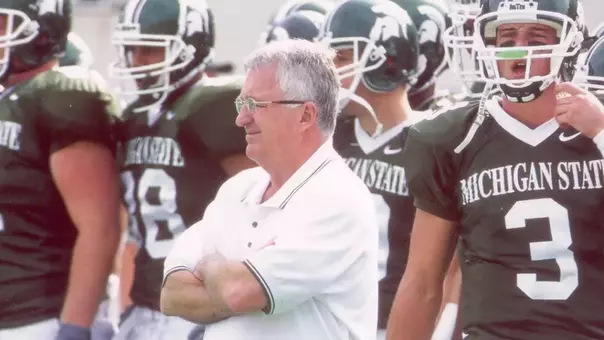
They are the same qualities Apisa sees being espoused by MSU under head coach Mark Dantonio.

Bob Apisa earned first-team All-America honors in both 1965 and 1966.
"I can't vouch for everybody else's personal opinion, but from my observation, this gentleman is reminiscent of that era Duffy brought with us," Apisa said. "Mark has a coaching style very similar to that of Duffy. If we were behind by halftime, Duffy would come in, address the team, point out some of the things we needed to shore up and would never point fingers or blame anybody.
"What he would say is, ‘You can do better than what you were doing in the first half.' Then, he would crack a joke, loosen the guys up, and we would be laughing running through the tunnel. We'd have a smirk on our faces on the sideline. I am confident that Dantonio is the man that's going to bring another National Championship number to be tacked on. As we celebrate the 50th anniversary, we're looking to Mark with hope. I know he's going in the right direction, based on discipline alone."
Apisa is in the process of gathering information of a documentary, "Men of Sparta," depicting the saga of '65-66 players and teams.
"For anybody, to go to the granddaddy of all bowls, to win the outright Big Ten Championship twice in a row and to share in the National Championship twice in a row, you know, that's not a bad record," Apisa said. "How many people in different schools and different conferences, let alone the Big Ten, how many players among the thousands and thousands who have played, ever even got close to a whiff of a conference title let alone getting into the inner sanctum?
"Those of us who are proud of our success can actually go to bat and say for two years, we ruled the world. When we played, people considered the Big Ten the way people do the SEC today. In my estimation, the SEC never wanted to fool with us. I would have loved to been able to play Alabama, LSU, Texas, Nebraska, Arkansas, but we were never given that opportunity because of the (segregation) issues of the time we had no control over."
Pat Gallinagh, a second-team All-Big Ten defensive tackle as a senior in '66, still marvels over the team and individual accomplishments of those two MSU teams, which he has chronicled in a recently published collection of poems, called "Spartan Verses," with all proceeds going to the George Webster Scholarship Fund.
Michigan State is the first team to have four African-American members of the same academic class – Webster, Smith, Washington and Jones – inducted into the National College Football Hall of Fame, and Notre Dame, Boston College and Stanford are the only other schools with four members of the same class in the hall, according to Gallinagh.
"The '65 team, the way we won it was we beat Ohio State by holding them to minus-yardage, we beat Purdue with Bob Griese in a big game on the road, we beat Notre Dame in South Bend and Michigan in Ann Arbor and they were all good teams," Gallinagh said. "But we never were as good offensively as we were defensively. We won a lot of games that were fairly close and we even struggled a little bit against Indiana.
"Even then, we shouldn't have lost the Rose Bowl. We were a 28-point favorite going in and they really did a number on us by feeding our egos on the West Coast. We were supposed to be invincible. One writer out there wrote that when we went through Yellowstone Park the bears fed us. But UCLA had some great players, a future Heisman Trophy winner in Gary Beban as their quarterback and Mel Farr was in the backfield."
As great as the '65 team was, it produced just one NFL draft pick with Lucas going in the second round to the St. Louis Cardinals. A year later, Smith (No. 1 overall by the Baltimore Colts), Jones (No. 2 by the Minnesota Vikings), Webster (No. 5 by the Houston Oilers) and Washington (No. 8 by the Vikings) were all taken in the first round and four other Spartans were chosen in later rounds.
The chip the Spartans carry on their shoulder today under Dantonio is not unlike the one they did in '65-66.

Patrick Gallinagh earned second-team All-Big Ten accolades as a senior in 1966.
"Everybody said that Duffy could never run the board because he had so many times over his career when he would lose one key game along the line everybody said he should have won," Gallinagh said. "There was the feeling he couldn't put it all together, that he was a great recruiter but not a great coach, that he was too nice a guy and wasn't a tough disciplinarian.
"All of that was nonsense. He was a very, very good coach and he was a disciplinarian. And we were tied, but we are actually the last football team at Michigan State to go undefeated. "
Raye has held on to a handful of mementos from his Spartan career. The '65 and '66 National Championship rings, his Rose Bowl watch, the game ball from the '66 Purdue game, the game ball from his first career start, against North Carolina State, in the '66 season opener.
MSU trounced the Wolfpack, 28-10.
"It's a school that was less than 60 miles from my hometown when I grew up, but was segregated and it was against the law in the Jim Crow era for me to be offered a scholarship," Raye said. "But mostly what I have is the blood that still runs green and white."

The 1966 Michigan State Spartans