
Michigan State University Athletics

11/16/2020 10:38:00 AM | Men's Ice Hockey
By Neil Koepke
MSUSpartans.com staff writer
EAST LANSING – In each of Danton Cole's three seasons as Michigan State hockey coach, the Spartans' record has improved from the previous season in Big Ten and non-conference play.
Steadily, MSU has gotten better from Cole's first season – 2017-18 – when the new-look Spartans compiled records of 12-22-2 overall and 6-16-2-1 in the Big Ten, with a seventh-place finish.
In Year 2, Michigan State got a little better, finishing 8-12-4-2 overall and 12-19-5 in conference play and again wound up seventh.
Last season, the Spartans took a bigger step and even spent a few weekends late in the year in first place in the Big Ten. With one or two more victories, they could have captured the regular-season title in the most competitive race in the seven-year history of the conference.
MSU posted an 11-11-2-0 record in the Big Ten in 2019-20, and despite a sixth-place finish, the Spartans, with 35 points, were only three points behind the three teams tied for second place – Ohio State, Michigan and Minnesota. MSU was only six points behind regular-season champ Penn State.
It was a season in which Michigan State beat every team in the Big Ten except Ohio State (0-4). The Spartans went 2-0-2-0 vs. Notre Dame, 3-1 against Wisconsin and 2-2 vs. Minnesota, Michigan and Penn State in league play. Overall, they were 14-13-1 in early February but a last-season slide led to a 15-19-2 record.
As Michigan State approaches the COVID-19-plagued and delayed 2020-21 season, the Spartans are eager to continue their improvement, and motivated to join the contenders at the top of the Big Ten standings.
Forget seventh and sixth places. How about at least fourth place or even third or second? And if things line up with high-level improvement in all areas, why not first place?
For sure, there are plenty of challenges on and off the ice, and the Spartans say they're ready to meet them.
"This year we want to take that next step. We want to be a winning team in the Big Ten,'' said senior center and co-captain Tommy Apap. "We don't want to just be in the conversation.
"What last year showed us is that we can be right there. Even one goal can separate you from sixth to seventh place, or first to seventh. The Big Ten is that close and competitive.''
The Spartans believe they'll be solid in goal, strong on defense and have the potential for a more productive offense.
"What we've tried to do is get a little better every year and I think we've been able to achieve that,'' Cole said. "One reason is that our depth has slowly improved. And I think that will be a factor this year.
"When we look at it now in putting four lines together and six (defensemen), we like that we're getting pushed by our young guys. We're not scrambling to find who are the right 12 (forwards and right six defensemen). I like our depth.''
Michigan State opens the 2020-21 season with a non-conference series against Arizona State (0-2) at 6 p.m. Thursday and 6 p.m. Friday at Munn Arena. Thursday's game will be televised by the Big Ten Network.
After losing three key forwards from last season in top scorer Patrick Khodorenko (16 goals, 17 assists, 33 points), Sam Saliba (10-7-17) and Logan Lambdin (7-10-17), MSU is looking more offensive punch from seniors Mitchell Lewandowski (8-12-20), Apap, (7-5-12) and Brody Stevens (3-5-8) and sophomores Josh Nodler (3-5-8), Nicolas Mueller (3-5-8) and Jagger Joshua (2-5-7).
Four regulars return on defense, led by junior Dennis Cesana (7-15-22), MSU's second-leading scorer last season and an All-Big Ten Second Team selection. The other returnees include senior Tommy Miller (2-7-9), a strong and reliable stay-at-home D-man, and the Krygier twins, Cole (3-3-6) and Christian (0-3-3), both juniors and strong defensively.
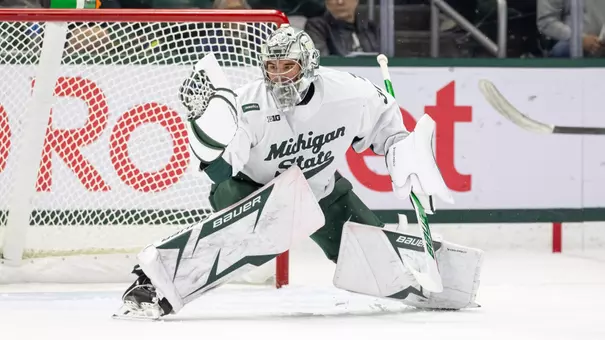
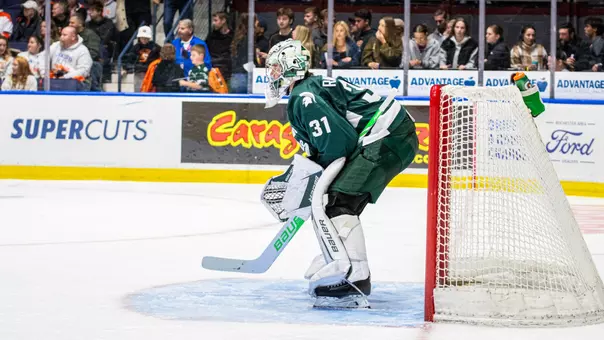
In goal, Drew DeRidder returns for his junior season after backing up John Lethemon, MSU's most valuable player last year and an All-Big Ten Second Team selection as a senior.
The Spartans have welcomed in 10 new players – nine freshmen and one graduate transfer.
The new forwards include Charlie Combs, 24, a grad transfer from Bemidji State, and freshmen Kristof Papp, 19; A.J. Hodges, 19, and Kyle Haskins, 20. Four freshmen will compete for the other two spots on defense - Powell Connor, 20; Calvin Dybicz, 20; Aiden Gallacher, 20, and Nash Nienhuis, 20.
DeRidder will have two new goaltending buddies. He'll compete with freshman Pierce Charleson, 20, while freshman Jon Mor, 20, will serve as the No. 3 goalie.
"Our young guys are going to contribute,'' Cole said. "I think Kristof Papp is going to do a fantastic job. He's fit in well and brings a skilled dynamic to his game that you like to have. A.J. Hodges will be an underrated player but after the first 10 games, he's not going to be hidden. He's going to play a lot for us.
"Another newcomer, Charlie Combs, a transfer, has really fit in well. He's brought some maturity, he's a goal scorer and plays hard on the edges. It gives us something that we haven't had in a down-low type of game. He's going to help us on the power play and 5-on-5.''
The Spartans coach also likes what he sees from the new faces on defense, all of whom are 20-year-old.
"It's nice having four returning guys on the back end but Aiden Gallacher and Nash Nienhuis have showed us some stuff back there, and Powell Connor and Cal Dybicz, too,'' he said. "You have guys who can defend plus move the puck and get it to the forwards.''
Cole says the opportunity is there for DeRidder, the 5-foot-10, 175-pound junior goalie from Fenton, Michigan, to stake his claim to the goal crease. DeRidder played in 17 games as a freshman but only four last season while backing up Lethemon.
"Now it's Drew's chance to take over the net and he'll be pushed by Pierce Charleson, but that's Drew's net so he has to elevate,'' he said. "From what we've seen over the last two years, we think he can do that.''
Over the last two months of practices, senior defenseman Miller says DeRidder and Charleson have looked good.
"Drew is really stepping up his game. He's looking solid in practice and has some confidence now,'' Miller said. "It's his net but he has to earn it. Pierce is looking good. He's adapting to the college pace. He works hard before practice and has really improved since the beginning of the summer.''
Of course, a huge key to MSU's success this season is returning forwards and defensemen lifting their games to a higher level.
Lewandowski, Apap, Nodler, Mueller, Joshua and Stevens will be expected to score, and several veterans will be counted on in defensive roles, like juniors Adam Goodsir and Mitchell Mattson and seniors Gino Esteves, Austin Kamer and Jake Smith.
Lewandowski had 19 goals and 34 points as a rookie in 2017-18 and was named Big Ten Freshman of the Year. He had 16 goals and 34 points in his second season but last season dropped to eight goals and 20 points.

"He looks outstanding. I think he'll end up having more goals and points than last year,'' Cole said. "He had surgery the summer before last season and that hurt him at the start and that gets in your head a bit. I don't worry about Lewie scoring as long as he's forechecking and jumping, and he's shown a ton of that.''
Cole expects more impact from his three sophomore forwards – Nodler, Mueller and Joshua.
"We lost Khodorenko, Saliba and Lambdin but the guys that are here, we feel they'll put more points on the board,'' he said. "Whether Josh Nodler breaks into the type of point producer we think he's going to be, well we'll see, but that's what we're looking for. Nodler will have an expanded role and has the talent and attitude to do that.
"And you look at Mueller and Joshua, those are two guys that can score goals and put up points. We were happy with their freshman year. They pushed for a lot of minutes. Nodler got some power-play time, Joshua was really good on the penalty kill. Mueller looks great. One guy to keep an eye on is Jagger Joshua. He's stronger, faster and more confident. Probably the biggest thing is just his maturity.''
In three seasons, Apap has developed into an outstanding leader and a solid center who can contribute in many ways. He's known for his solid defensive play and winning key faceoffs but he can also chip in offensively.
"Tommy Apap, a captain for the third year, returns and his role is well defined in terms of being big and heavy in checking situations, plus penalty killing and taking faceoffs,'' Cole said. "And he had a great year offensively last season.
"Mitch Mattson did a great job for us in the second half of last season. He's a big presence and gave us some good minutes.''
With four newcomers eager to find a spot in the lineup, competition for playing time up front will be intense.
"The new guys are going to push. We've always wanted to be in that spot where the freshmen were pushing and the seniors and juniors were saying 'If I'm not going, they'll take ice from me.''' Cole said. "That's when you get things done.
"That's something (assistant coaches) Joe Exter and Chris Luongo, in recruiting, have tried to work on – driving that depth.''
CAPTAINS, LEADERSHIP: Senior Tommy Apap enters his third season in the role of a captain. He served as an assistant captain as a sophomore and co-captain last season with Sam Saliba. This year, he'll share the captain's duties with senior defenseman Tommy Miller.
Senior forward Mitchell Lewandowski and junior defenseman Dennis Cesana will serve as assistant captains.
"Apap is a tremendous leader and a tremendous young man and Tommy Miller is joining him as one of our captains,'' Cole said. "They're just great men on and off the ice and great leaders.
"Dennis Cesana is one of the best defensemen in the Big Ten. He's had two great years with us, and the one thing he's added to his game now that he's older is leadership. Mitch Lewandowski has had a great run, too, and we expect him to have a great year.''
Cole praised his players, especially his leaders and upper classmen, for the way they've handled the challenges of the COVID-19 limitations in getting ready for the season. Players were away from campus for several months and when they returned, they were limited to skating in small groups without coaches, and then they had to wait more than two months after classes started to actually play.
"I'm really happy with the way they kept working and stayed focused as it became more likely that we were going to schedule games,'' Cole said. "The focus level, excitement level and the engagement level, which was a hard thing to keep going, they handled it well.
"Our leadership had a lot of extra responsibility and they did an outstanding job.''

THE SCHEDULE: Michigan State will play 28 regular-season games this season – 24 against the other six Big Ten teams and four non-conference home games against Arizona State, which will play 28 road games against the seven conference teams.
The Big Ten recently released the first part of the schedule from mid-November to Dec. 20 and it will feature several early-week and mid-week games. Some teams will play four games in six days and some will play four in seven days.
MSU's first two series are Thursday-Friday (vs. Arizona State, Nov. 19-20) and Saturday-Sunday (at Ohio State, Nov. 28-29).
Then, it's four games in seven days for the Spartans at Munn Arena. It's starts against Minnesota, Thursday-Friday, Dec. 3-4, and ends vs. Wisconsin, Tuesday-Wednesday, Dec. 8-9.
Michigan State gets a week off before closing out the early part of the schedule with a Saturday-Sunday series, Dec. 19-20, at Notre Dame.
The January-March schedule probably will be announced in early December.
During that stretch, MSU will play four games – two at home, two on the road - against Michigan and Penn State, two home games with Notre Dame and Ohio State and Arizona State and two at Minnesota and Wisconsin.
The season ends the weekend of March 12-13, and the Big Ten Tournament will be played March 18-20 at a site which has yet to be determined.
All seven teams will take part with the same format used during the first four years of the Big Ten. The first-place team will get a bye and the quarterfinal matchups on March 18 will have No. 2 vs. No. 7, No. 3 vs. No. 6 and No. 4 vs. 5. The lowest surviving seed will play the Big Ten regular season champion and the two other surviving teams meet in the semifinals on March 19. The championship game is on March 20.
The NCAA Hockey Committee announces the 16-team tournament field on March 21. The NCAA Regionals are set for March 26-28 with the NCAA Frozen Four scheduled for April 8 and 10 in Pittsburgh, but that site could change if fans are still not allowed to attend.
For the first time since the Great Lakes Invitational started in 1965, the tournament will not be played this season because Big Ten and most other leagues aren't playing non-conference games or in tournaments.

NCAA RULE CHANGES: In July, the NCAA Playing Rules Oversight Panel approved changes to the overtime format in men's and women's hockey starting this season.
When games are tied at the end of three periods, the teams will immediately play a five-minute, 3-on-3 sudden-victory overtime. If neither team scores, a three-player shootout can be used in conference games or in-season tournaments for advancement purposes. This eliminates the five-minute, 5-on-5 overtime that's been used in the past.
The Big Ten, National Collegiate Hockey Conference (NCHC) and Western Collegiate Hockey Association (WCHA) will continue to use the shootout to decide a winner and extra points in league standings. As in past seasons, games not decided in overtime will be considered a tie in a team's overall record
The NCAA also made illegal the "spin-o-rama" move in shootouts. That's where a player with the puck completes a 360-degree turn while approaching the goal.
In regular-season non-conference games that go into overtime, the teams will play the five-minute, 3-on-3 OT, but if neither team scores, the shootout will not be used, and the game would be considered a tie.
The NCAA rules panel also approved a rule in which teams can choose which offensive zone faceoff circle to take a faceoff after an icing violation or to start a power play.
MSUSpartans.com staff writer
EAST LANSING – In each of Danton Cole's three seasons as Michigan State hockey coach, the Spartans' record has improved from the previous season in Big Ten and non-conference play.
Steadily, MSU has gotten better from Cole's first season – 2017-18 – when the new-look Spartans compiled records of 12-22-2 overall and 6-16-2-1 in the Big Ten, with a seventh-place finish.
In Year 2, Michigan State got a little better, finishing 8-12-4-2 overall and 12-19-5 in conference play and again wound up seventh.
Last season, the Spartans took a bigger step and even spent a few weekends late in the year in first place in the Big Ten. With one or two more victories, they could have captured the regular-season title in the most competitive race in the seven-year history of the conference.
MSU posted an 11-11-2-0 record in the Big Ten in 2019-20, and despite a sixth-place finish, the Spartans, with 35 points, were only three points behind the three teams tied for second place – Ohio State, Michigan and Minnesota. MSU was only six points behind regular-season champ Penn State.
It was a season in which Michigan State beat every team in the Big Ten except Ohio State (0-4). The Spartans went 2-0-2-0 vs. Notre Dame, 3-1 against Wisconsin and 2-2 vs. Minnesota, Michigan and Penn State in league play. Overall, they were 14-13-1 in early February but a last-season slide led to a 15-19-2 record.
As Michigan State approaches the COVID-19-plagued and delayed 2020-21 season, the Spartans are eager to continue their improvement, and motivated to join the contenders at the top of the Big Ten standings.
Forget seventh and sixth places. How about at least fourth place or even third or second? And if things line up with high-level improvement in all areas, why not first place?
For sure, there are plenty of challenges on and off the ice, and the Spartans say they're ready to meet them.
"This year we want to take that next step. We want to be a winning team in the Big Ten,'' said senior center and co-captain Tommy Apap. "We don't want to just be in the conversation.
"What last year showed us is that we can be right there. Even one goal can separate you from sixth to seventh place, or first to seventh. The Big Ten is that close and competitive.''
The Spartans believe they'll be solid in goal, strong on defense and have the potential for a more productive offense.
"What we've tried to do is get a little better every year and I think we've been able to achieve that,'' Cole said. "One reason is that our depth has slowly improved. And I think that will be a factor this year.
"When we look at it now in putting four lines together and six (defensemen), we like that we're getting pushed by our young guys. We're not scrambling to find who are the right 12 (forwards and right six defensemen). I like our depth.''
Michigan State opens the 2020-21 season with a non-conference series against Arizona State (0-2) at 6 p.m. Thursday and 6 p.m. Friday at Munn Arena. Thursday's game will be televised by the Big Ten Network.
After losing three key forwards from last season in top scorer Patrick Khodorenko (16 goals, 17 assists, 33 points), Sam Saliba (10-7-17) and Logan Lambdin (7-10-17), MSU is looking more offensive punch from seniors Mitchell Lewandowski (8-12-20), Apap, (7-5-12) and Brody Stevens (3-5-8) and sophomores Josh Nodler (3-5-8), Nicolas Mueller (3-5-8) and Jagger Joshua (2-5-7).
Four regulars return on defense, led by junior Dennis Cesana (7-15-22), MSU's second-leading scorer last season and an All-Big Ten Second Team selection. The other returnees include senior Tommy Miller (2-7-9), a strong and reliable stay-at-home D-man, and the Krygier twins, Cole (3-3-6) and Christian (0-3-3), both juniors and strong defensively.
In goal, Drew DeRidder returns for his junior season after backing up John Lethemon, MSU's most valuable player last year and an All-Big Ten Second Team selection as a senior.
The Spartans have welcomed in 10 new players – nine freshmen and one graduate transfer.
The new forwards include Charlie Combs, 24, a grad transfer from Bemidji State, and freshmen Kristof Papp, 19; A.J. Hodges, 19, and Kyle Haskins, 20. Four freshmen will compete for the other two spots on defense - Powell Connor, 20; Calvin Dybicz, 20; Aiden Gallacher, 20, and Nash Nienhuis, 20.
DeRidder will have two new goaltending buddies. He'll compete with freshman Pierce Charleson, 20, while freshman Jon Mor, 20, will serve as the No. 3 goalie.
"Our young guys are going to contribute,'' Cole said. "I think Kristof Papp is going to do a fantastic job. He's fit in well and brings a skilled dynamic to his game that you like to have. A.J. Hodges will be an underrated player but after the first 10 games, he's not going to be hidden. He's going to play a lot for us.
"Another newcomer, Charlie Combs, a transfer, has really fit in well. He's brought some maturity, he's a goal scorer and plays hard on the edges. It gives us something that we haven't had in a down-low type of game. He's going to help us on the power play and 5-on-5.''
The Spartans coach also likes what he sees from the new faces on defense, all of whom are 20-year-old.
"It's nice having four returning guys on the back end but Aiden Gallacher and Nash Nienhuis have showed us some stuff back there, and Powell Connor and Cal Dybicz, too,'' he said. "You have guys who can defend plus move the puck and get it to the forwards.''
Cole says the opportunity is there for DeRidder, the 5-foot-10, 175-pound junior goalie from Fenton, Michigan, to stake his claim to the goal crease. DeRidder played in 17 games as a freshman but only four last season while backing up Lethemon.
"Now it's Drew's chance to take over the net and he'll be pushed by Pierce Charleson, but that's Drew's net so he has to elevate,'' he said. "From what we've seen over the last two years, we think he can do that.''
Over the last two months of practices, senior defenseman Miller says DeRidder and Charleson have looked good.
"Drew is really stepping up his game. He's looking solid in practice and has some confidence now,'' Miller said. "It's his net but he has to earn it. Pierce is looking good. He's adapting to the college pace. He works hard before practice and has really improved since the beginning of the summer.''
Of course, a huge key to MSU's success this season is returning forwards and defensemen lifting their games to a higher level.
Lewandowski, Apap, Nodler, Mueller, Joshua and Stevens will be expected to score, and several veterans will be counted on in defensive roles, like juniors Adam Goodsir and Mitchell Mattson and seniors Gino Esteves, Austin Kamer and Jake Smith.
Lewandowski had 19 goals and 34 points as a rookie in 2017-18 and was named Big Ten Freshman of the Year. He had 16 goals and 34 points in his second season but last season dropped to eight goals and 20 points.
"He looks outstanding. I think he'll end up having more goals and points than last year,'' Cole said. "He had surgery the summer before last season and that hurt him at the start and that gets in your head a bit. I don't worry about Lewie scoring as long as he's forechecking and jumping, and he's shown a ton of that.''
Cole expects more impact from his three sophomore forwards – Nodler, Mueller and Joshua.
"We lost Khodorenko, Saliba and Lambdin but the guys that are here, we feel they'll put more points on the board,'' he said. "Whether Josh Nodler breaks into the type of point producer we think he's going to be, well we'll see, but that's what we're looking for. Nodler will have an expanded role and has the talent and attitude to do that.
"And you look at Mueller and Joshua, those are two guys that can score goals and put up points. We were happy with their freshman year. They pushed for a lot of minutes. Nodler got some power-play time, Joshua was really good on the penalty kill. Mueller looks great. One guy to keep an eye on is Jagger Joshua. He's stronger, faster and more confident. Probably the biggest thing is just his maturity.''
In three seasons, Apap has developed into an outstanding leader and a solid center who can contribute in many ways. He's known for his solid defensive play and winning key faceoffs but he can also chip in offensively.
"Tommy Apap, a captain for the third year, returns and his role is well defined in terms of being big and heavy in checking situations, plus penalty killing and taking faceoffs,'' Cole said. "And he had a great year offensively last season.
"Mitch Mattson did a great job for us in the second half of last season. He's a big presence and gave us some good minutes.''
With four newcomers eager to find a spot in the lineup, competition for playing time up front will be intense.
"The new guys are going to push. We've always wanted to be in that spot where the freshmen were pushing and the seniors and juniors were saying 'If I'm not going, they'll take ice from me.''' Cole said. "That's when you get things done.
"That's something (assistant coaches) Joe Exter and Chris Luongo, in recruiting, have tried to work on – driving that depth.''
CAPTAINS, LEADERSHIP: Senior Tommy Apap enters his third season in the role of a captain. He served as an assistant captain as a sophomore and co-captain last season with Sam Saliba. This year, he'll share the captain's duties with senior defenseman Tommy Miller.
Senior forward Mitchell Lewandowski and junior defenseman Dennis Cesana will serve as assistant captains.
"Apap is a tremendous leader and a tremendous young man and Tommy Miller is joining him as one of our captains,'' Cole said. "They're just great men on and off the ice and great leaders.
"Dennis Cesana is one of the best defensemen in the Big Ten. He's had two great years with us, and the one thing he's added to his game now that he's older is leadership. Mitch Lewandowski has had a great run, too, and we expect him to have a great year.''
Cole praised his players, especially his leaders and upper classmen, for the way they've handled the challenges of the COVID-19 limitations in getting ready for the season. Players were away from campus for several months and when they returned, they were limited to skating in small groups without coaches, and then they had to wait more than two months after classes started to actually play.
"I'm really happy with the way they kept working and stayed focused as it became more likely that we were going to schedule games,'' Cole said. "The focus level, excitement level and the engagement level, which was a hard thing to keep going, they handled it well.
"Our leadership had a lot of extra responsibility and they did an outstanding job.''
THE SCHEDULE: Michigan State will play 28 regular-season games this season – 24 against the other six Big Ten teams and four non-conference home games against Arizona State, which will play 28 road games against the seven conference teams.
The Big Ten recently released the first part of the schedule from mid-November to Dec. 20 and it will feature several early-week and mid-week games. Some teams will play four games in six days and some will play four in seven days.
MSU's first two series are Thursday-Friday (vs. Arizona State, Nov. 19-20) and Saturday-Sunday (at Ohio State, Nov. 28-29).
Then, it's four games in seven days for the Spartans at Munn Arena. It's starts against Minnesota, Thursday-Friday, Dec. 3-4, and ends vs. Wisconsin, Tuesday-Wednesday, Dec. 8-9.
Michigan State gets a week off before closing out the early part of the schedule with a Saturday-Sunday series, Dec. 19-20, at Notre Dame.
The January-March schedule probably will be announced in early December.
During that stretch, MSU will play four games – two at home, two on the road - against Michigan and Penn State, two home games with Notre Dame and Ohio State and Arizona State and two at Minnesota and Wisconsin.
The season ends the weekend of March 12-13, and the Big Ten Tournament will be played March 18-20 at a site which has yet to be determined.
All seven teams will take part with the same format used during the first four years of the Big Ten. The first-place team will get a bye and the quarterfinal matchups on March 18 will have No. 2 vs. No. 7, No. 3 vs. No. 6 and No. 4 vs. 5. The lowest surviving seed will play the Big Ten regular season champion and the two other surviving teams meet in the semifinals on March 19. The championship game is on March 20.
The NCAA Hockey Committee announces the 16-team tournament field on March 21. The NCAA Regionals are set for March 26-28 with the NCAA Frozen Four scheduled for April 8 and 10 in Pittsburgh, but that site could change if fans are still not allowed to attend.
For the first time since the Great Lakes Invitational started in 1965, the tournament will not be played this season because Big Ten and most other leagues aren't playing non-conference games or in tournaments.
NCAA RULE CHANGES: In July, the NCAA Playing Rules Oversight Panel approved changes to the overtime format in men's and women's hockey starting this season.
When games are tied at the end of three periods, the teams will immediately play a five-minute, 3-on-3 sudden-victory overtime. If neither team scores, a three-player shootout can be used in conference games or in-season tournaments for advancement purposes. This eliminates the five-minute, 5-on-5 overtime that's been used in the past.
The Big Ten, National Collegiate Hockey Conference (NCHC) and Western Collegiate Hockey Association (WCHA) will continue to use the shootout to decide a winner and extra points in league standings. As in past seasons, games not decided in overtime will be considered a tie in a team's overall record
The NCAA also made illegal the "spin-o-rama" move in shootouts. That's where a player with the puck completes a 360-degree turn while approaching the goal.
In regular-season non-conference games that go into overtime, the teams will play the five-minute, 3-on-3 OT, but if neither team scores, the shootout will not be used, and the game would be considered a tie.
The NCAA rules panel also approved a rule in which teams can choose which offensive zone faceoff circle to take a faceoff after an icing violation or to start a power play.

Players Mentioned

F
/ Men's Ice Hockey
D
/ Men's Ice Hockey
G
/ Men's Ice Hockey
F
/ Men's Ice Hockey
D
/ Men's Ice Hockey
G
/ Men's Ice Hockey
D
/ Men's Ice Hockey
D
/ Men's Ice Hockey
F
/ Men's Ice Hockey
F
/ Men's Ice Hockey
F
/ Men's Ice Hockey
F
/ Men's Ice Hockey
F
/ Men's Ice Hockey
F
/ Men's Ice Hockey
F
/ Men's Ice Hockey
G
/ Men's Ice Hockey
F
/ Men's Ice Hockey
F
/ Men's Ice Hockey
D
/ Men's Ice Hockey
G
/ Men's Ice Hockey
D
/ Men's Ice Hockey
F
/ Men's Ice Hockey
F
/ Men's Ice Hockey
F
/ Men's Ice Hockey
F
/ Men's Ice Hockey
F
/ Men's Ice HockeyWednesday, October 21
Wednesday, October 14
Sunday, October 11
Friday, October 09